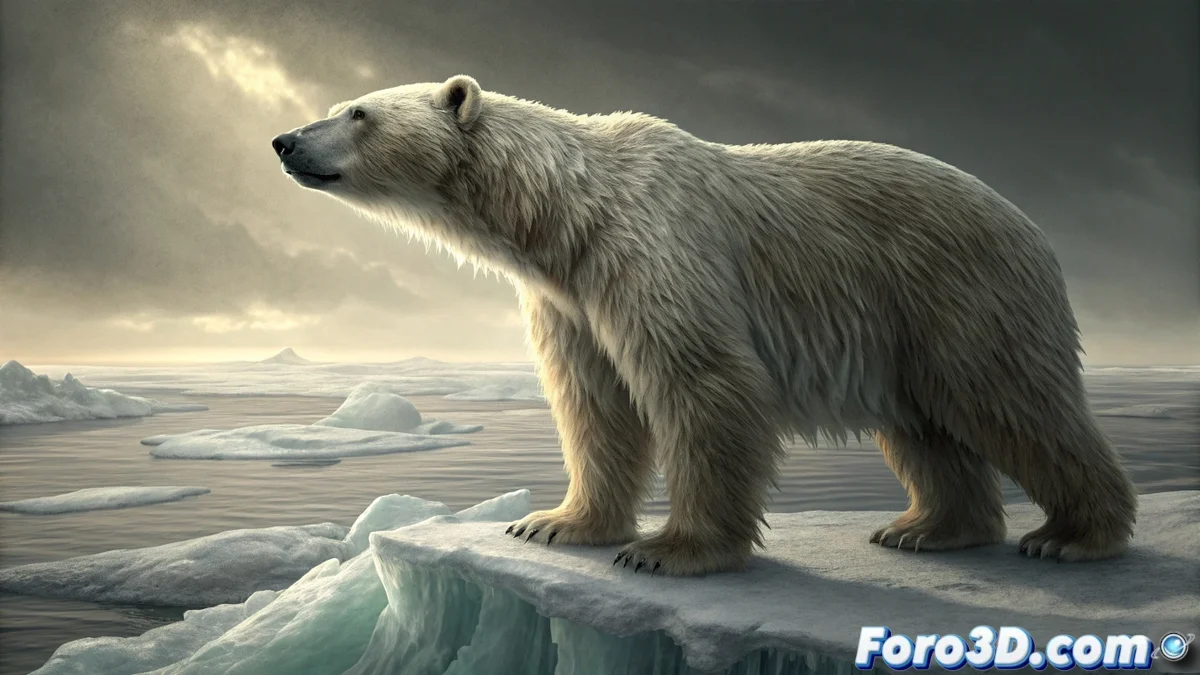
The Grolar Bear: A Hybrid Emerging from Climate Change
Climate change is rapidly altering the Arctic, reducing the sea ice cover. This forces polar bears to spend more time on land. At the same time, grizzly bears are expanding their range northward. When these two large carnivores meet, they sometimes mate, producing hybrid offspring known as grolar or pizzly. Their appearance is not an isolated curiosity, but a clear indicator of the profound transformations the planet is undergoing. 🐻❄️
Physical and Genetic Characteristics of the Hybrid
A grolar exhibits intermediate traits from its parents. Its fur combines the white of the polar bear with brown hues from the grizzly. Its build is usually more stocky than that of a pure polar bear, but less bulky than that of a grizzly. Scientific studies confirm that these individuals are fertile and can reproduce, either with other hybrids or with specimens from the original species, adding complexity to the genetic future of both populations.
Distinctive Traits of the Grolar:- Mixed fur, with a white base and brown patches or tones.
- Intermediate body structure, less exclusively adapted to swimming than that of the polar bear.
- Head that often resembles that of the polar bear more closely.
Hybridization may be a short-term survival strategy for some individuals, but in the long term, it threatens to dilute the genes adapted to the extreme Arctic.
A Biological Phenomenon Driven by the Environmental Crisis
This process of natural hybridization is biology observable in real time. Polar bears need sea ice to hunt seals. Losing this essential platform, they seek food on the coast, entering grizzly territory. This forced encounter generates competition, but also these unusual unions.
Key Factors Driving the Phenomenon:- Accelerated retreat of sea ice in the Arctic.
- Northward expansion of the grizzly bear's habitat due to warmer temperatures.
- Overlap of foraging areas on the coasts.
Implications for the Future of the Species
The story of these hybrid bears allows us to observe how nature responds when its fundamental balances are disrupted. Hybridization represents an immediate change in strategy for some animals, but poses a risk to the unique genetic identity of the polar bear, specialized for living in an extreme environment. In the game of survival, nature reshuffles its pieces when the rules change abruptly. 🌍