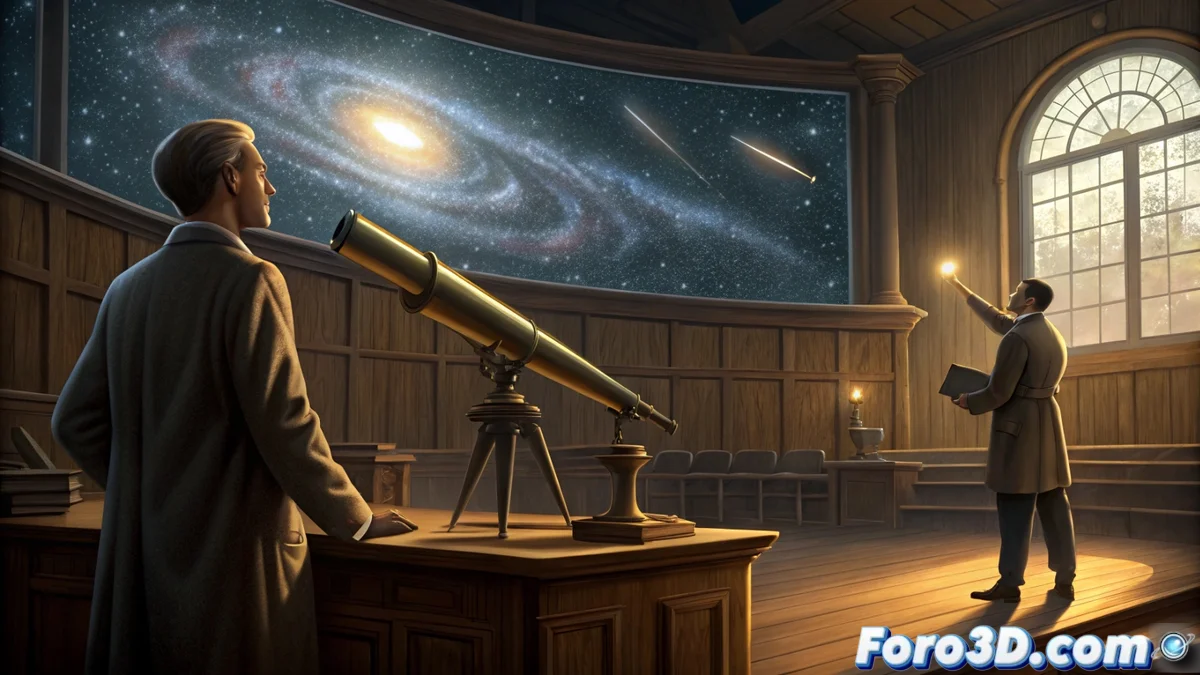
The Great Cosmological Debate Turns a Century Without Resolution
In 1920, two astronomers starred in a confrontation that shaped modern astronomy. Harlow Shapley and Heber Curtis heatedly discussed the nature of spiral nebulae and the scale of the cosmos. This clash, known as the Great Debate, raised the fundamental questions that still guide scientists today. 🔭
The Core of the Historic Dispute
Shapley argued that our Milky Way constituted the entirety of the known universe. In contrast, Curtis contended that those diffuse patches in the sky were island universes independent of ours, galaxies similar to ours but incredibly distant. Although the debate had no clear winner at the time, it established the framework for investigating the large-scale structure of the cosmos.
The Pillars of the Debate:- Single Universe Model: Shapley proposed a cosmos limited to the Milky Way, with nebulae as minor objects within it.
- Island Universes Theory: Curtis envisioned a vast universe populated by many galaxies, each an independent stellar system.
- The Role of Technology: The discussion highlighted the need for more powerful telescopes to measure cosmic distances accurately.
Science progresses not only with answers, but with better-formulated questions. The Great Debate is a testament to that.
From Resolution to New Uncertainties
Years later, Edwin Hubble measured the distance to the Andromeda nebula, proving it was an external galaxy and vindicating Curtis. However, the spirit of the controversy merely evolved. Today, cosmologists debate the universe's expansion rate and the conflicting values of the Hubble constant. Discrepancies in modern measurements reflect the same uncertainty that existed in 1920.
Contemporary Cosmic Questions:- The Hubble Tension: Different methods for measuring the universe's expansion yield inconsistent results.
- The Dark Energy Enigma: The force accelerating cosmic expansion remains a profound mystery.
- The Precision of New Instruments: Telescopes like the James Webb seek definitive data to settle current debates.
The Enduring Legacy of a Discussion
A century later, this anniversary underscores that astronomy advances by questioning the established. Disagreements drive the pursuit of more precise data and robust theories. Today's astronomers measure the cosmos with the same passion and, at times, frustration as Shapley and Curtis, proving that great cosmic discussions simply change scale, but never lose intensity. The journey to understand the universe continues. 🌌