Ghost Cat Anzu is a Franco-Japanese animated film directed by Yôko Kuno and Nobuhiro Yamashita, released in 2024. The story follows Karin, an 11-year-old girl abandoned by her father in the Japanese countryside, where she meets Anzu, a ghost cat who must take care of her, leading them on a series of adventures and encounters with forest spirits.
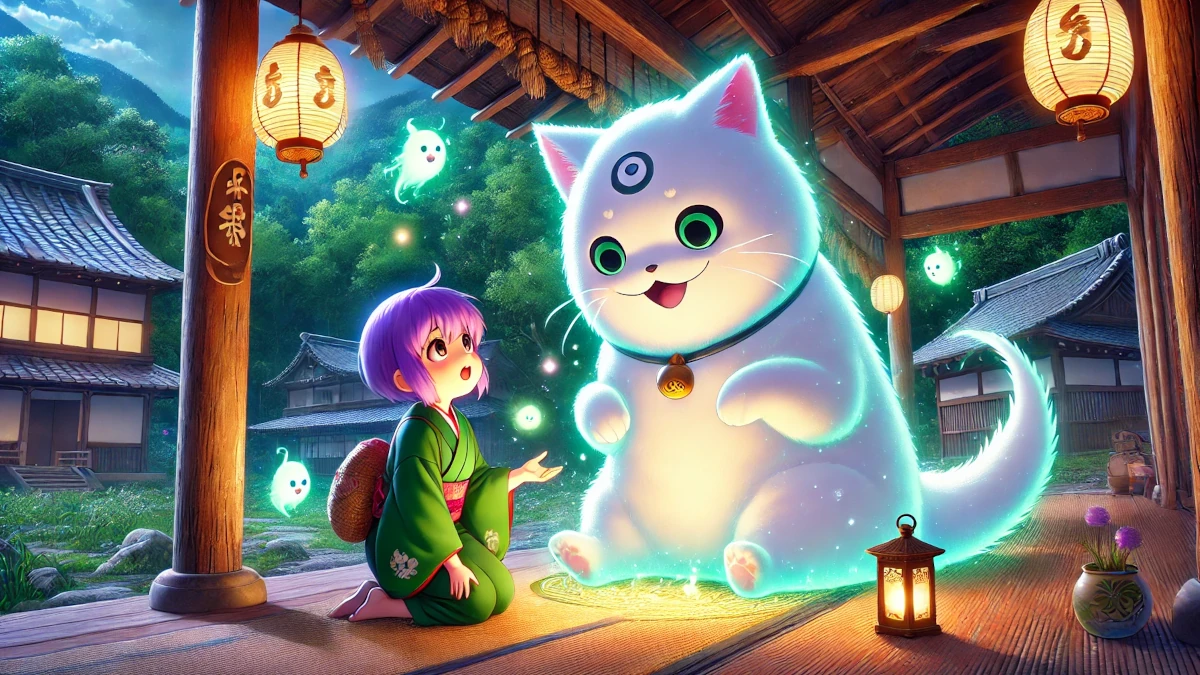
Rotoscoping Animation Style
The film uses the rotoscoping technique for much of its animation, where live-action footage is traced over in 2D animation. This gives Ghost Cat Anzu a sense of realism in the characters' movements, especially in human interactions, while maintaining the stylization and charm of traditional animation.
Traditional 2D with a Modern Touch
Although rotoscoping is central, the animation also includes hand-drawn elements with styles ranging from detailed to more caricatured to represent spirits and fantastical creatures. This approach creates an interesting contrast between the everyday and the supernatural.
Character Design
Anzu, the ghost cat, has a design that blends the human with the feline, offering a comical and endearing mix. The human characters, like Karin, have designs that reflect their personality; for example, Karin's clothing evolves throughout the film to show her emotional growth.
Environments
The settings are inspired by rural Japan, with special attention to the texture of forests, temples, and small towns. The color palette tends to be more naturalistic, but becomes more vibrant and fantastical when supernatural elements are introduced.
Fantasy Effects
For moments of magic and the appearance of supernatural creatures, particle effects and transformation animations are used, adding a sense of wonder and awe. It is here that the film plays with more saturated colors and lighting effects to differentiate the real world from the spiritual one.
Integration of 3D Elements
Although predominantly 2D, 3D elements have been used for certain parts of the landscapes or for special effects that require greater depth or complexity, such as the representation of spirits or interaction with objects.
Hybrid Workflow
The combination of traditional animation with modern post-production techniques (such as rotoscoping and 3D integration) shows innovation in contemporary animation, attempting to capture the essence of Japanese fantasy stories in an accessible and visually rich way.
Expression Animation
A lot of attention is paid to facial and body animation to express the wide range of emotions, especially in the dynamic between Karin and Anzu, where their relationship evolves visually.
Graphical Aspects
The film has been praised for its unique visual style, with critics highlighting how rotoscoping brings a level of realism to the animation that makes the characters more accessible and empathetic. It has been compared to Studio Ghibli's work for its ability to create fantastical worlds with a deep sense of place and character. However, some critics have pointed out that the animation can be inconsistent at times, especially in the transition between the real and the magical.
Challenges and Achievements
- The biggest challenge was maintaining visual cohesion between the animation techniques used, and achieving a balance between the authenticity of rural Japan and the fantasy of the spirits.
- The main achievement is having created a film that, although not always perfectly polished, has a distinctive visual personality that resonates with audiences of all ages.
"Ghost Cat Anzu offers a visual experience that blends the nostalgia of traditional animation with the innovation of modern techniques, providing viewers a window into a world where the everyday meets the fantastical."