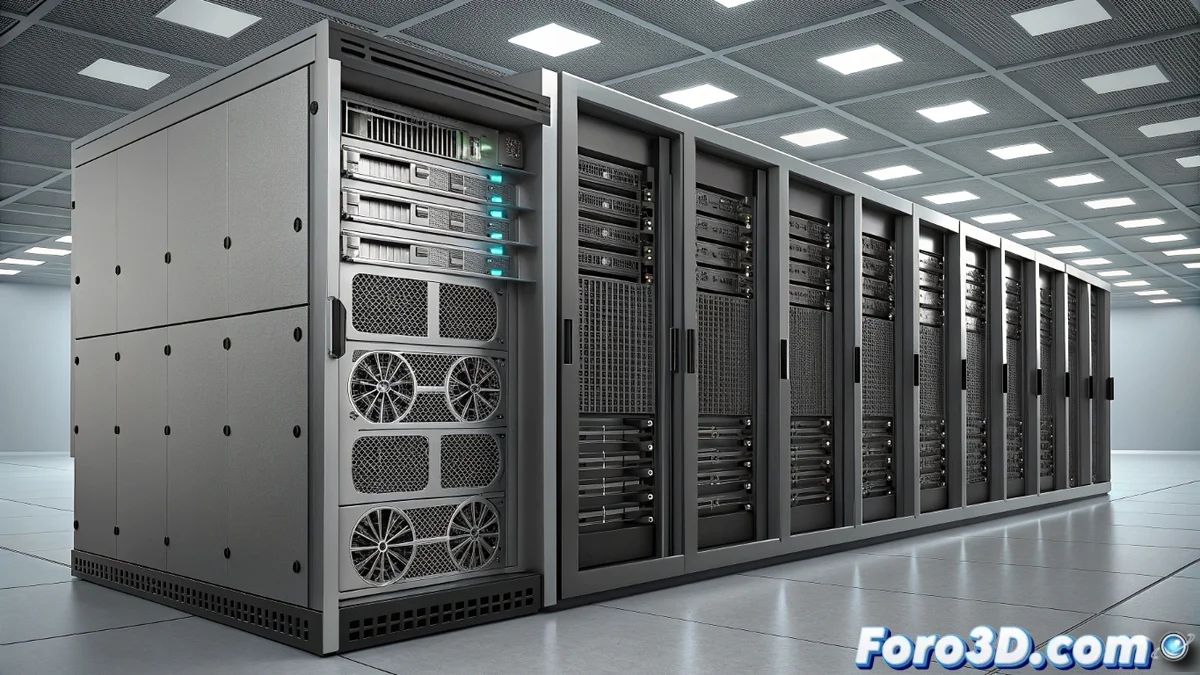
Graphcore's IPU-M2000: AI Computing Module
Graphcore presents the IPU-M2000, a computing module specifically designed to handle the demands of modern artificial intelligence. This system consolidates the power of four Bow IPU processors into a single rack unit, offering a unique combination of processing capacity and a large amount of memory integrated directly into the chip. 🚀
Internal Architecture and Key Components
At the core of the module reside the four Bow IPU processors. Each incorporates 900 MB of on-chip SRAM memory, a strategy that eliminates the bottleneck of accessing external memory and significantly accelerates operations. Communication between these processors is managed through the IPU-Fabric network, which enables high-speed data exchange within the module itself and, crucially, with other modules in a cluster. The design is completed with 100 GbE network interfaces and an integrated thermal management system for operation in standard data center environments.
Main design elements:- Four Bow IPU cores: Provide power for parallel processing.
- On-chip SRAM memory (900 MB per IPU): Reduces latency and increases bandwidth for data.
- IPU-Fabric: Interconnection network that enables ultra-fast and scalable communication.
The ability to scale horizontally by connecting multiple modules is fundamental for tackling AI models that require massive parallelism.
Scalability and Practical Use Cases
The main application of the IPU-M2000 is training large-scale deep learning models, such as large language models (LLMs) or advanced recommendation systems. Its strength shines in tasks that can be efficiently parallelized through its network. By connecting up to 64,000 IPUs in a single cluster via IPU-Fabric, it is possible to distribute a massive model across thousands of collaborating processors. This drastically reduces the time needed to complete a training cycle, allowing research teams to iterate and experiment much more quickly.
Scalability advantages:- Form massive clusters: Connect many modules to increase power linearly.
- Reduce training time: Collaboration among thousands of IPUs accelerates workflows.
- Parallelize complex models: Ideal for network architectures that divide easily.
Final Consideration for Adoption
Although the IPU-M2000 promises to transform how AI is trained with its focus on massive parallelism and on-chip memory, its implementation is not straightforward for everyone. Adopting this technology involves significantly rewriting or adapting code that was originally written for GPU-based architectures. This migration process represents an entry barrier that not all development teams are prepared or willing to overcome initially. 🤔