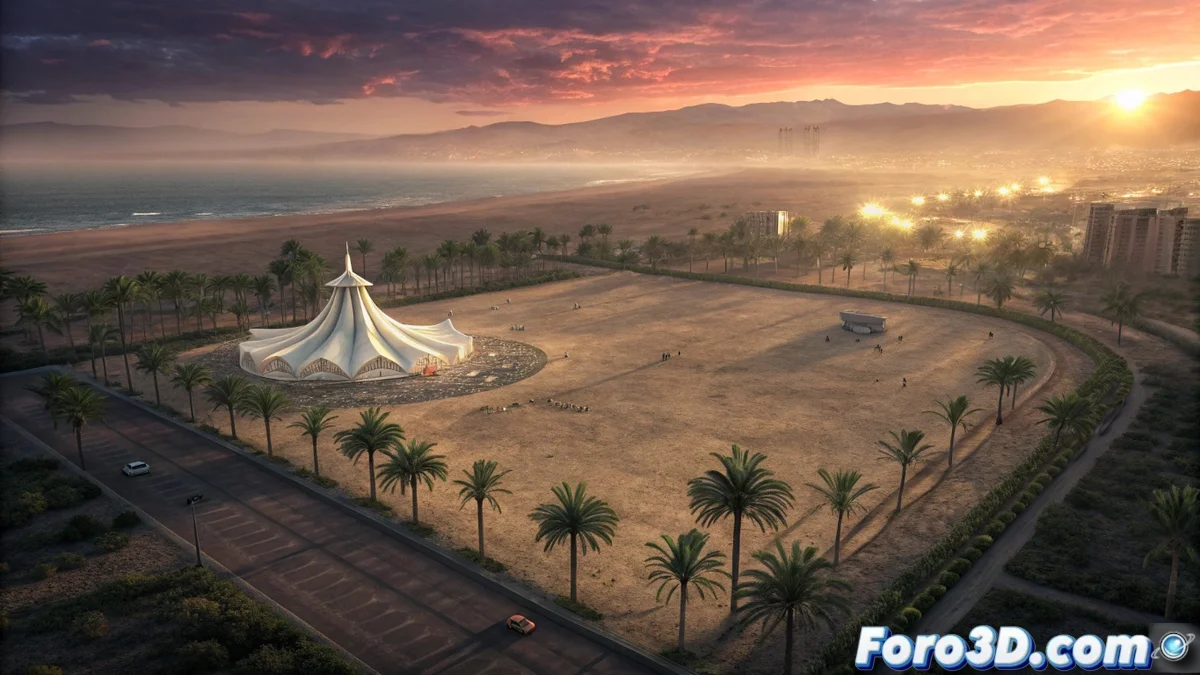
The Ghost Tent of Tenerife: The Cirque du Soleil Dream That Never Rose
On the coastline of Costa Adeje, in Tenerife, there exists an urban paradox: a vast and flat plot, prepared for the extraordinary, that only houses dust and the echo of an unfulfilled promise. This site is the silent stage of La Ciudad del Circo, a pharaonic project to install a permanent headquarters for Cirque du Soleil that captured all the headlines only to vanish into thin air, leaving no trace other than disappointment. 🎪
The Announcement of a Futuristic Tourist Icon
It was the year 2006 when the institutions and the famous Canadian company presented with great fanfare a plan that aimed to revolutionize leisure in the Canary Islands. The vision was to build a giant and fixed tent with avant-garde design, a complex that would go beyond a simple theater to include restaurants, shops, and various entertainment areas. With an initial investment exceeding one hundred million euros, it promised a new hub for cultural tourism and hundreds of jobs.
Key elements of the original project:- Millionaire investment: More than 100 million euros in initial budget, with great expectation of economic return.
- Unique architectural design: A permanent tent with a futuristic structure, conceived to be a visual icon of the island.
- Institutional commitment: Presented by the then president of the Cabildo, Ricardo Melchior, with land cession by the Adeje City Council and even a symbolic first stone.
A show of shadows and promises where the only acrobatic act was performed by expectation before falling into oblivion.
The Slow Agony of a Dream
After the initial euphoria, the project entered a spiral of silences and delays. Problems began to emerge, first subtly and then palpably for the entire citizenry. The 2008 global financial crisis dealt a critical blow to the already complicated financing, while Cirque du Soleil's corporate strategy also changed course. The foundations, literally, never came to set.
Factors that led to failure:- Unstable financing: Difficulties in securing and maintaining the capital necessary for a project of such magnitude.
- Corporate changes: Reassessments in the circus company's global expansion strategy, which prioritized other markets.
- Bureaucratic obstacles: Administrative and legal procedures that dragged on and complicated the development process.
A Legacy of Empty Land and Lessons to Learn
Today, that empty plot in Adeje is more than an unused space; it is a physical reminder of the volatility of large development projects. No construction truck ever moved for that purpose, nor was a single pillar erected. The land has had marginal uses, such as temporary parking, but its main destiny remains uncertainty. Tenerife's most famous tent exists only in the collective imagination and in old promotional models, a monument to ambition that could not overcome the barriers of reality. This case remains a study on the risks of projects that depend on complex alliances and volatile economic contexts. 🏗️