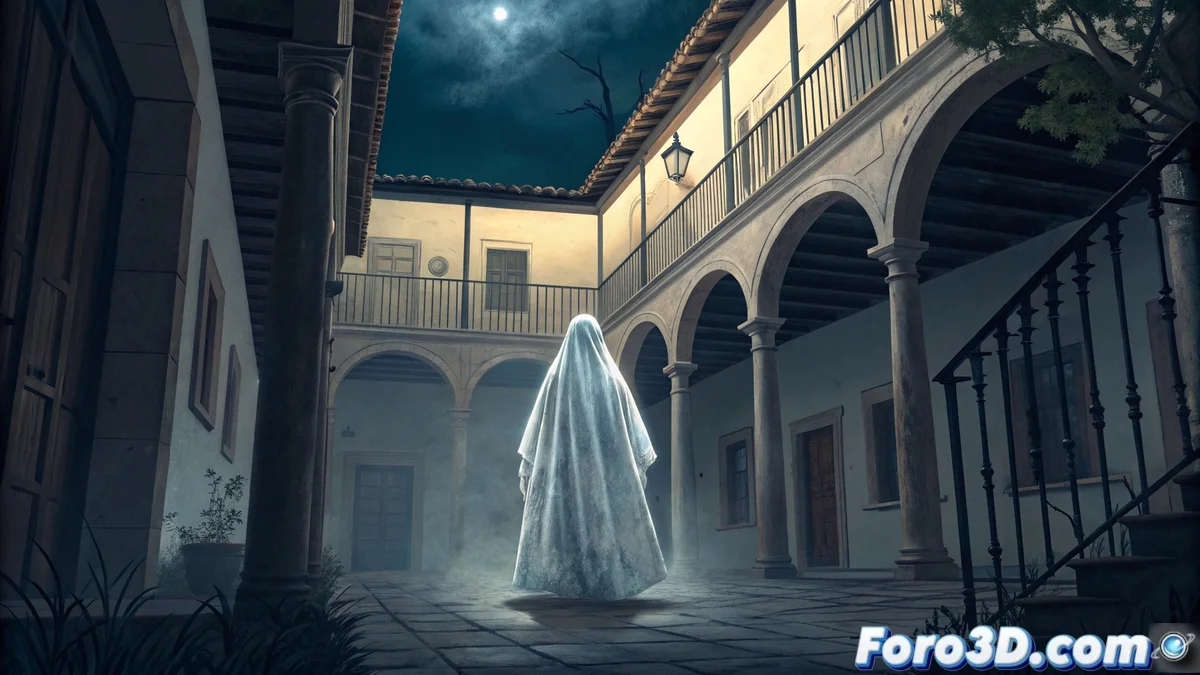
A Somber Aesthetic Brought to the Present
The timeless darkness of Francisco de Goya finds a new home in the digital world through the short film The Ghost of the Quinta. 🎨 This innovative project rescues the expressive power of the Black Paintings, those gloomy masterpieces that the Aragonese genius created directly on the walls of his residence at the Quinta del Sordo. Iconic pieces like Saturn Devouring His Son and The Witches' Sabbath are reborn through digital animation that scrupulously respects the original aesthetic while incorporating movement and dimension. Goya's characteristic visual texture, chromatic palette, and compositions are transposed into contemporary language without losing an iota of their original emotional intensity.
The Role of Virtual Reality
Virtual reality technology becomes the perfect bridge between the 19th and 21st centuries in this ambitious initiative. The creative team has employed specialized tools like Tilt Brush and Quill to sculpt three-dimensional brushstrokes that capture the gestural rawness of Goya's stroke. The implementation of Unreal Engine 5 allows for the creation of immersive environments where viewers not only observe the works but literally inhabit their space. This technical approach preserves artistic authenticity while adding layers of sound atmosphere and cinematic elements that amplify the emotional impact of the original paintings.
The Black Paintings reflected his pessimistic and tormented vision of the human condition
Artistic and Educational Impact
Beyond its value as an aesthetic experience, the project represents an unprecedented educational resource for bringing Goya's legacy to new generations. The ability to physically enter the paintings through virtual reality offers an intuitive understanding of their scale, composition, and emotional energy. Museums and cultural institutions can use this technology to contextualize the works within their original environment, allowing visitors to experience the atmospheric weight of Goya's creations in a way that would be impossible with the paintings transferred to canvas and hung in conventional galleries.
The Technological Irony of Rescuing Darkness
There is a profoundly significant paradox in using virtual reality, one of the brightest and most futuristic technologies of our time, to revive the darkest and most pessimistic period of a 19th-century master. While Goya painted from deafness and isolation in his Madrid quinta, contemporary creators employ total immersion systems to convey that same existential despair. This technological contradiction demonstrates how the most advanced tools can serve to preserve and transmit the most timeless human truths, no matter how somber they may be.
Reconstructing the Lost Context
One of the most valuable contributions of this project lies in its ability to digitally reconstruct the original environment that Goya conceived for his Black Paintings. When these works were torn from the walls of the Quinta del Sordo decades after the artist's death to be transferred to canvas, they suffered irreparable damage and lost their original spatial relationship. Virtual reality not only allows for the visual restoration of this relationship but also enables experiencing the site-specific intentionality that Goya imprinted on each composition in relation to the architecture that contained it.
Immersive Production Techniques
The faithful recreation of the Goyaesque universe requires innovative technical approaches that respect both the original heritage and the possibilities of the digital medium.
- Volumetric Brushstrokes: Use of VR tools to create three-dimensional strokes that emulate the physical texture of tempera painting
- Atmospheric Lighting: Setup of lights and shadows that replicate the dim illumination of the original spaces
- Organic Animation: Incorporation of subtle movement that amplifies the drama without altering compositional integrity
- Spatialized Sound: Design of ambient audio that reinforces emotional immersion in each scene
Applications in Heritage Conservation
This project establishes an important precedent for the preservation and dissemination of cultural heritage through immersive technologies.
- Comprehensive digital documentation of works at risk of deterioration or in inaccessible locations
- Reconstruction of lost original contexts due to historical interventions
- Democratization of access to masterpieces for global audiences without physical travel
- Creation of multisensory educational experiences that complement traditional observation
The Future of Art in Immersive Environments
The success of The Ghost of the Quinta points to fascinating directions for the evolution of artistic experience in the digital age.
- Development of non-linear narratives where the viewer explores masterpieces at their own pace
- Integration of artificial intelligence to recreate artistic styles in generative experiences
- Creation of virtual exhibitions that transcend physical limitations of space and conservation
- Fusion of multiple artistic disciplines in unified immersive experiences
While Goya contemplated the human condition from the darkness of his deafness, virtual reality demonstrates that sometimes we need to fully immerse ourselves in the shadows to truly appreciate the light of genius. 🖌️ Because, let's be honest, what would be more revealing than walking among a master's nightmares to understand his dreams?