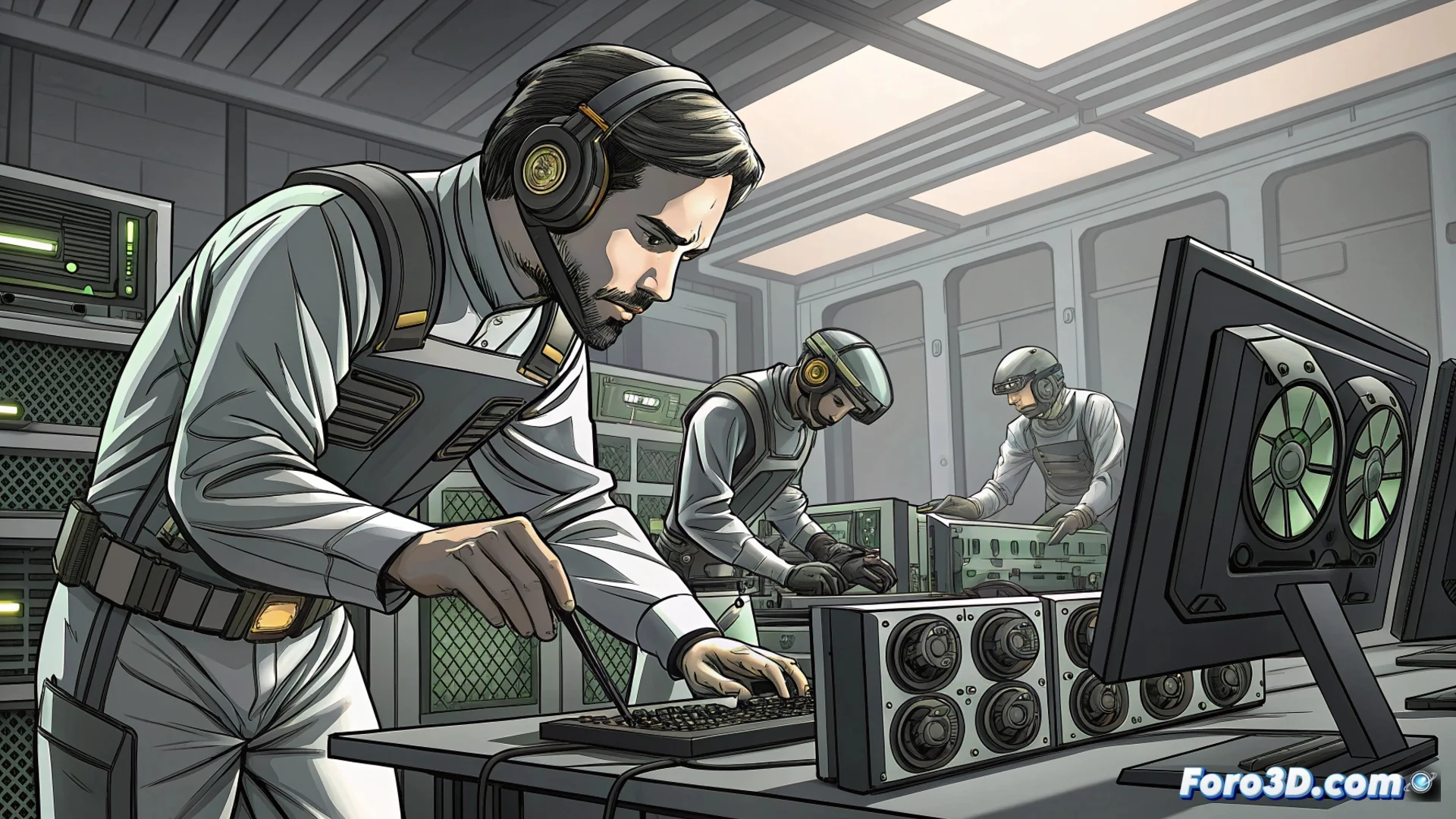
The GeForce RTX 5090 Attracts Chinese Buyers for AI Tasks
The most powerful Nvidia graphics cards, designed to deliver the best gaming experience, are finding a new purpose far from video games. In China, massive interest has emerged in these components for training and running complex artificial intelligence models. This shift in usage demonstrates how the market adapts to geopolitical limitations. 🤖
Consumer Hardware for Professional Challenges
Chinese developers face trade barriers that limit their access to specialized accelerators like the H100 GPUs. Faced with this shortage, they turn to creative solutions: high-end gaming GPUs. Although not specifically designed for it, their architecture and raw power allow processing deep learning algorithms. The GeForce RTX 5090, with its large number of Tensor cores and high-bandwidth GDDR7 memory, positions itself as a powerful and more accessible tool.
Key factors driving this demand:- Import restrictions: Trade sanctions make it difficult to acquire professional AI hardware, creating a market gap.
- Proven performance: The Ada Lovelace architecture and third-generation RT and Tensor cores offer massive parallel computing.
- Relative availability: Although also scarce, consumer GPUs are easier to obtain than blocked enterprise solutions.
The component created to render virtual worlds at high speed now helps train artificial minds, an ironic market twist.
A Demand Cycle That Repeats in History
This phenomenon is not isolated. It clearly recalls the cryptocurrency boom, when miners hoarded the same cards to solve consensus algorithms, causing shortages and inflated prices for gamers. Now, the AI fever drives a similar pattern, with a different main actor. The high demand from China for a product classified as gaming hardware shows how the industry navigates supply and regulatory obstacles.
Comparison between two parallel demand cycles:- Mining era: GPUs were used to validate blockchain transactions (Proof of Work). The incentive was direct economic gain.
- AI era: GPUs are used to train language and image models. The incentive is technological development and innovation.
- Common consequence: In both cases, gamers and content creators face difficulties acquiring hardware at market prices.
Implications for the Future of the Market
This situation poses a dilemma for Nvidia and consumers. On one hand, the company sees its consumer hardware meeting a high-value market need. On the other, gamers could once again feel frustration if the availability of the RTX 5090 and similar models drops drastically. This scenario highlights the growing convergence between gaming and professional hardware, and how geopolitical tensions can redirect global consumer technology product flows. The market, once again, finds a way.