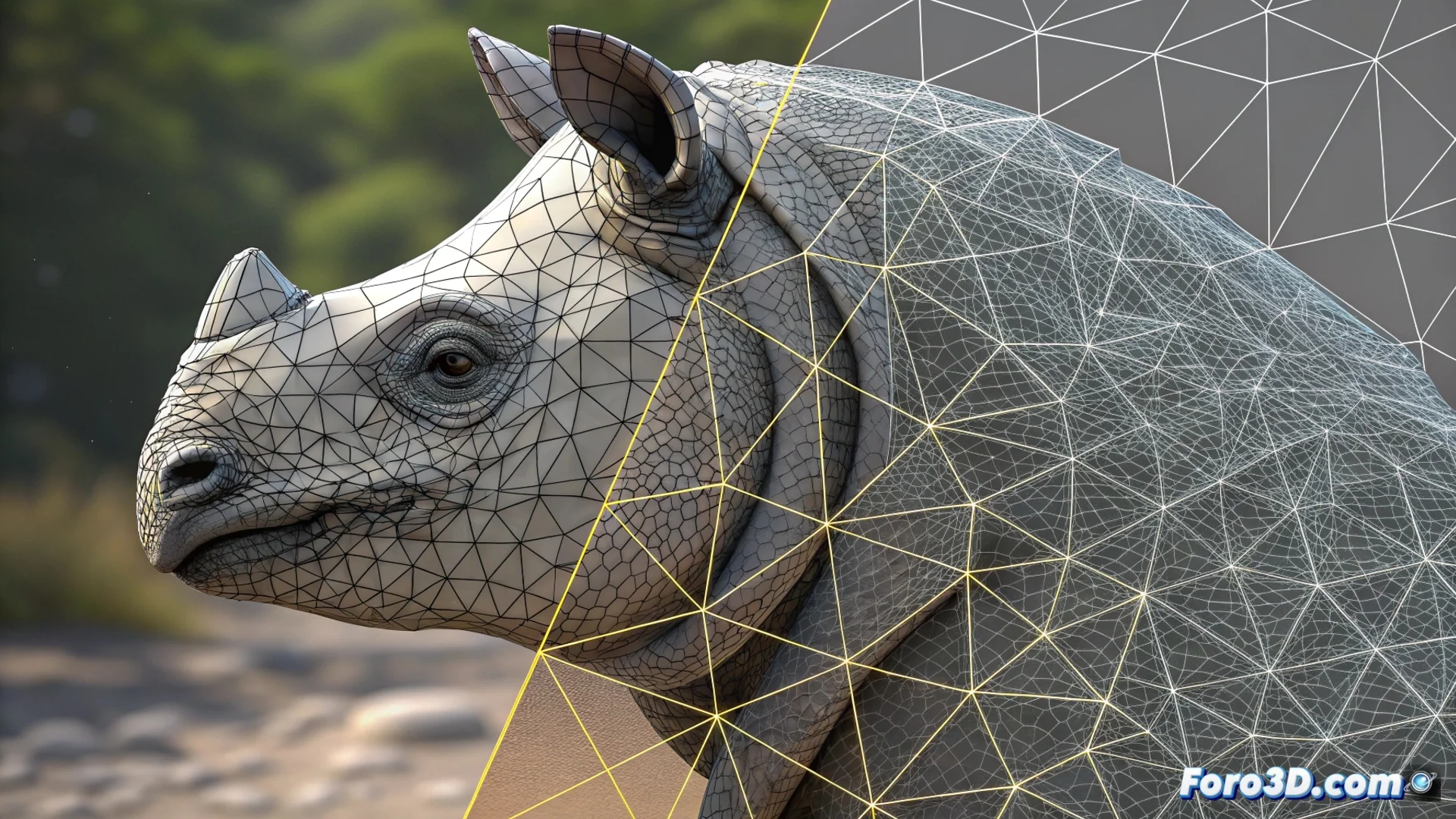
Gaussian Curvature Flow for Smoothing 3D Meshes
In 3D mesh modeling and processing, smoothing surfaces is a common task. Gaussian Curvature Flow represents an advanced approach based on deep geometric principles, offering a more natural alternative to traditional smoothing methods. 🌀
Understanding the Intrinsic Mechanism
This algorithm works by displacing each vertex of the mesh according to its local Gaussian curvature. Unlike mean curvature flow, which can flatten or contract the shape, this technique evolves the surface while respecting its intrinsic structure. This means that fundamental properties such as angles and areas are distorted less, achieving a result that preserves defined edges and micro-details.
Key Features of the Process:- The direction of vertex movement is derived directly from a fundamental geometric property.
- Minimizes distortion of the original mesh's intrinsic geometry during smoothing.
- Particularly effective for maintaining edge sharpness and complex volumes.
Gaussian flow tends to evolve the mesh while preserving its intrinsic structure, distorting areas and angles less.
Comparison with Laplacian Smoothing
Standard Laplacian approaches operate by calculating averages of the positions of adjacent vertices. Although they are fast to execute, they frequently cause the model to lose volume and its important features to blur. Gaussian curvature flow mitigates these issues because its dynamics depend on a more stable and fundamental geometric property.
Practical Applications Where It Excels:- Remeshing and repairing models from 3D scanning, where shape integrity is critical.
- Preparing meshes for physics simulation or animation, as it preserves the surface's mechanical structure.
- Preventing a model with an aggressive character from losing its intimidating essence when smoothed excessively.
Advantages in the Production Pipeline
Implementing this algorithm is particularly useful in contexts where maintaining geometric integrity is crucial. Its ability to regulate the surface more naturally, without shrinking it or blurring its fine details, makes it a valuable tool for optimizing complex meshes. The final result is a smoothed surface that feels more faithful to the original design. ⚙️