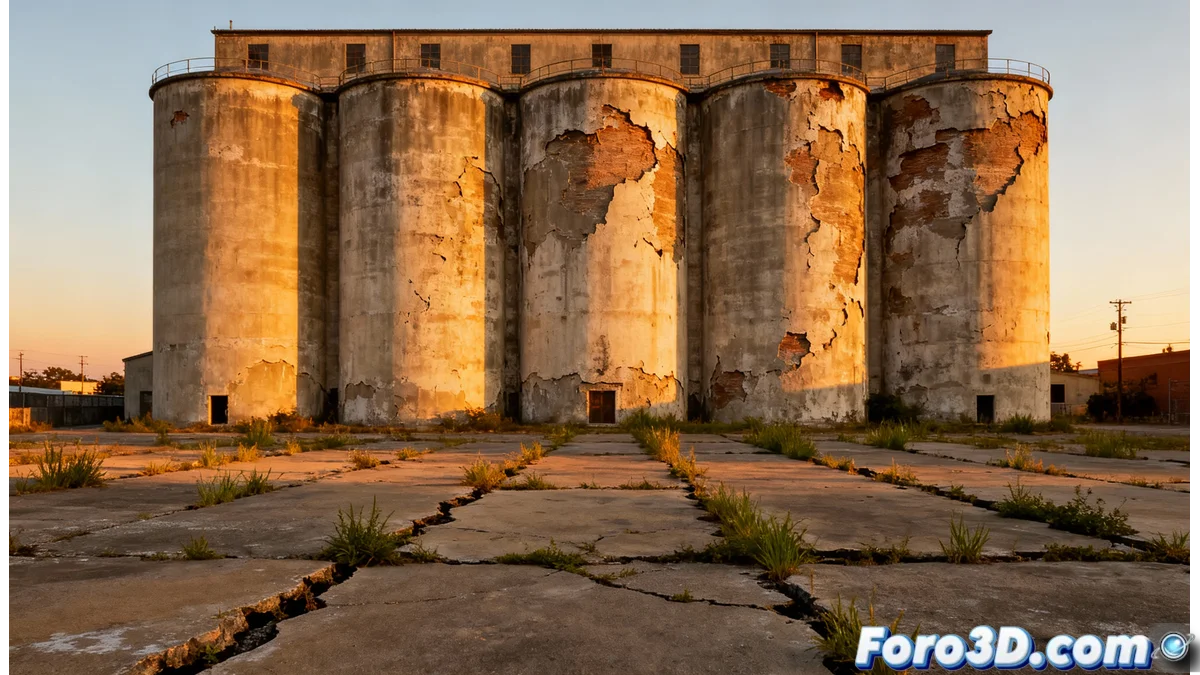
The Garvey Wineries: Jerez's Modern Ruin and Fisac's Unfinished Legacy
In the urban horizon of Jerez de la Frontera rises a ghostly and powerful silhouette: the skeleton of the Garvey Wineries. Conceived by the visionary Miguel Fisac, this industrial structure was designed as a beacon of modernity, standing out for its innovative prestressed concrete roofs with hyperbolic paraboloid shapes. Started in the 1960s, the promise of a model winery was frozen in time, transforming into a monument to thwarted ambition 🏗️.
A Protected Heritage That Is Fading Away
Despite its state of abandonment, the architectural value of the complex is unquestionable and enjoys legal protection. However, this theoretical safeguard clashes with a harsh reality: the progressive and unstoppable deterioration. The pioneering concrete elements now exhibit deep erosion, while nature reclaims its space, introducing cracks and blurring the pure lines of the design. This paradox defines its essence: a masterpiece that crumbles before everyone's eyes, even though it is cataloged 🏛️.
The key factors in its decline:- Functional abandonment: The lack of a specific use and maintenance for decades is the main cause of structural deterioration.
- Environmental aggressions: Rain, wind, and thermal cycles act on the concrete, accelerating its physical degradation.
- Vegetal reconquest: Roots and climbing plants weaken joints and materials, integrating the ruin into the natural landscape.
It is the supreme triumph of the idea over matter, a lesson in humility for any architect: you can design a cathedral for wine, but if you don't fill it, time will drink up the last drop of your glory.
The Debate on Its Future: Rehabilitation or Perpetual Ruin?
The future of the Garvey Wineries is a continuous headache for urban planners and conservators. The discussion oscillates between the urgent need for a respectful rehabilitation that preserves its architectural soul and the enormous difficulty of giving economic viability to a concrete colossus with such a singular morphology. In this limbo, the complex has become a place of cultural pilgrimage, where admiration for Fisac's genius mixes with melancholy for what never came to be 🧱.
Possible scenarios for the complex:- Cultural reconversion: Adaptation of the space to house a museum, wine interpretation center, or space for contemporary art exhibitions.
- Consolidating intervention: An action that stops the deterioration without altering its ruin aesthetic, keeping it as an urban sculpture and monument.
- Controlled abandonment: Accepting its fate as a modern ruin, documenting its decay process as an integral part of its history.
A Symbol of the Fragility of Contemporary Heritage
The silhouette of the Garvey Wineries transcends its failed function to become a powerful symbol. It represents the vulnerability of 20th-century architectural heritage when it loses its connection to a city's useful life. Its presence is a constant reminder that legal protection is not enough without a social and economic project to sustain it. More than a simple ruin, it is a manifesto in concrete about the dialogue, sometimes failed, between innovation, memory, and the urban future ⏳.