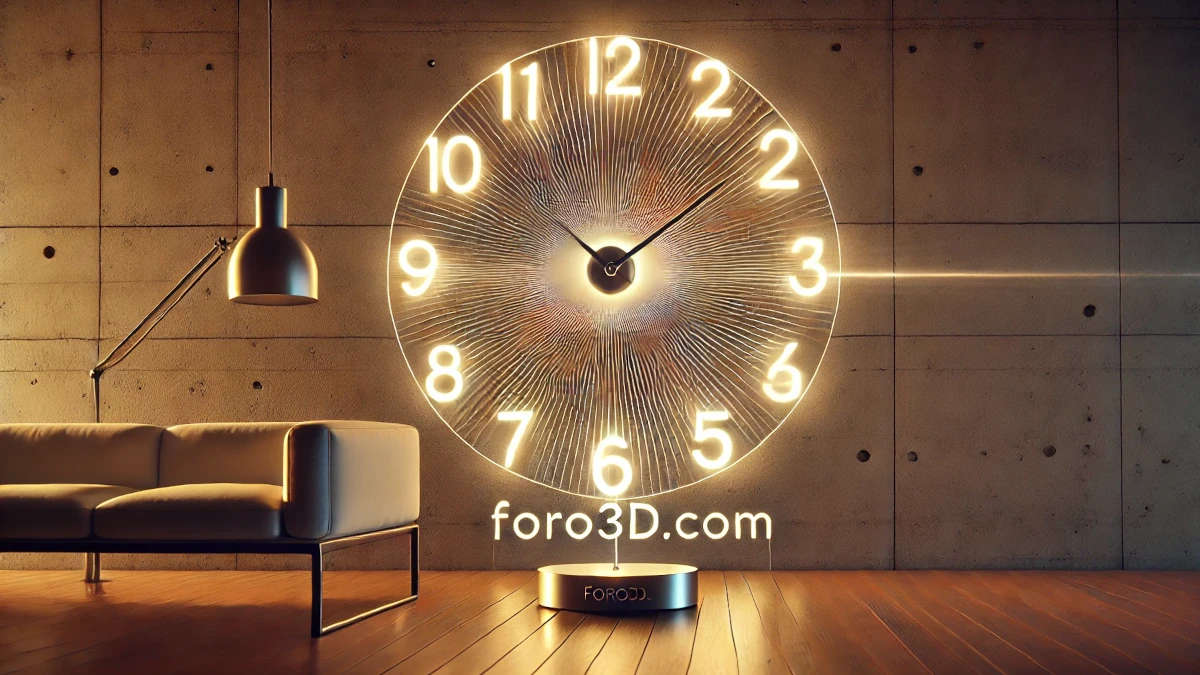
Technological evolution has brought 3D printing to unexpected fields, and one of the most innovative uses is the creation of clocks that display the time without the need for screens or traditional mechanisms. By using a 3D printed lens, it is possible to manipulate light to project numbers onto a surface, offering a futuristic and minimalist alternative to conventional clock design.
The Optical Phenomenon Behind the System
The principle behind this technology is that of caustics, an optical effect observed, for example, when light passes through a glass of water and projects bright patterns onto a table. By applying this concept to a precisely designed lens, light rays can be redirected to form specific images, in this case, the numbers of a clock.
Design and Manufacturing with 3D Printing
Thanks to advances in 3D printing, the manufacturing of these lenses is no longer exclusive to the optical industry and is within reach of anyone with access to a suitable printer.
Precision in Modeling
- The lens design requires exact calculations so that the light projects correctly and the numbers are visible with clarity.
- Unlike industrial methods, 3D printing allows the lens to be modified and customized easily.
- Any user with basic knowledge of 3D modeling can try different configurations and optimize the projection.
Applications Beyond Clocks
The potential of this technology is not limited solely to time projection. This method of light manipulation could be applied in other fields:
- Screenless Signage: Projected information without the need for electricity, ideal for public spaces or sustainable signage.
- Lighting Decoration and Art: Surfaces that reflect complex patterns without the need for ink or digital screens.
- Interactive Interfaces: Combined with sensors, this system could serve to control devices without physical contact.
The Future of Screenless Projection
The combination of 3D printing and computational optics opens the door to a new way of designing visual devices without relying on screens or traditional elements.
“As this technology advances, the possibilities for its application in design, visual communication, and practical functionality will continue to grow, offering innovative and sustainable solutions for the future.”