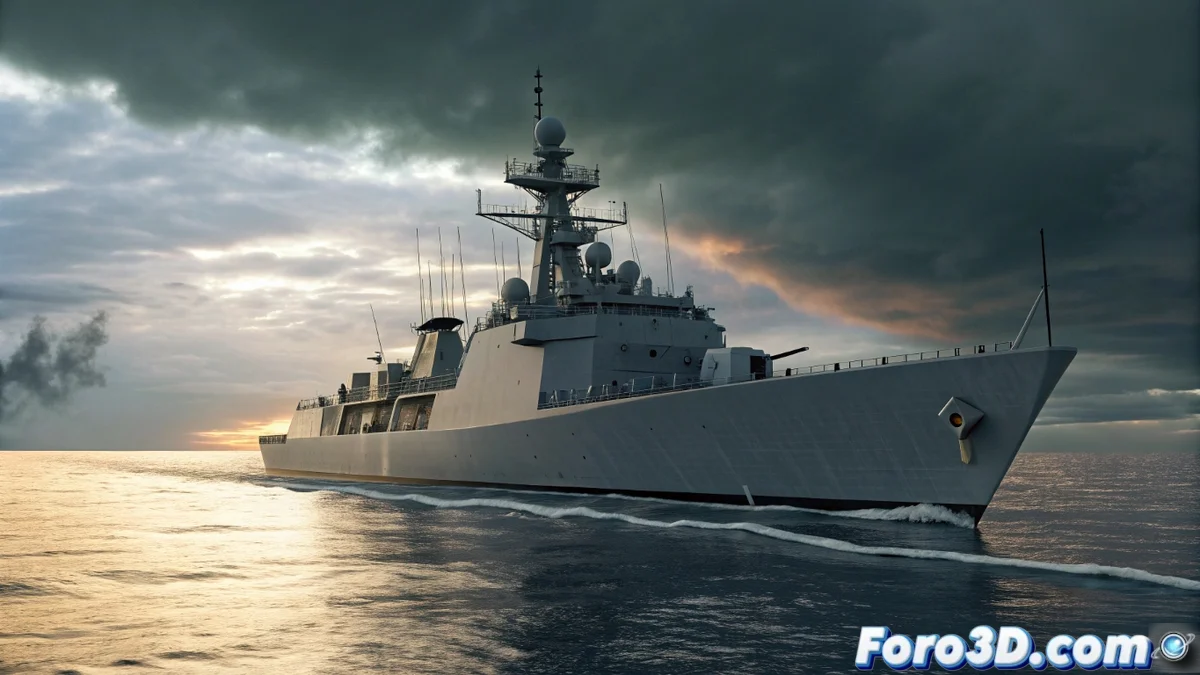
The FREMM Class: Franco-Italian Multi-Mission Frigates
The FREMM program (European Multi-Mission Frigate) represents a milestone in European naval cooperation. The result of collaboration between France and Italy, these ships establish a new paradigm for 21st-century frigates, fusing offensive and defensive capabilities in a highly adaptable platform. 🚢
Design and Stealth Features
The FREMM design prioritizes operational versatility and survivability. With dimensions of 142 meters in length and 20 in beam, its architecture incorporates solutions to reduce the radar signature. The French variant Aquitaine stands out for its integrated mast, while the Italian Bergamini features an especially clean superstructure. These characteristics minimize detection and allow operation in high-threat environments.
Main design aspects:- Dimensions: 142m length, 20m beam, 7.6m draft for great oceanic stability.
- Stealth: Angular shapes and radar-absorbent materials (RAM) for low detectability.
- Adaptability: Common platform with specific configurations for ASW (anti-submarine) or AAW (air defense) missions.
The fusion of multi-mission capabilities with a stealth design makes the FREMM a strategic asset for any modern fleet.
Weapons Systems and Capabilities
The combat power of the FREMM class lies in its integration of weapons systems. Its configuration allows it to face air, surface, and submarine threats simultaneously, acting as a nerve center in a naval group. 🎯
Main integrated armament:- Air Defense: Vertical Launch Systems (VLS) for Aster 15 and Aster 30 missiles, providing an area anti-air and anti-missile shield.
- Surface Attack: Exocet missiles (French version) or Teseo (Italian version) to neutralize naval targets at long range.
- Artillery and ASW: Main gun of 76 mm (Italy) or 127 mm (France), complemented with MU90 Impact torpedoes for anti-submarine warfare.
Conclusion and Strategic Relevance
The FREMM class embodies the concept of the future multi-mission frigate. Its success lies not only in its advanced technology, but in the industrial cooperation model that underpins its construction. Beyond the subtle differences between its national variants, its common core demonstrates that interoperability and shared ingenuity are as valuable as its own armament. This platform will continue to define naval operations in the coming decades. ⚓