The FLIP Method for Simulating Liquids in Visual Effects
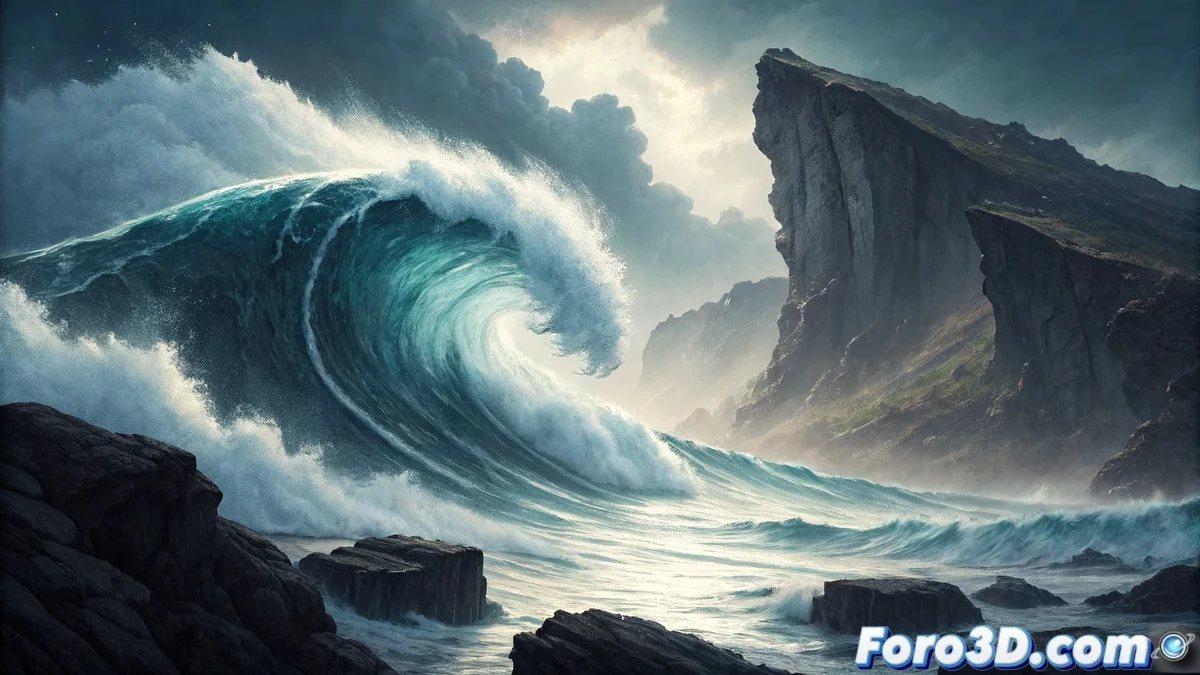
In the film and video game industry, simulating water realistically is a complex technical challenge. The FLIP (Fluid-Implicit-Particle) algorithm has established itself as the standard solution for creating large bodies of water, such as oceans or floods. This hybrid system fuses two approaches to offer artistic control and numerical stability. 🌊
How the Hybrid Particle-Grid System Works
The technique operates in a repetitive cycle for each frame. First, a group of marker particles without mass transports the fluid's attributes, such as its velocity. Then, this data is projected onto a fixed Eulerian grid. On this grid, the algorithm solves the Navier-Stokes equations to calculate pressure and ensure the fluid is incompressible. Finally, the results are interpolated back to the particles, which move freely.
Key Advantages of the FLIP Approach:- Stability: The fixed grid avoids common numerical issues in other methods, allowing for larger time steps.
- Detail: Particles capture fine features like splashes and foam that a grid alone would miss.
- Efficiency: It combines the speed of grid processing with the precision of particle tracking.
For those trying to simulate an entire ocean for the first time, the render usually finishes just when patience and RAM memory run out.
Application in Large-Scale Productions
The main use of the FLIP method is in generating visual effects for film and television. Technical artists configure parameters like viscosity, surface tension, and how water collides with objects. Although it demands considerable computing power, the results are extremely detailed and realistic.
Software that Implements FLIP:- Houdini: It has native and very powerful implementations for simulating fluids.
- Maya: Uses plugins like Bifrost to integrate this technology.
- Blender: Through the particle system and plugins, it also allows using FLIP principles.
Technical Considerations for Artists
Implementing a FLIP simulation requires balancing detail with computation time. Simulation TDs must optimize the grid resolution and number of particles. The ultimate goal is to produce believable fluid behavior that can be rendered efficiently, maintaining artistic control over the water's movement. 💻