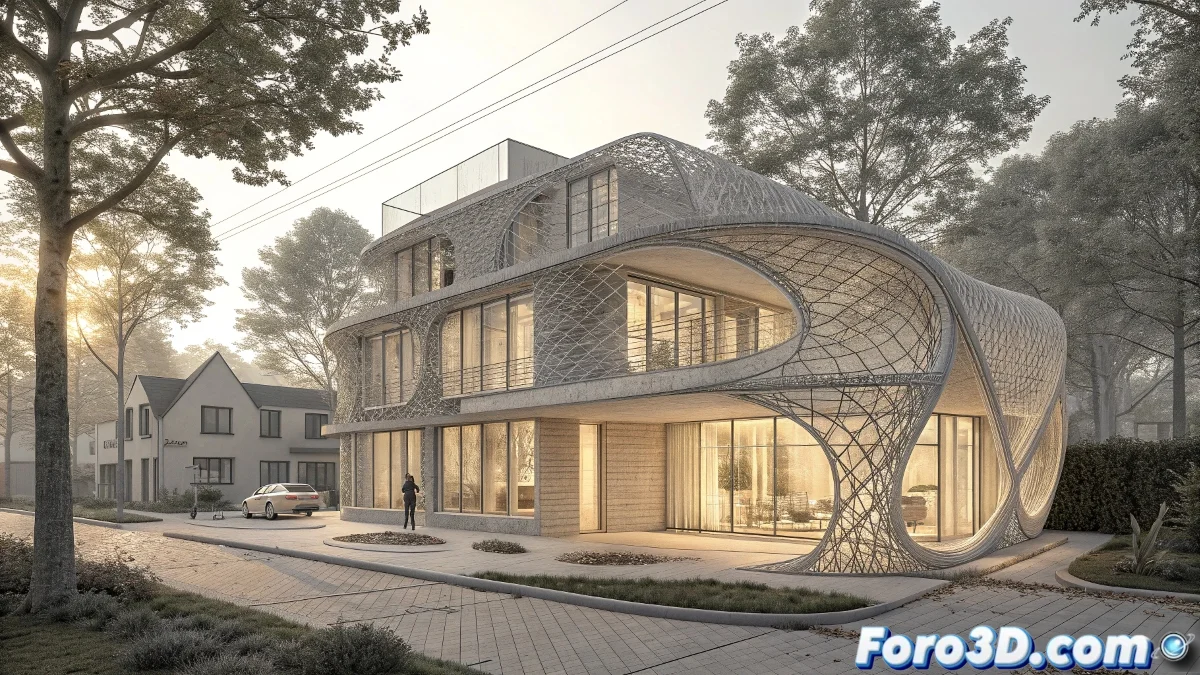
When 3D Printing Stops Being a Prototype and Becomes a Real Home
Eindhoven becomes the world capital of additive construction with a milestone that many in the industry considered still distant. Project Milestone, the collaboration between Eindhoven University of Technology and the municipality, has delivered the keys to the first fully 3D-printed house to its first tenants. This moment represents the materialization of years of research and development in 3D concrete printing, transforming from a laboratory experiment to a tangible housing solution.
The house demonstrates that 3D printing in construction has surpassed the proof-of-concept phase to become a viable alternative to traditional methods. With its organic shapes impossible to achieve with conventional formwork and its revolutionary material efficiency, this house is not just a building, but an architectural manifesto on the future of construction. The first residents are not mere tenants, but voluntary pioneers in the digital construction revolution. 🏠
In Eindhoven, the future of housing is not being built, it is being printed layer by layer
The Engineering Behind the Dutch Miracle
Project Milestone solves technical challenges that until now limited 3D printing to isolated structural elements.
- Specialized concrete with controlled setting times for continuous printing
- Robotic printing system capable of working on the scale of a full house
- Integration of utilities electrical and plumbing during the printing process
- Real-time quality control that ensures the consistency of each printed layer
The ability to print curved and organic shapes is not just an aesthetic issue, but allows for structurally optimized design to use up to 60% less material than traditional construction.
Advantages That Redefine the Concept of Housing
For tenants and the real estate market, this technology offers benefits that go beyond the purely technical.
- Mass customization where each house can be unique without significant additional costs
- Reduction in construction times from months to weeks or even days
- Inherent sustainability by minimizing construction waste and material transportation
- Potential economic accessibility by reducing specialized labor and waste
The residents enjoy not only a technologically advanced home, but architectural features that would be economically prohibitive with conventional methods.
The Impact on the Future of Global Construction
This Dutch success could accelerate the global adoption of 3D printing in construction. The model is scalable and adaptable.
If Project Milestone proves its long-term viability, we could see entire cities adopting this technology to address housing crises, post-disaster reconstruction, and sustainable urban development. Construction, one of the most traditional and change-resistant industries, could be on the verge of its most radical digital transformation. 🔨
And if these printed houses work as well as promised, we could soon see entire neighborhoods emerge in the time it previously took to build a single house... though architects will probably keep arguing about design details as always 😉