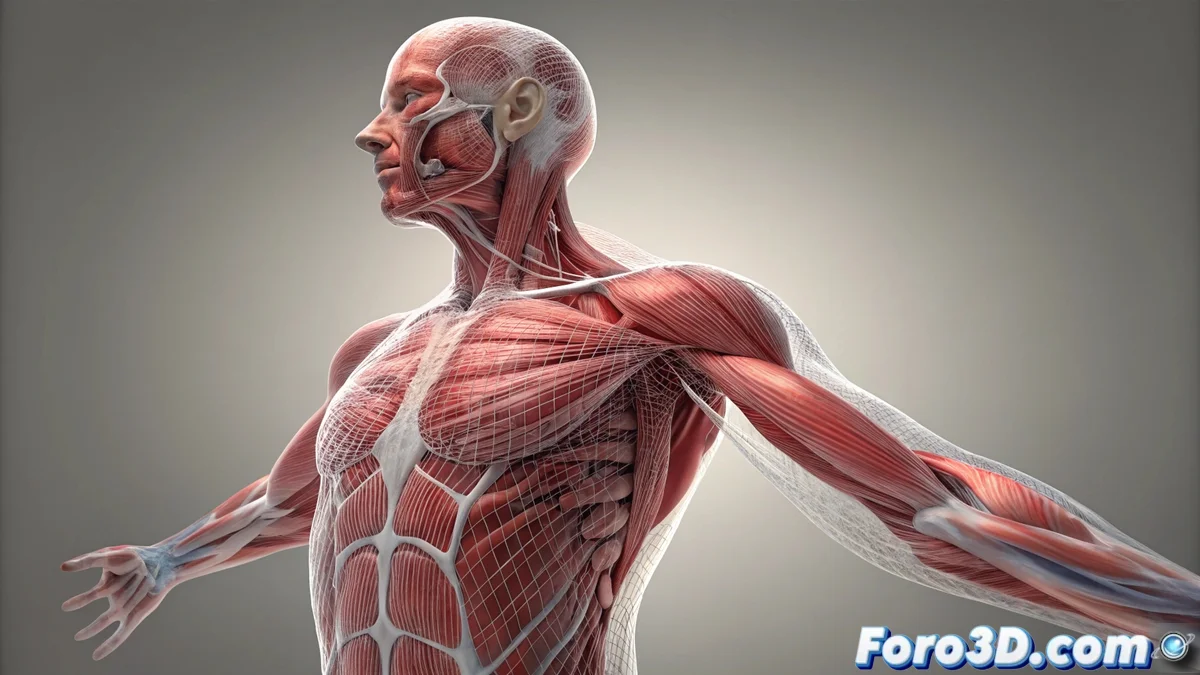
The Finite Element Method for Simulating Soft Bodies in 3D
In the world of animation and visual effects, simulating the realistic movement of organic tissues is a complex challenge. The Finite Element Method (FEM) stands out as a powerful computational technique that addresses this problem. Unlike methods that only work with the surface, FEM models the complete internal volume of an object, allowing for highly faithful recreation of how soft materials compress, stretch, and bend. 🧠
Fundamentals of FEM Simulation
The technique is based on converting a solid 3D model into a dense network of thousands of interconnected tetrahedral elements. Each of these small tetrahedrons functions as an independent unit with assigned physical properties, such as elasticity and density. A specialized physics engine solves a massive system of equations for each element, calculating how it deforms and how it transfers stress to its neighbors when forces like gravity or an impact act. This process preserves the total volume of the material, an essential property for muscle, fat, or skin simulations to appear believable.
Key Advantages of the FEM Approach:- Volumetric Accuracy: Maintains the material's mass during deformation, preventing objects from appearing to inflate or shrink unnaturally.
- Realistic Physical Behavior: Calculates complex internal interactions, generating convincing secondary motions, such as fat jiggle or muscle flexion.
- Artist Control: Results are predictable and adjustable via physical parameters, reducing the time needed to correct or tweak animations.
FEM allows digitally dissecting a model to precisely define different material layers, such as skin, fat, and muscle, within the same mesh.
Application in Computer Graphics
In the entertainment and video game industry, FEM is the preferred choice for animating any organic tissue that requires physical realism. Its use is extensive in areas where other soft body simulation methods may fail. Animators and technical artists apply it to create facial deformations when speaking, simulate the swaying of fat layers, or show how muscles tense under the skin. The key lies in the method inherently respecting the laws of physics, generating motion that the eye perceives as correct.
Main Use Cases:- Facial and Body Animation: For expressions and movements involving multiple layers of soft tissue.
- Special Effects: In simulating impacts, wounds, or interactions with objects in dynamic environments.
- Medical and Scientific Prototyping: Where biomechanical accuracy is a fundamental requirement.
Considerations and Complexity
Although the results offered by the finite element method are visually impressive and physically sound, preparing a model for this simulation is not trivial. The process can be as meticulous as a real dissection, as it requires precisely defining the different material regions within the 3D model. Setting up the mesh resolution, material properties, and necessary calculations demands significant technical knowledge and processing power. However, for projects seeking maximum realism in soft body animation, the investment in FEM is usually worthwhile. 💡