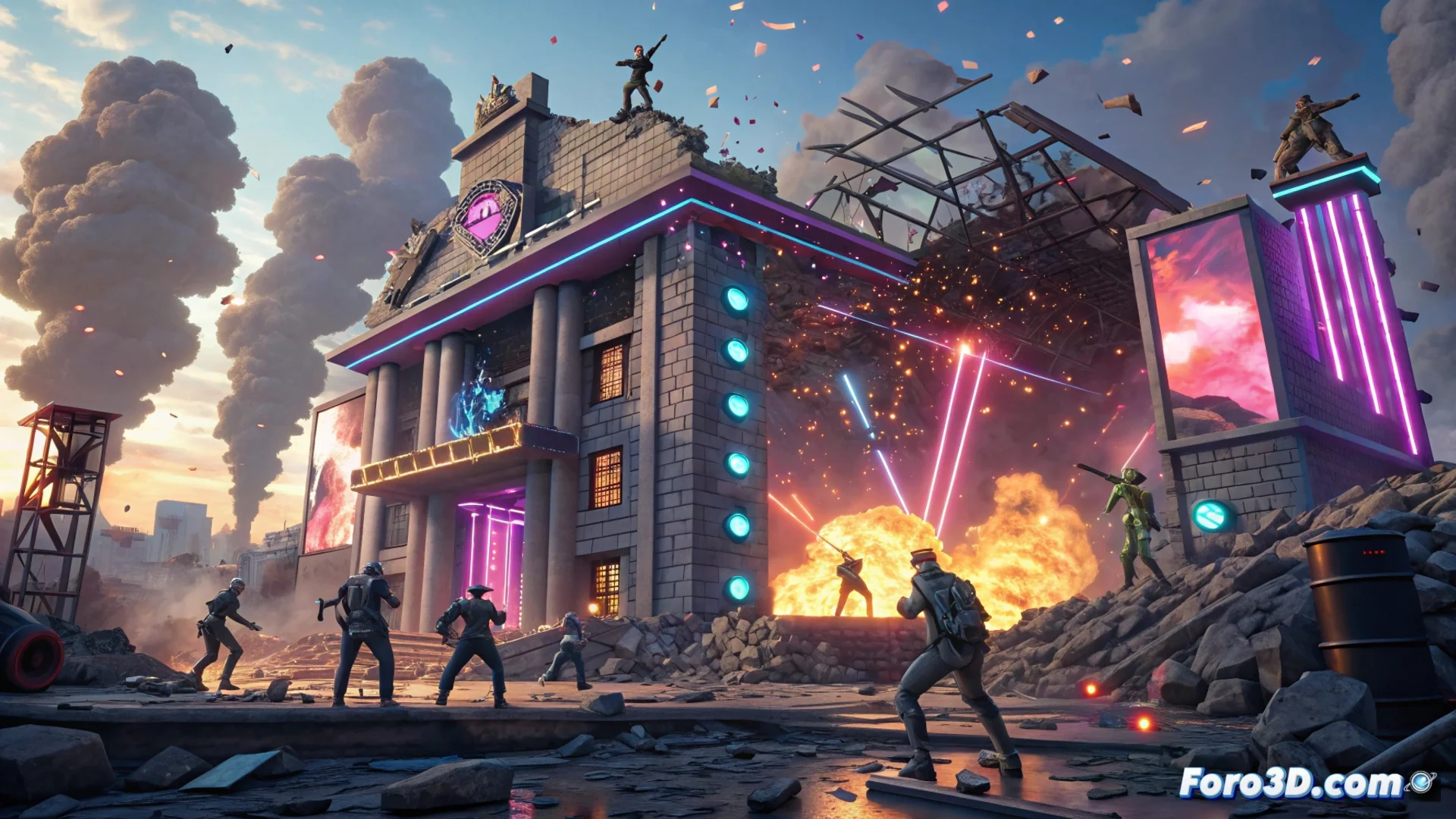
The Finals: how Unreal Engine 5 synchronizes destructive chaos
The competitive shooter The Finals is built on the foundations of Unreal Engine 5, and its greatest technical feat is not just what it shows, but how it does it. The core of its experience lies in an environmental destruction system that processes and synchronizes the chaos for all players in real time, transforming every match into a unique and unpredictable spectacle. 💥
The server as the director of the destructive spectacle
For the demolition to be credible and fair, the game delegates to a central server the task of calculating every structural collapse. This server determines how a wall, a floor, or a tower collapses, and sends that identical information to each player. This method ensures absolute coherence: everyone perceives the same debris, the same holes, and the same landscape transforming at the same instant, avoiding unfair advantages and maintaining competitive integrity.
Technological pillars of destruction:- Centralized calculation: The authoritative server processes all destruction physics, synchronizing the scenario state for each client.
- Constant visual dynamism: Maps are not static; they evolve and degrade during the confrontation, offering a playing field that changes minute by minute.
- Strategic interaction: Players don't just shoot; they plan how to demolish structures to flank, defend, or trap their rivals.
Destruction in The Finals is not an adornment; it is the main language with which every match is written.
A visual aesthetic that screams "live show"
The graphical section enhances this chaotic sensation with a deliberately exaggerated aesthetic. Inspired by television competition programs, the game uses saturated colors, neon lights, and a profusion of particle effects. To achieve this, it relies on two key UE5 tools: Lumen, for dynamic global illumination that reacts to every explosion and collapse, and Nanite, which allows handling an astronomical amount of detailed geometry, even when that geometry fractures into thousands of fragments.
From visual effect to core gameplay mechanic
The technology here is not mere boasting. It directly defines gameplay. Players can create new routes by demolishing a wall, collapsing an entire floor on an enemy team, or destroying the ground under an opponent's feet. This ability to shape the battlefield in a synchronized way turns destruction into another tactical tool, as important as a weapon or a grenade.
Hardware implications:- High graphical demand: Rendering so much destruction, with Lumen and Nanite active, requires a powerful graphics card.
- Constant special effects: The GPU must process non-stop explosions, particles, changing lighting, and complex geometry in real time.
- The price of fidelity: Experiencing this visual chaos with full detail implies having modern hardware capable of handling the load.
A new standard for interactive action
The Finals demonstrates how the latest tools from an engine like Unreal Engine 5 can transcend the visual to merge with the core of gameplay. Its destruction system, more than a spectacle, is the essence of its strategy and controlled chaos, setting a benchmark on how to meaningfully integrate technical advances into a video game. 🎮