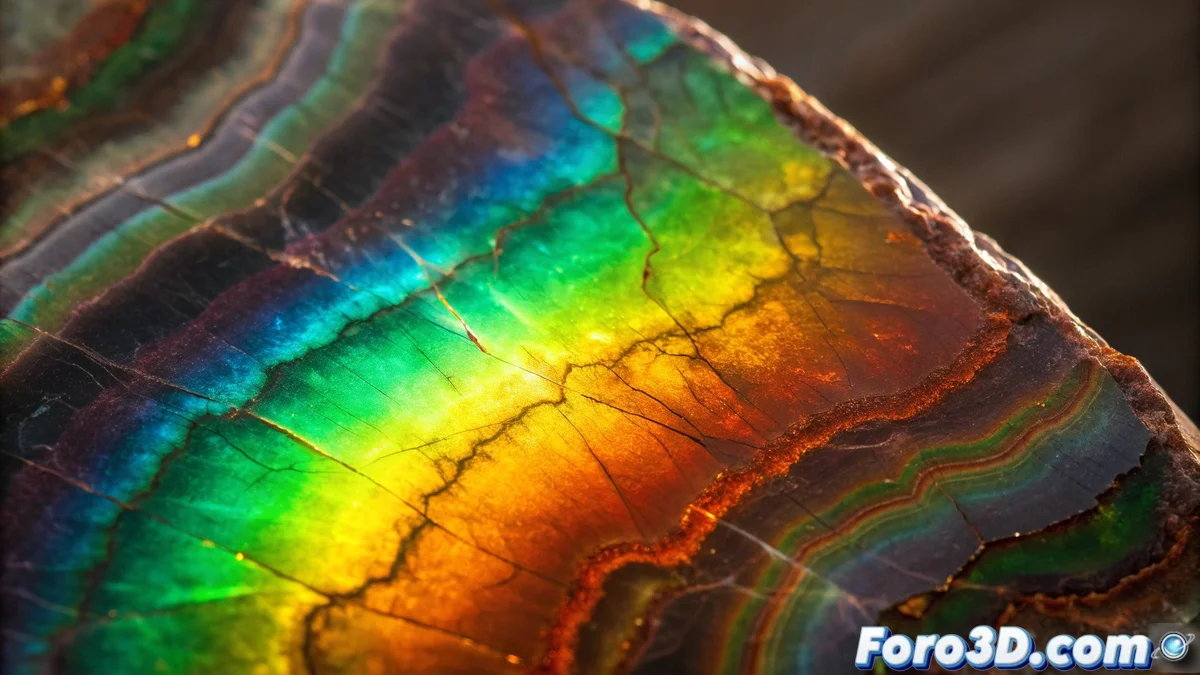
The Fascinating Optical Phenomenon of Ammolite
Ammolite reveals its dazzling chromatic palette through a complex process of light interference that transforms visual perception. This organic gem, formed from ammonite fossils, acts as a natural diffractor that decomposes visible light in all its spectral splendor ✨.
Interference Mechanism in Nanometric Layers
The secret lies in the lamellar structure of ammolite, composed of very thin layers of aragonite arranged in parallel. When photons strike this configuration, constructive and destructive interferences occur that enhance certain wavelengths while canceling others.
Key Structural Characteristics:- Arrangement in parallel laminae of nanometric thickness
- Behavior similar to nacre but with distinctive visual effects
- Thickness and separation between layers that determine the predominant colors
Nature has been perfecting these optical principles for millions of years, while we continue to marvel at basic artificial holograms.
Influence of the Observation Angle
The visual experience is completely transformed according to the observer's perspective, as the angle of incidence modifies the interference conditions. This dynamic phenomenon generates a continuous transformation of colors that no conventional pigment can match.
Factors Affecting Perception:- Angle of incidence of light on the layers
- Variation in the optical path difference
- Changes in the dominant colors according to movement
Natural Structural Precision
The nanometric precision in the thickness of the layers allows different zones of the same gem to show diverse and complementary tones. This mineralogical architecture functions as a natural filter that specifically selects frequencies from the visible spectrum, creating that characteristic iridescent effect that seems alive and in constant evolution 🌈.