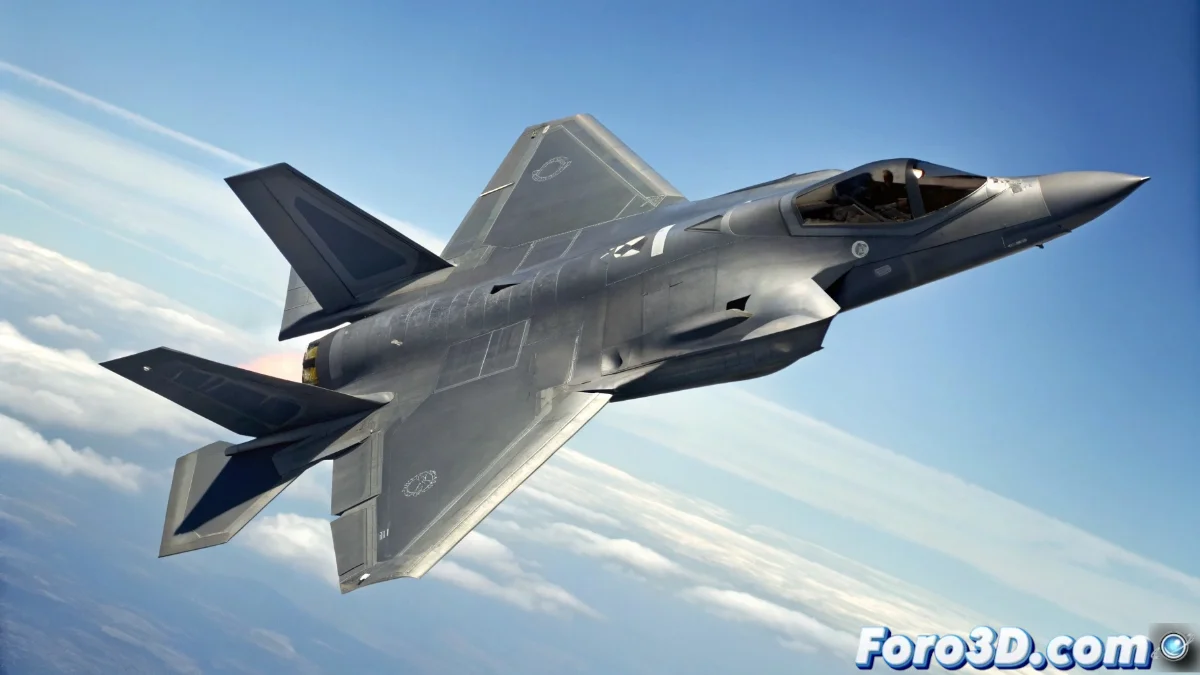
The F-35 Lightning II: Technical Analysis and 3D Modeling Guide
The F-35 Lightning II represents the forefront of modern military aviation, being a multirole fifth-generation fighter developed through an international program led by the United States. Its design prioritizes stealth technology and integrated combat capabilities that make it a versatile platform for multiple operational scenarios ✈️.
Fundamental Technical Characteristics
The main dimensions of the F-35 include 15.67 meters in length, 10.7 meters in wingspan, and 4.38 meters in height, with a carefully profiled fuselage that minimizes its radar signature. The design features a single thrust nozzle configuration and is available in three main versions adapted to different operational requirements.
Main F-35 Variants:- Version B: STOVL capability for short takeoff and vertical landing, ideal for operations from improvised bases
- Version C: Specifically designed for naval operations on aircraft carriers with larger wings and reinforced structure
- Version A: Standard configuration for the Air Force with conventional takeoff and landing capabilities
The F-35 development program represents one of the most ambitious and costly military projects in history, with a budget that even taxpayers could feel when passing by.
Weapons Systems and Operational Capabilities
The integrated armament of the F-35 includes advanced systems such as the 25 mm GAU-22/A cannon, AIM-120 AMRAAM missiles for long-range air-to-air combat, and precision-guided bombs like the GBU-31 JDAM. The internal weapons bays maintain its stealth profile during missions requiring stealth, while external pylons allow for greater payload when the tactical situation permits.
Key Avionics Elements:- Integrated Sensors: Data fusion system that combines information from multiple sources
- Advanced Avionics: Electronic warfare capabilities and defensive countermeasures
- Secure Communications: Data links for networked operations with other platforms
Essential Considerations for 3D Modeling
To achieve an accurate 3D model of the F-35, it is crucial to capture the smooth curvatures of its fuselage and the composite surfaces that define its stealth geometry. Differences between variants affect elements such as the landing gear, wing structure, and propulsion systems, particularly in the STOVL version with its complex vertical lift mechanism. Details of the air intakes, panoramic vision canopy, and composite material textures are determinant for achieving visual authenticity in the final model 🎨.