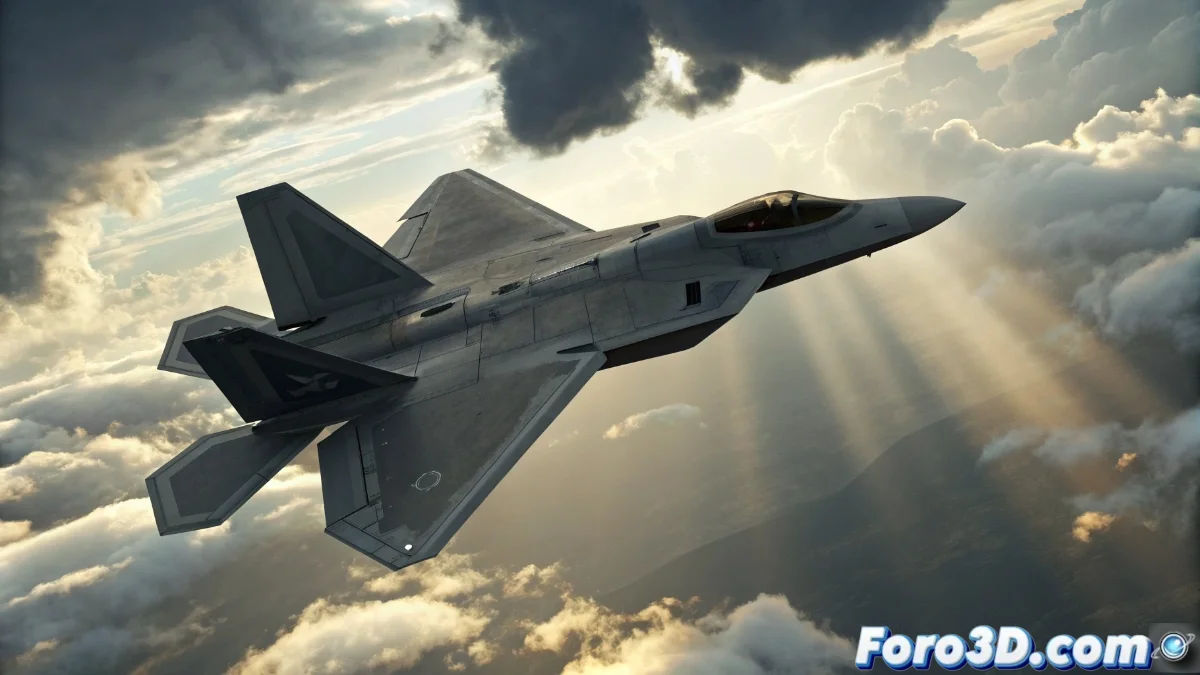
The F-22 Raptor: Technical Analysis and 3D Modeling Tips
The F-22 Raptor represents the pinnacle of contemporary military aviation technology, embodying the standard of a fifth-generation air superiority fighter. Its fundamental dimensions - 18.9 meters in length, 13.56 meters in wingspan, and 5.08 meters in height - have been meticulously calculated to maximize both its stealth capabilities and its extraordinary combat agility 🛩️.
Advanced Technical Features
This formidable aircraft incorporates revolutionary engineering solutions, including a latest-generation stealth design to drastically reduce its radar signature, two-dimensional thrust vectoring nozzles that enable maneuvers impossible for other fighters, and internal weapon compartments that preserve its optimized aerodynamic profile. Each structural element responds to specific operational requirements that balance discretion, power, and tactical versatility.
Weapons Systems Configuration:- 20 mm M61A2 cannon located in the right wing for close combat
- Six AIM-120 AMRAAM missiles housed in the main compartment for medium- and long-range engagements
- Two AIM-9 Sidewinder missiles positioned in specialized side bays for short-range combat
The internal arrangement of the armament allows the Raptor to maintain its minimal radar signature while carrying lethal capacity for multiple combat scenarios.
Essential Considerations for 3D Modeling
When tackling the creation of a 3D model of the F-22, it is essential to accurately capture the compound angles of the fuselage specifically designed to disperse electromagnetic energy, the complex thrust vectoring nozzles with their moving components, and the weapon bay door opening mechanisms. Surface details such as panel joints, integrated antennas, and radar-absorbent material treatments demand meticulous attention during the modeling process.
Critical Elements for Faithful Representation:- Trapezoidal wing geometry and stabilizers with their exact characteristic angles
- 2D vector nozzle systems with all their moving components
- Weapon bay doors and their opening/closing mechanisms
Frequently Underestimated Details
A particularly challenging aspect when modeling this aircraft is that its stealth capabilities are so advanced that, ironically, even the digital representation can seem to "disappear" from the viewport at unexpected moments during the creation process. This phenomenon graphically illustrates the effectiveness of the original design and serves as a reminder of the technological complexity we are attempting to capture digitally ✨.