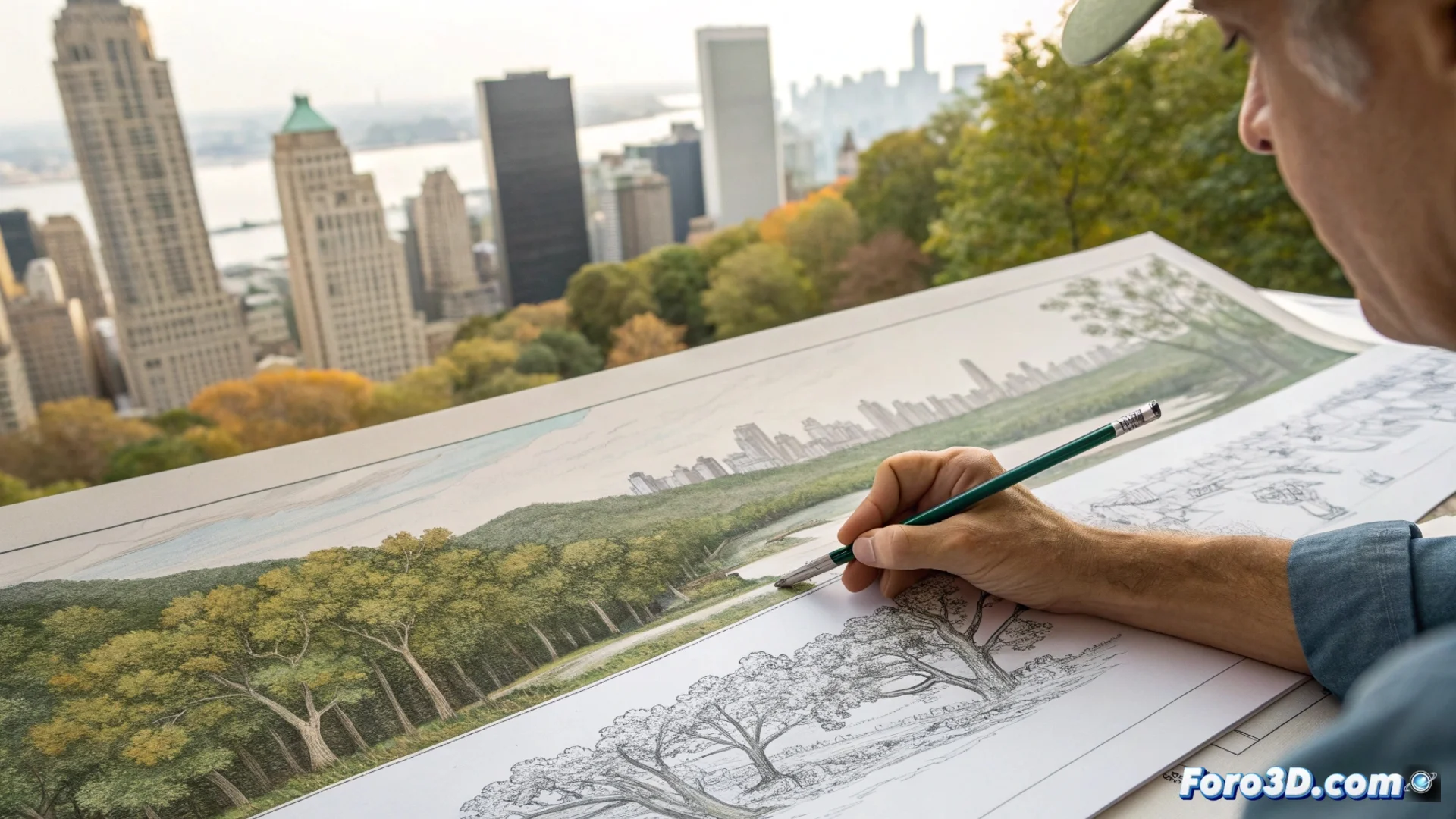
The Extreme Format Technique Challenges Standard Composition
This creative proposal invites drawing on supports that break with the traditional rectangle. By adopting a panoramic strip, a circle, a triangle, or a set of linked vignettes, the artist submits to an active canvas that determines the course of the graphic story. The support ceases to be a mere container and becomes a participant that defines how the work is interpreted. 🎨
The Format Establishes the Rhythm and Directs the Gaze
A panoramic strip with a 1:5 ratio imposes a horizontal visual path, perfect for narrating a journey or a sequence in time. A circle focuses attention on its center, evoking cycles, confinement, or gazes. A triangle leads the view toward its vertex, creating tension or establishing a clear hierarchy. A polyptych, or series of connected panels, enables fragmenting and then assembling a narrative, giving the author control over when and how information is discovered.
The effect of each format on the narrative:- Panoramic strip: Forces a linear scan, ideal for showing progression or movement.
- Circle: Its nature without beginning or end suggests repetition, introspection, or contained elements.
- Triangle: Its geometry directs attention to a point, generating dynamism or highlighting a main element.
- Polyptych: Allows decomposing a scene into moments, controlling the reading order and narrative rhythm.
The format limitation is not an obstacle, but the engine that suggests compositional solutions that a standard rectangle would never propose.
Applying the Method in Practice
To begin, select a format that dialogues with the concept to be captured. The initial sketch must consider how unusual edges affect balance and the focal point. In an elongated strip, repetition or transformation of motifs can be experimented with. In a circle, radial or concentric compositions are usually the most effective. The essence lies in accepting the restriction and letting the shape of the support inspire creative decisions.
Steps to experiment:- Choose an unconventional format (panoramic, circular, triangular, fragmented).
- Sketch taking into account how unusual edges redefine balance and points of interest.
- Test the visual flow that the support imposes naturally.
- Embrace the restriction as a guide, not as a limitation.
The Final Creative Challenge
The true moment of revelation arises when, working on a polyptych, you realize you have built a narrative sequence similar to a comic, but with a more abstract visual language and less dependent on text or speech bubbles. This technique challenges habits and expands the possibilities of storytelling through images. ✏️