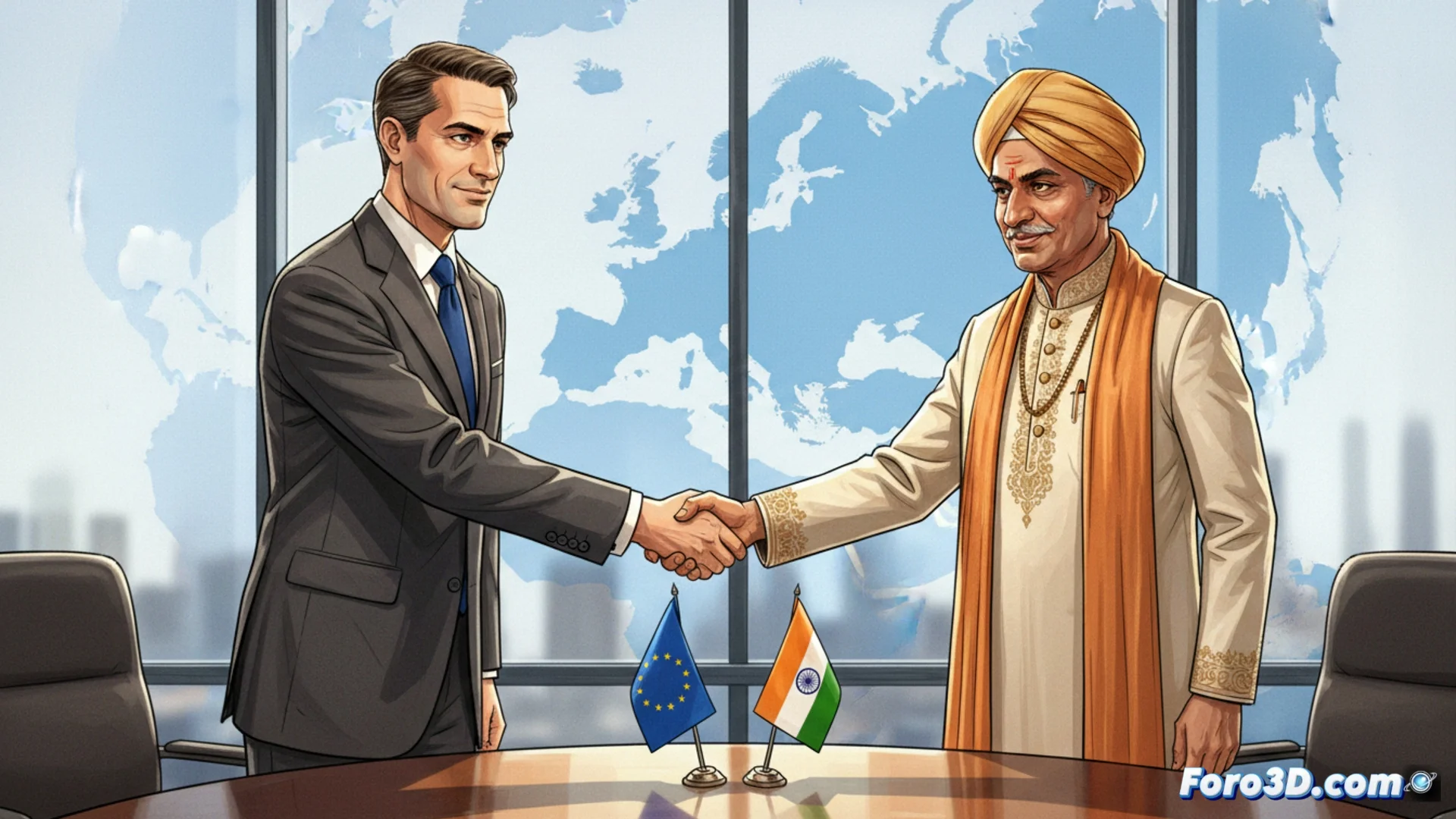
The European Union and India Advance on a Trade and Defense Pact
The European Union and India are giving a new boost to their talks to close a free trade agreement and strengthen their collaboration on security matters. This rapprochement is seen as an effort to build an axis of cooperation that serves as a counterweight to the traditional influence of other powers on the world stage 🌍.
A Trade Treaty with Clear Objectives
The negotiations for the free trade treaty, which had been stalled for a long period, have regained significant momentum. The main objective is to eliminate tariff barriers and streamline investment flows, which would allow balancing the economic relationship between both blocs.
Key Economic Interests:- For the EU, this pact is a way to diversify its supply chains and penetrate a market of enormous dimensions.
- India seeks to attract European capital and technology to modernize its industrial base, create jobs, and strengthen its position as a global manufacturing hub.
- The context of protectionist policies and the change in the US administration motivate Brussels and New Delhi to seek more autonomous paths of collaboration.
If you can't beat the rival, negotiate with its competitor.
Collaboration on Security and Political Realism
In parallel to the trade front, both powers are increasing their defense cooperation. This includes conducting joint naval exercises and maintaining dialogues to facilitate the transfer of military technology. This alliance reflects a shared geopolitical pragmatism in the face of a volatile international landscape ⚓.
Aspects of the Strategic Partnership:- Security cooperation is based on concrete defense interests and regional stability.
- Europe is closely watching India's internal political evolution, as certain aspects could generate frictions in a partnership that also aims to be based on shared values.
- The rapprochement is grounded more in tangible mutual benefits than in a complete ideological affinity.
An Axis Under Construction
This joint diplomatic push between the EU and India ultimately seeks to weave an alternative in the global order. While some powers talk about decoupling economies, Brussels and New Delhi opt for a strategy of practical convergence, prioritizing agreements that benefit their economic growth and strategic profile in a multipolar world 🧩.