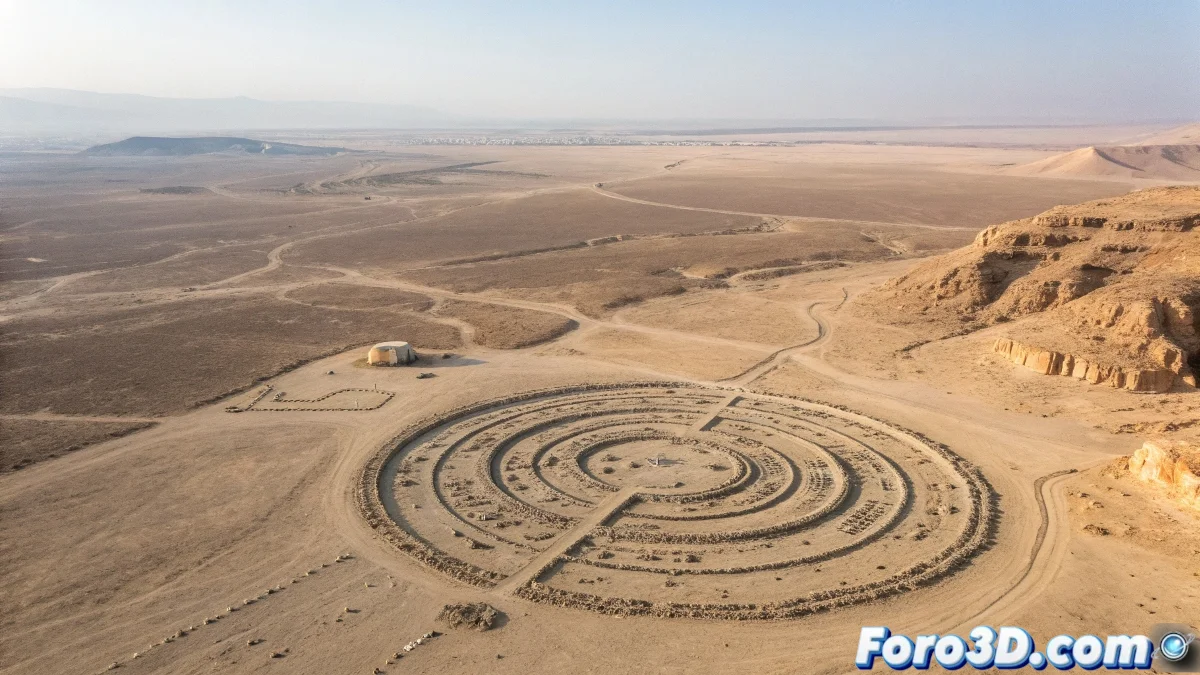
A Mystery Etched into the Desert Land
In the vast expanses of the Jordanian desert lies a millennial secret that can only be appreciated from the sky. 🏜️ It is an imposing circular geoglyph, colloquially known as one of the "Middle Eastern Wheels," with an estimated age of over 2,000 years. With a diameter of approximately 70 meters, this structure of stones arranged in an intricate radial pattern has challenged the understanding of archaeologists and historians for decades, raising questions about the nomadic civilizations that once inhabited the region.
Astronomical Calendar or Ceremonial Site?
The exact purpose of this stone wheel remains an enigma. The most accepted theory suggests it may have functioned as an astronomical marker. 🌞 Some of its spokes appear to align with the sunrise and sunset during solstices and equinoxes, indicating it was used by ancient peoples to track the cycle of seasons, crucial for survival in such a hostile environment. Another hypothesis points to a ritual or ceremonial use, possibly linked to fertility cults or rites of passage, where the circular shape would symbolize the cyclicity of life and nature.
These wheels are the Google Calendar of desert civilizations.
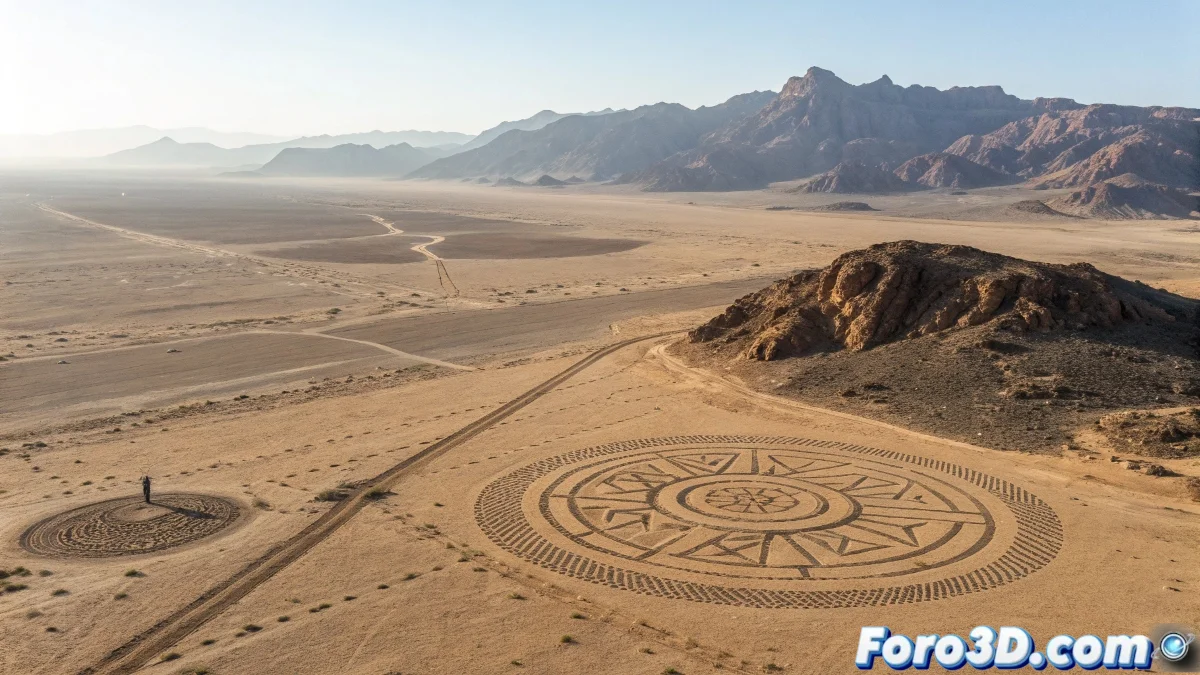
The Difficulty of Studying the Invisible
One of the great paradoxes of these geoglyphs is that they are practically invisible from ground level. Their enormous scale and location on flat terrain only allow their full design to be appreciated from an aerial perspective. 🚁 This has led to speculation about the sophistication of their creators, who must have possessed advanced knowledge of geometry and large-scale planning capabilities, despite lacking the flight technology that today allows us to admire their work.
- Construction technique: Simple stacking of dark basaltic stones on the light desert ground.
- Recurrent pattern: Similar structures have been found in other countries in the region.
- State of preservation: The arid climate has allowed for their exceptional preservation.
Recreating the Enigma in 3D
To visualize and study this geoglyph, tools like Autodesk Maya are invaluable. Using a NURBS circle as a base, the radial structure can be modeled with precision. 💡 The key to realism lies in applying displacement maps that simulate the granular texture of the sand and erosion on the stones. Setting up a directional light that simulates midday sun accentuates the shadows of the spokes, replicating the effect seen in satellite aerial photographs and helping to analyze their possible alignments.
It is fascinating that a structure as simple as a circle of stones can contain such a profound mystery. 😉 Perhaps the answer lies not in what it represents, but in the simple human act of wanting to leave a lasting mark on the landscape.