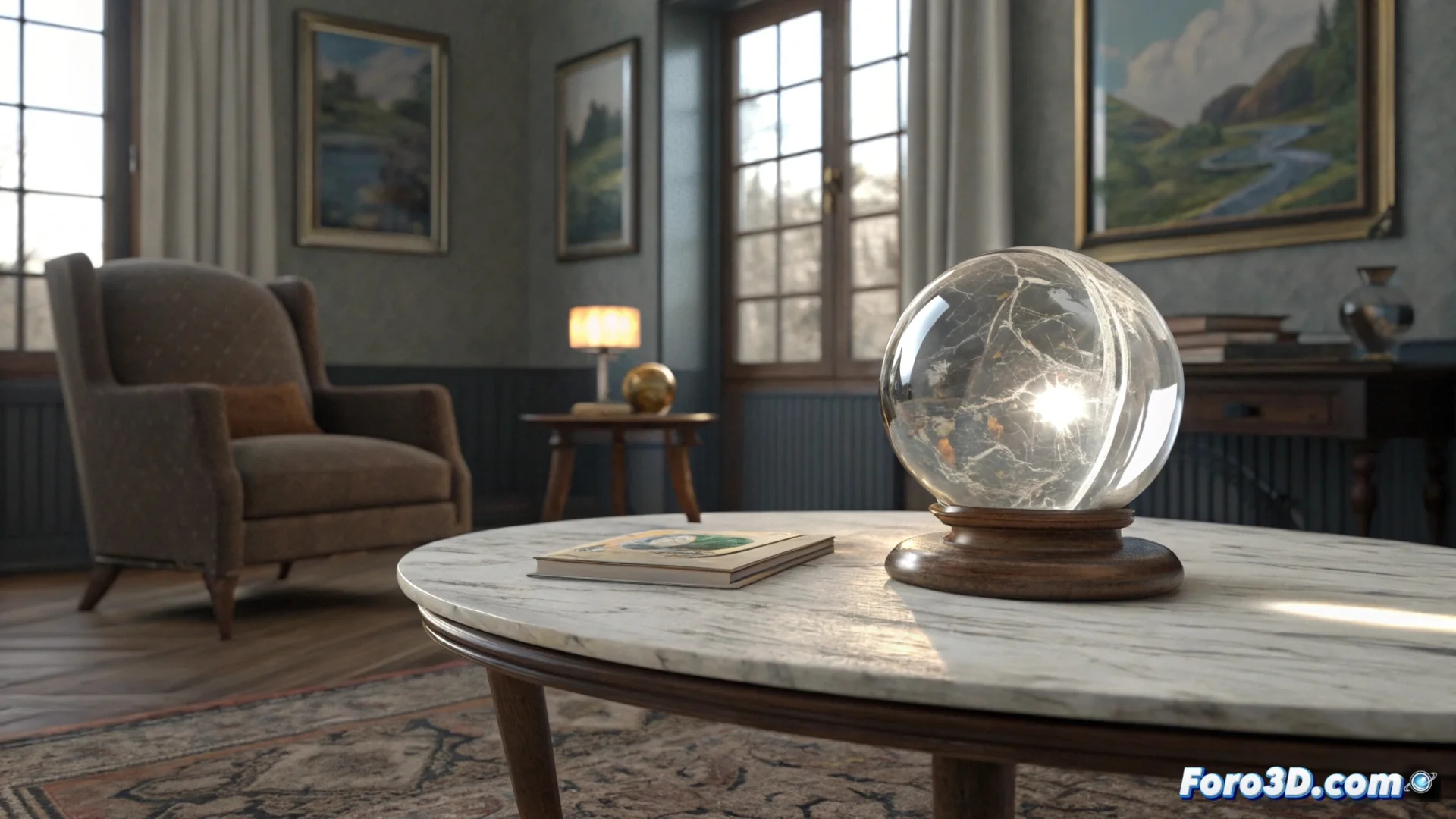
Das Element Implements Photon Mapping for Rendering
The 3D rendering engine Das Element stands out for using Photon Mapping, an advanced technique that physically accurately simulates how light behaves in a scene. Unlike approximation methods, this algorithm tracks and stores millions of light particles, or photons, to calculate lighting. 🚀
How the Core of the Algorithm Works
The process is structured in two clear stages. First, the engine emits photons from each light source and follows their path as they bounce off surfaces. Each impact on a non-specular surface is recorded in a photon map. In the second stage, for the final rendering, the program consults this map to accurately estimate the amount of light reaching each visible point from the camera.
Lighting Effects That Can Be Achieved:- Caustics: Concentrated light patterns that form when light refracts or reflects on materials like glass or water.
- Global Indirect Lighting: Light that bounces off surfaces and tints other objects, creating more natural and cohesive environments.
- Soft and Diffuse Shadows with realistic transitions, thanks to the detailed sampling of stored photons.
Photon Mapping seeks a balance between physical realism and the time it takes to process the image.
Managing the Balance Between Quality and Performance
The main advantage of precalculating and storing photons is that the calculations can be reused. This significantly speeds up the rendering of animation sequences where the lighting remains constant. However, to ensure the final image shows no noise, it is necessary to generate and store a huge number of photons, which demands a lot of RAM memory and computing power.
Das Element Optimizes This Process in Several Ways:- Efficiently manages memory to store photon maps.
- Distributes computation to make the most of system resources.
- Offers controls to adjust the number of photons, allowing a balance to be found between rendering time and visual quality.
The Price of Physical Realism
Although it simulates particles traveling at the speed of light, the Photon Mapping process can considerably extend rendering time. Das Element focuses on managing these resources to deliver a clean and detailed final result, even when the computation requires patience. The wait, ironically, is the tribute for achieving a level of realism in light that other methods cannot match. ⏳