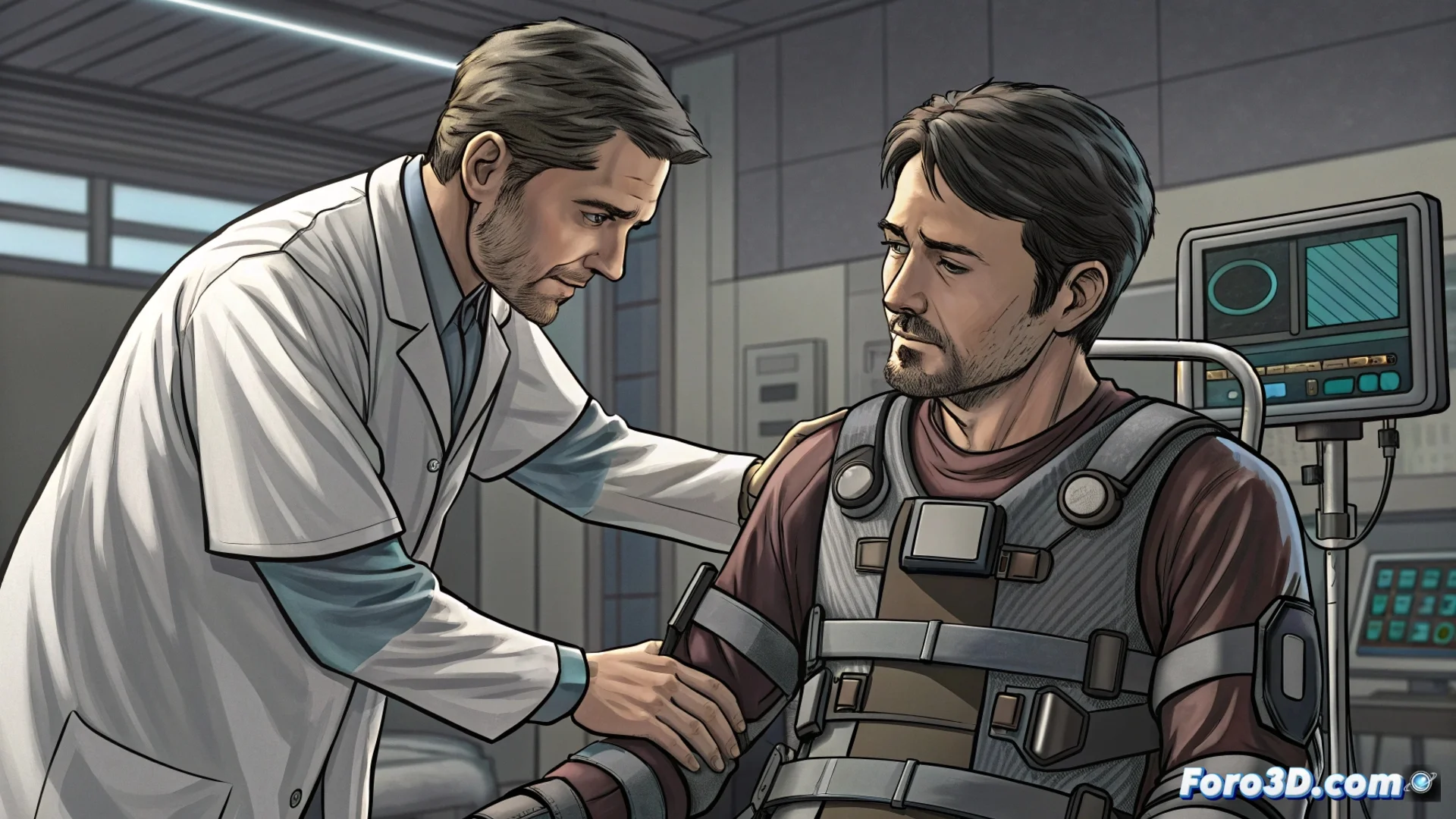
The EksoUE Exoskeleton for Upper Limb Rehabilitation
The company Ekso Bionics has developed the EksoUE, a portable robotic device specifically designed to rehabilitate the arm. This system is aimed at people who need to recover motor function after suffering a stroke, a spinal cord injury, or a traumatic brain injury. Its purpose is to make therapy more precise and quantifiable 🤖.
Robotic Assistance for Therapeutic Movements
The device attaches to the upper limb, covering the shoulder, elbow, and wrist joints. Its main function is to guide the user's arm through a series of repetitive and specific movements, allowing practice and relearning of essential motor patterns that have been lost or damaged. While the patient performs these exercises, the system collects data automatically.
Exoskeleton Operating Modes:- Passive Mode: The robot completely moves the patient's arm, ideal for initial phases with little residual strength.
- Active-Assisted Mode: The device detects the user's movement attempt and provides the necessary assistance to complete it.
- Active Mode: The patient performs the movement against adjustable resistance, strengthening the musculature.
The integration of robotic hardware and analysis software aims to make rehabilitation more consistent, measurable, and potentially more intensive.
Quantifiable Information to Personalize Therapy
One of the pillars of the EksoUE is its ability to transform progress into metrics. It objectively records parameters such as joint range of motion, applied force, and the regularity with which the patient follows the program. This contrasts with traditional methods, where evaluating improvement may depend more on the therapist's subjective perception.
Advantages of Using Objective Data:- Allows clinicians to adjust rehabilitation programs with greater precision and based on concrete evidence.
- Provides the patient and therapist with a clear and measurable view of progress, which can increase motivation.
- Aims to optimize the path to maximum functionality and independence in daily activities.
A Complementary Tool in the Clinic
The EksoUE does not intend to replace the therapist, but to act as a powerful complementary tool within the clinical environment. Professionals use a software interface to configure therapy sessions and monitor results in real time. The ultimate goal is that, through this guided, repetitive, and measured practice, patients can regain a greater degree of autonomy. Robotic technology thus becomes an ally for improving outcomes in neurorehabilitation 💪.