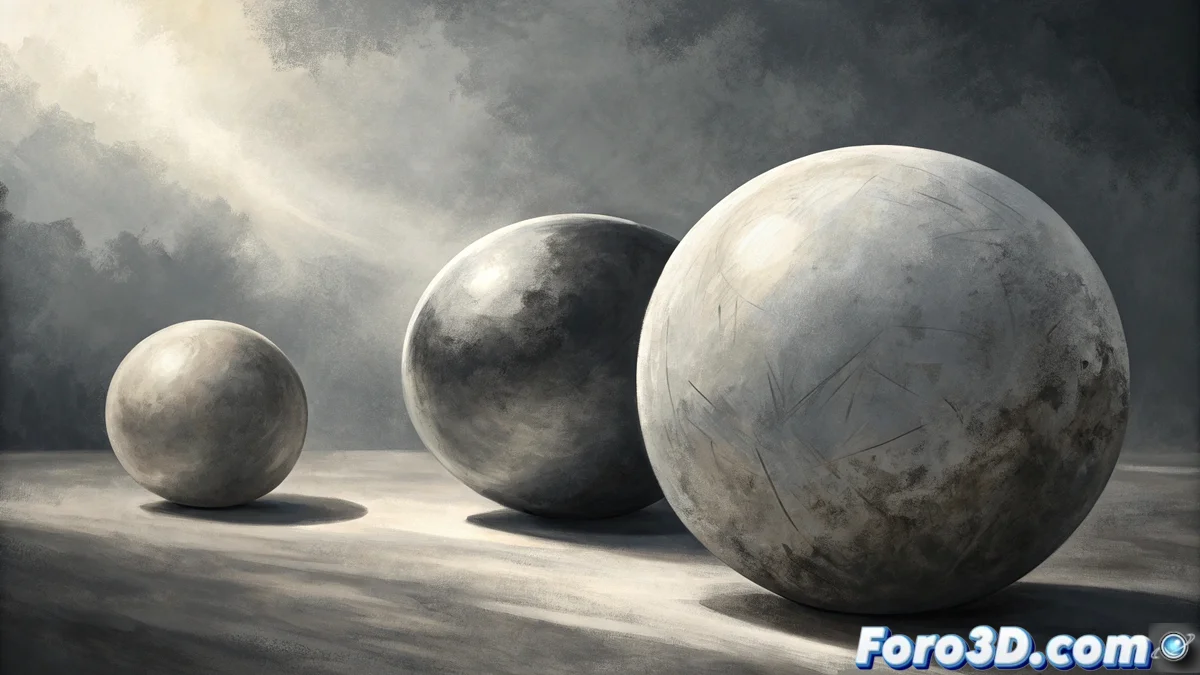
The Edge Technique in Visual Creation
The edge technique constitutes an essential pillar for generating impactful images, where the creator deliberately modulates transitions between shapes and tonal values to weave a cohesive visual narrative. This method acts as an invisible director, synchronizing how we interpret depth, focus, and atmosphere within any scene. By adjusting the definition of these boundaries, we make certain components stand out toward the viewer while others recede into the environment, establishing an intuitive visual hierarchy that guides the gaze through the represented space 🎨.
Classification and Properties of Edges
There are three main varieties of edges that every visual artist must identify and apply strategically. Hard edges arise where two surfaces meet with marked contrast, defining precise outlines and instantly capturing the viewer's attention. Soft edges feature progressive transitions that suggest delicate curvatures or mid-distances, perfect for representing organic materials. Lost edges occur when an element optically merges with its context, often used in shadow areas or nebulous backgrounds, providing a sense of air and depth between different planes.
Distinctive characteristics of each type:- Hard edges: Abrupt transitions that define sharp silhouettes and emphasize protagonist elements
- Soft edges: Subtle gradients that suggest rounded volumes and intermediate distances
- Lost edges: Imperceptible fusion with the environment, ideal for creating atmospheric and distance effects
Conscious handling of edges transforms flat compositions into three-dimensional experiences, allowing the artist to highlight key components through defined contours and subordinate secondary areas with diffuse boundaries.
Practical Applications in Visual Projects
Mastery of this technique revolutionizes two-dimensional works by endowing them with palpable three-dimensionality, where the creator chooses what deserves protagonism through crisp edges and which sectors will function as support with blurred boundaries. In portraits, sharp edges on the eyes contrast with soft transitions in the hair to direct attention. In natural scenes, evaporated edges on distant hills replicate aerial perspective. This intentional manipulation not only generates volume, but also conveys emotional states, from the luminous transparency of dawn to the enigmatic darkness of dusk.
Examples of effective implementation:- Portraits: Combine defined edges on facial features with soft transitions in hair and clothing
- Landscapes: Use lost edges on distant elements to simulate mist and distance effects
- Atmospheric scenes: Apply blurred edges in backgrounds to reinforce sensations of humidity or dimness
Common Mistakes and Solutions
The critical challenge arises when trying to explain why a character seems to float artificially over its environment, revealing that hard edges have been used where lost edges were needed, degrading a potentially masterful work to a simple cut-out silhouette. This mismatch breaks the spatial coherence and distorts the viewer's immersion, underscoring the need for conscious selection of each edge type according to its narrative function and position in the visual space 🔍.