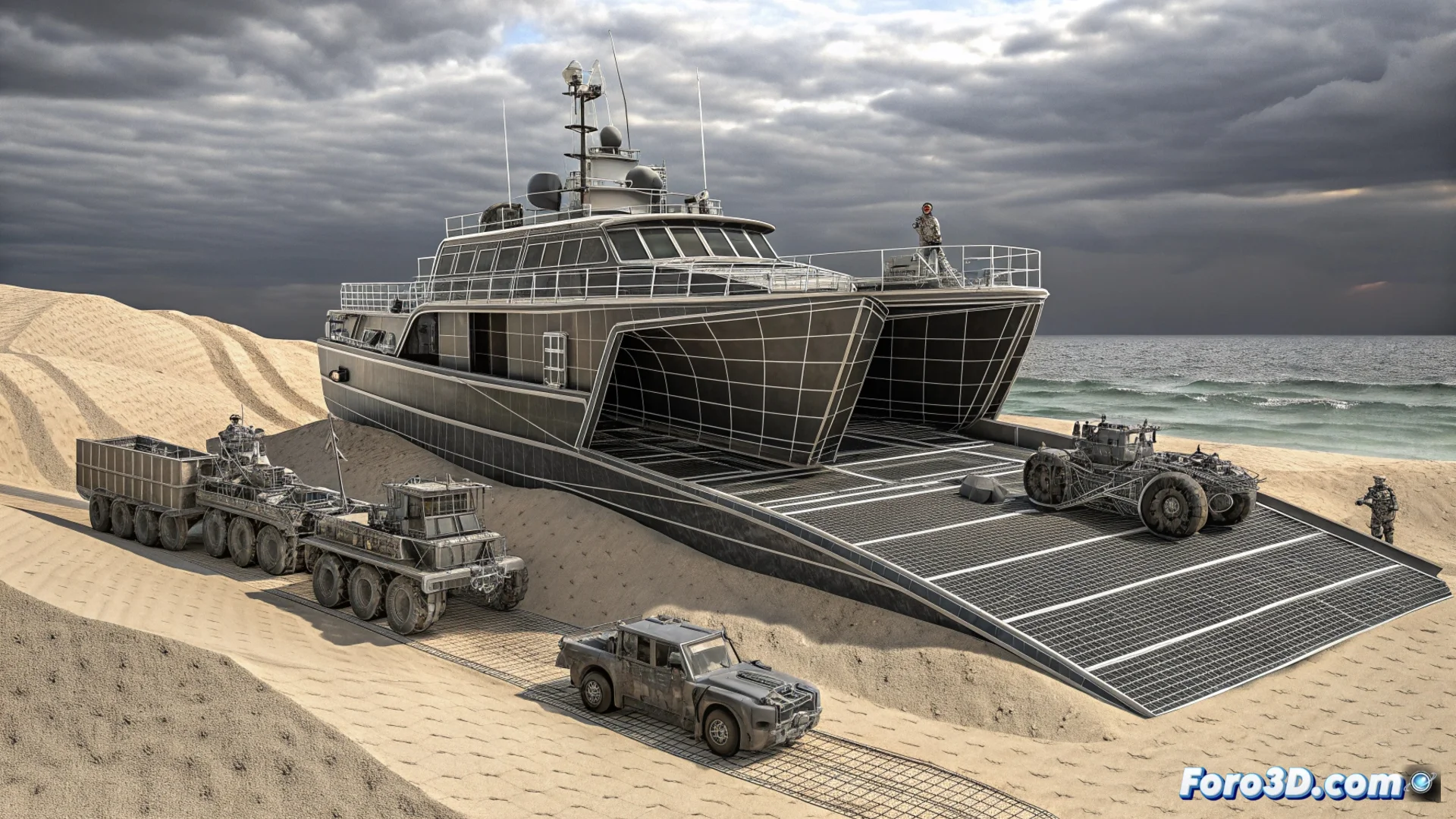
The EDA-R L-CAT: French Navy's Fast Landing Craft
The EDA-R, also designated as L-CAT, is a key military vessel for amphibious operations. This high-speed catamaran serves the French Navy to create a direct logistical link between assault ships and the shoreline. Its twin-hull design prioritizes stability and the capacity to transport heavy cargo in complex sea conditions. 🚤
Design and Transport Capabilities
With dimensions of 30 meters in length and 12.8 meters in beam, the EDA-R has significant cargo volume. It can accommodate light armored vehicles, logistical containers, or a complete marine infantry detachment. Its main function is to shorten the time it takes to move material and personnel from a mother ship to a beach, acting as an efficient maritime bridge.
Main design features:- Catamaran configuration: The two parallel hulls provide great stability at sea and a wide, stable loading platform.
- High payload capacity: Its main deck is designed to support the weight and dimensions of essential military equipment.
- High operational speed: It is designed to be fast, reducing its vulnerability during approach and withdrawal phases.
The versatility of the hydraulic platform transforms the vessel from a sea catamaran to a beaching barge in minutes.
The Transformative Hydraulic Platform
The most ingenious element of the EDA-R is its central loading platform. This system is powered hydraulically and has two clear operating modes. During navigation in deep waters, the platform is raised, configuring the vessel as a traditional catamaran with optimal hydrodynamic performance. When approaching the shore, the platform lowers, creating a flat bottom that allows the craft to beach directly on the beach for unloading.
Advantages of the platform system:- Quick transition: Switches from navigation mode to landing mode smoothly and quickly.
- Optimizes performance: Improves speed and handling in open sea by reducing drag.
- Facilitates unloading: Allows direct loading and unloading operations on land