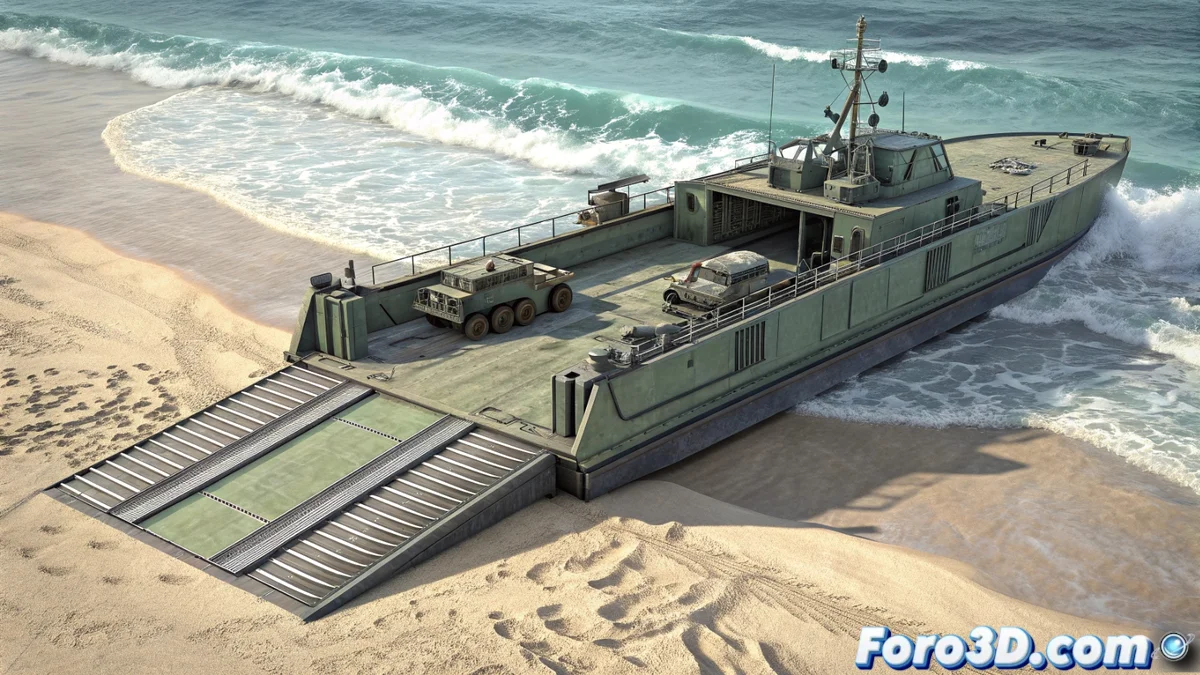
Modeling the EDA-R L-CAT Fast Landing Craft
The EDA-R L-CAT is a French military vessel with a catamaran design. Its most distinctive feature is a central loading platform that moves with a hydraulic system, allowing it to change shape to optimize speed or beach landing capacity. It represents a fascinating technical challenge for any 3D artist 🚤.
Geometry and Main Mechanism
To model this vehicle accurately, you must focus on its dual architecture. The vessel measures 30 meters in length and 12.8 meters in beam. It consists of two slender hulls and a superstructure that houses the cabin and machinery. The key element is the movable central platform.
Operating modes to represent:- Navigation mode: The platform rises between the hulls, reducing water resistance and allowing high speed.
- Landing mode: The platform lowers to the waterline level, creating a flat bottom that can approach the shore and beach.
- Hydraulic mechanism: It is crucial to model the pistons and anchor points in detail that enable this transformative movement.
The challenge is not only the shape, but animating the transition between a fast catamaran and a landing barge.
Structural Details and Finishing
Once the main geometry is resolved, it's time to add the components that give realism to the model. The superstructure houses the bridge and propulsion systems. On the wings of this bridge are the points for defensive armament.
Key elements to detail:- Armament: Two mounts designed to carry 12.7 mm heavy machine guns.
- Operational equipment: Access gangways, safety railings, mooring points, and navigation lights.
- Texturing: Apply a standard naval gray paint scheme, including operational wear, friction marks, and signage.
A Project with Personality
Modeling the EDA-R L-CAT goes beyond replicating a vehicle; it's about capturing its dual function. You can invest a lot of time in the complex hydraulic details, only for the model to be used in a final scene for a mundane activity, adding an ironic layer of narrative. This contrast between precise military engineering and its potentially mundane use is what makes the project a unique piece for any 3D modeling portfolio ⚙️.