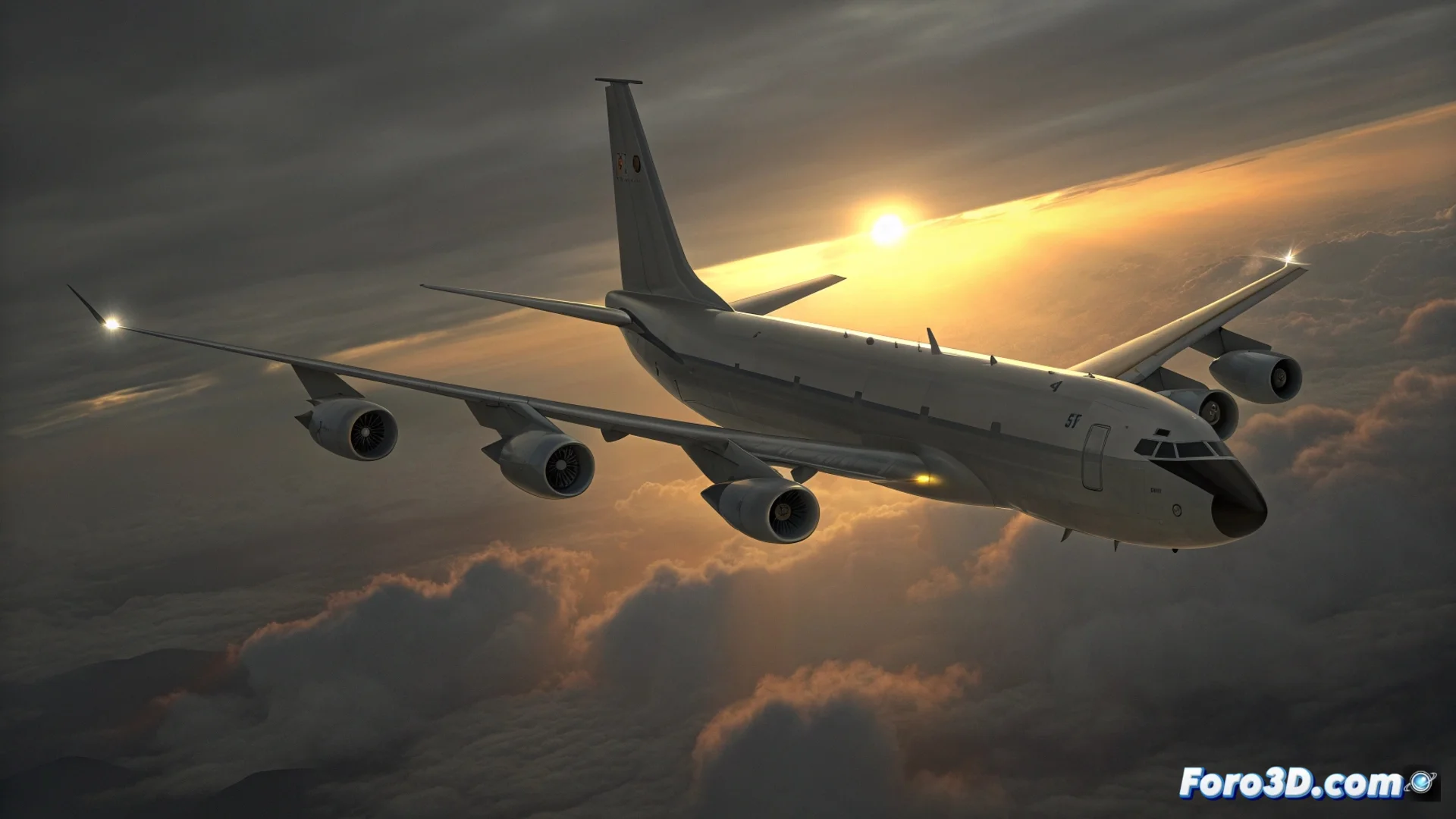
The E-6 Mercury, the US Navy's Flying Command Post
In the realm of strategic deterrence, certain assets operate from the shadows. The E-6 Mercury is one of them. This aircraft, which functions as an air communications and control center, ensures that the US politico-military command can direct its nuclear submarine forces in any circumstance. Its existence is a pillar of the continuous deterrence concept. 🛩️
The Critical Mission of the TACAMO Program
The raison d'être of the E-6 Mercury is summarized in the acronym TACAMO (Take Charge And Move Out). This program defines its fundamental task: to establish and maintain an indestructible communications link with the ballistic missile submarine (SSBN) fleet. Unlike other aircraft, the Mercury carries no armament. Its power lies in its ability to transmit vital orders in scenarios where other systems might fail, acting as a last-resort communications repeater.
Key Operational Features:- Exclusive Function: Ensure command and control link with strategic submarines.
- Program: Operates under the TACAMO doctrine, essential for the nuclear triad.
- Configuration: Lacks armament; all its space is dedicated to communication systems and mission crew accommodations.
“Take Charge And Move Out” – The operational philosophy that turns a commercial aircraft into a strategic command node.
A Proven Design with a Crucial Modification
To achieve the necessary reliability and autonomy, the US Navy chose a known platform. The E-6 derives directly from the Boeing 707 fuselage. This base gives it transoceanic range and the ability to remain airborne during prolonged missions. Its dimensions are imposing: 46.6 meters long and 45.1 meters wingspan. The most visible modification is a large dorsal bulge, a “hump” that houses antennas and specialized communications equipment.
Details of its Architecture:- Platform: Based on the Boeing 707, leveraging its proven efficiency and internal space.
- Autonomy: Designed for very long-duration flights, crucial for alert patrols.
- Distinctive Feature: The antenna hump on the upper fuselage, which houses sensitive systems.
The Communications System that Penetrates the Depths
The most unique technology of the E-6 Mercury is its very low frequency (VLF) communications system. To employ it, the aircraft deploys two kilometer-long cables in flight from the tail and fuselage. These trailing wire antennas generate VLF signals that can penetrate the ocean surface and reach submarines operating at great depths, where conventional radio waves are not viable. Inside, the crew processes and sends messages from a console configured as a flying command center.
Externally, it may look like an ordinary airliner. However, in its cabin, one of the planet's most critical and secret communication links is managed. Every takeoff, even if it's a routine mission, represents an exercise of high responsibility perfectly camouflaged under an innocuous appearance. This aircraft ensures that command and control is never lost, maintaining an open channel even in the most extreme conditions. 🔗