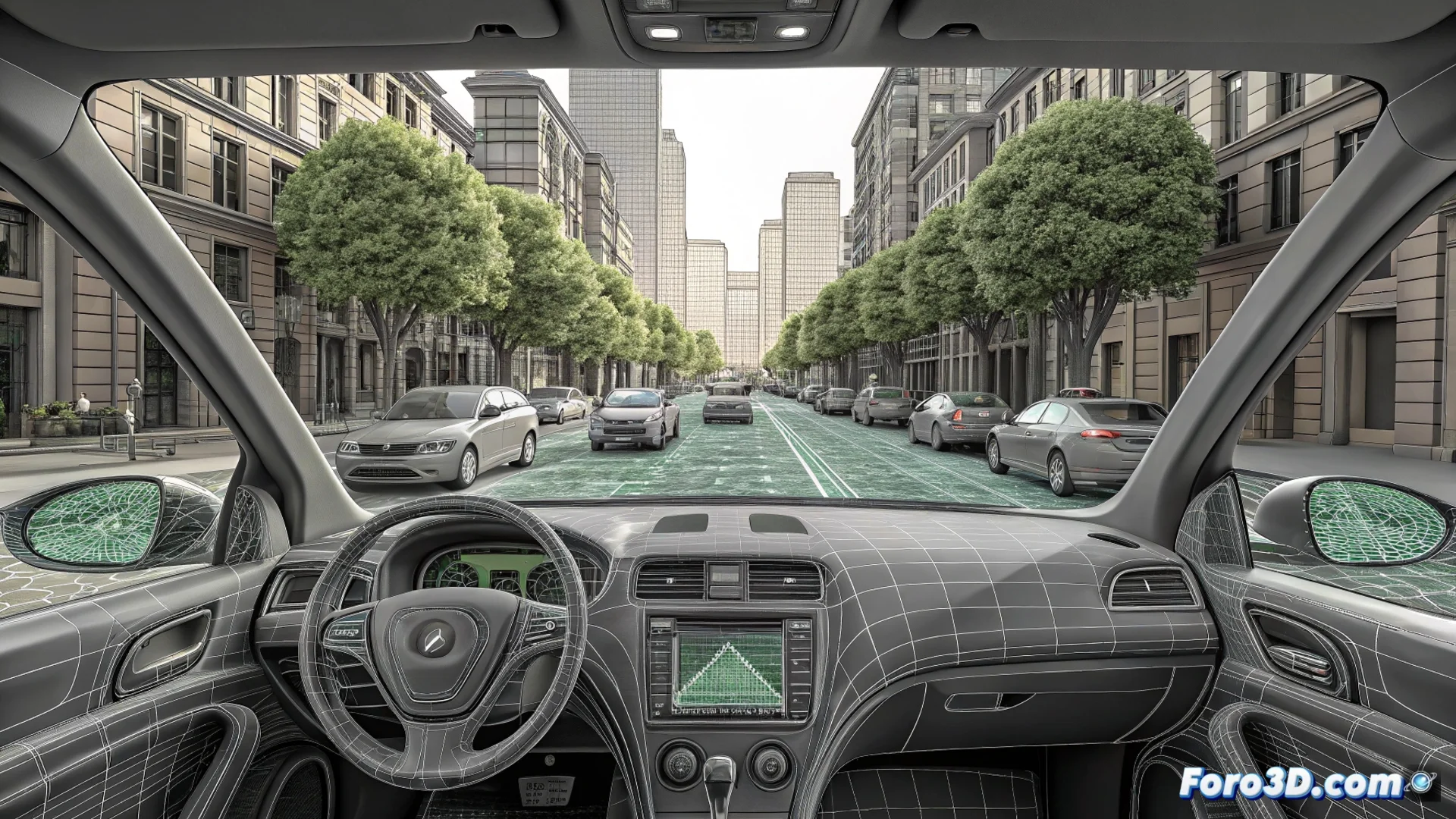
The DVGT Model Reconstructs Dense 3D Maps for Autonomous Driving
The Driving Visual Geometry Transformer (DVGT) represents an advance in perception for autonomous vehicles. This model creates dense 3D maps of the environment directly from camera image sequences, dispensing with the need for precise camera calibration or the use of expensive external sensors like LiDAR. Its pure vision-based approach simplifies the perception pipeline 🚗.
Attention Mechanisms to Infer Geometry
The transformer architecture in DVGT processes visual information through three specialized attention mechanisms that work together. This strategy allows it to adapt to different camera configurations and dynamic scenarios, producing precise metric geometry.
The three pillars of attention in DVGT:- Intra-view attention: Analyzes and captures details and relationships within a single individual image.
- Inter-view attention (spatial): Correlates equivalent points between images taken from slightly different angles, fundamental for triangulating and calculating depth.
- Inter-frame attention (temporal): Tracks the movement of points across a video sequence, which consolidates the reconstruction and provides temporal coherence to the 3D map.
The combination of spatial and temporal attention is key for the model to understand the 3D structure of the world in real time without relying on specialized hardware.
Results that Surpass Established Benchmarks
In experimental evaluations, DVGT outperforms previous 3D reconstruction models on multiple public driving scene datasets. Its robustness in varied conditions demonstrates the potential of vision-only perception systems.
Advantages demonstrated by the model:- Generates dense and coherent 3D maps without exact external camera calibration.
- Handles different types of cameras and configurations flexibly.
- Produces metric geometry, essential for an autonomous vehicle to navigate safely.
A Step Toward Practical Autonomous Perception
DVGT's ability to reconstruct environments in 3D accurately and efficiently brings the technology closer to more accessible and reliable autonomous driving systems. This approach brings closer a future where the vehicle perceives its environment with a depth and understanding that, at times, could rival human perception in complex tasks 🧠.