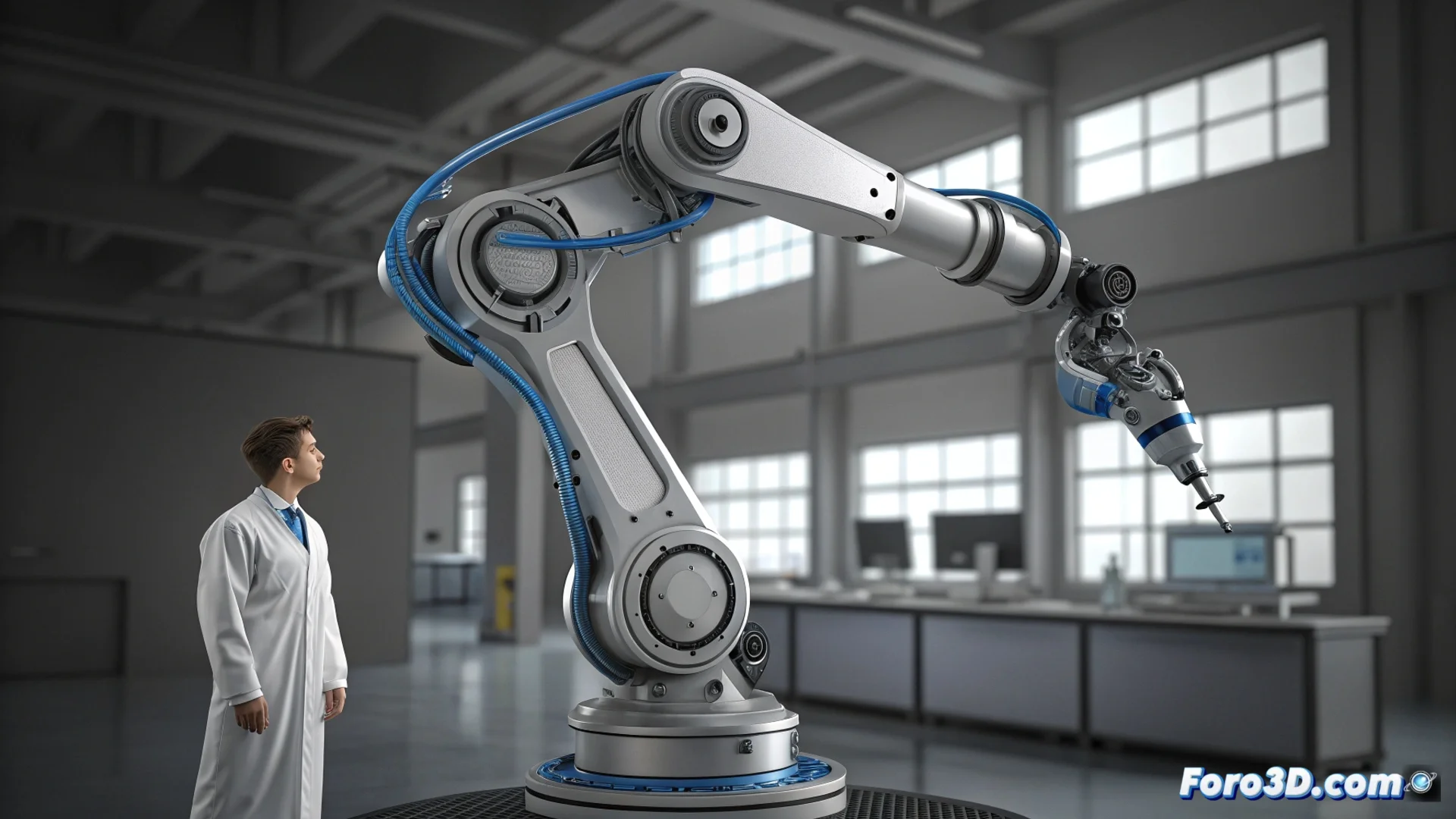
The DLR's BioRob Arm Robotic Arm is Ultralight and Safe
Engineers from the German Aerospace Center (DLR) have created the BioRob Arm, a robotic arm that redefines the parameters of lightness and safety. Its design focuses on operating alongside humans without risks, an essential field of collaborative robotics. 🤖
The secret lies in the elastic joints
To achieve safe movements, the system employs series elastic actuators (SEA). These components integrate a flexible element between the motor and the joint, allowing the force exerted by the arm to be measured and adjusted with great precision. This technology imitates the compliance or yielding of human muscles, making movements less rigid and more adaptable.
Key advantages of SEA actuators:- Allow precise force regulation in real time.
- Convert robotic movements into smooth and natural ones, reducing the risk in collisions.
- Are essential for the robot to perceive and interact with its physical environment.
The ultimate goal is to create robots that are not only powerful, but also sensitive and reactive to their environment.
Applications in shared work environments
This ability to control physical interaction opens new possibilities. The BioRob Arm is designed for spaces where humans and machines collaborate directly.
Potential areas of use:- Assisted assembly lines in the manufacturing industry.
- Assistance in research laboratories for handling delicate materials.
- Integration into mobile platforms or exoskeletons, where its minimal weight is a decisive advantage.
A future of direct collaboration
The DLR's development goes beyond creating a lightweight arm; it seeks to establish a new standard in how machines and people share a workspace. By prioritizing safety through controlled elasticity, it paves the way for robots that are true work companions, powerful but intrinsically safe. The future of human-robot collaboration is lightweight, strong, and sensitive. 🚀