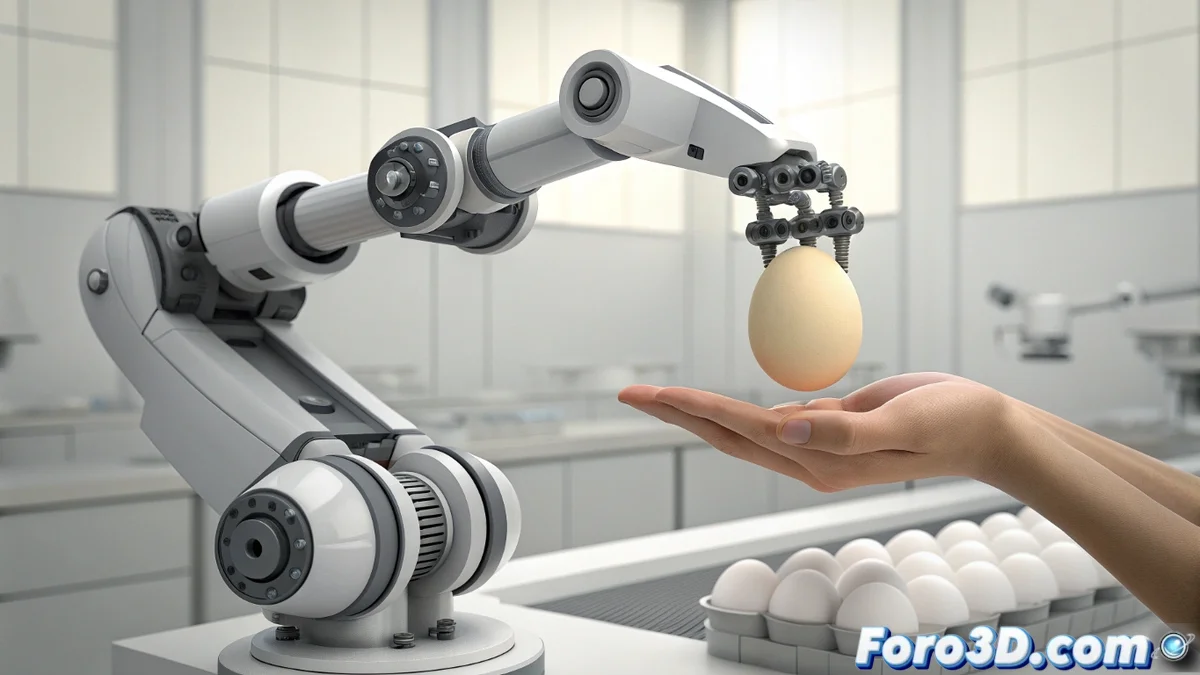
The DLR Robotic Arm Redefines Human-Machine Collaboration
The boundary between operators and automata blurs with technologies like the robotic arm created by the German Aerospace Center (DLR). This system is not just a tool, but a work companion designed to perceive the environment with almost human sensitivity. Its architecture prioritizes safe interaction and direct contact, eliminating the need for physical barriers in shared environments 🤖.
A Design That Senses and Reacts
The key to its safe operation lies in its hardware and software. Each joint integrates torque and elasticity sensors, allowing it to detect forces and unexpected contacts in real time. By combining lightweight materials with compact motors, its mass is reduced, and thus the kinetic energy in case of collision. This not only protects people but also gives it the delicacy needed to handle fragile objects or assemble complex components without damaging them.
Key Safety Features:- Joint Sensors: Detect forces and allow reaction by stopping or yielding to contact.
- Lightweight Architecture: Minimizes inertia and risks associated with impact.
- Reactive Control: Algorithms that process sensor data to make instantaneous safety decisions.
True collaboration between human and robot begins when the machine can perceive and adapt to the shared environment, not just blindly execute orders.
From the Factory to Outer Space
The applications of this robot are as versatile as its design. In industrial environments, it can collaborate on assembly lines, passing tools or performing repetitive operations that require high precision, freeing operators for more cognitive tasks. Its robustness and precision make it ideal for the aerospace sector, where it can maintain or assemble structures in remote or hard-to-reach places.
Main Areas of Application:- Industry 4.0: Collaborative assembly and internal logistics in factories.
- Space Exploration: Performing maintenance tasks on satellites or stations.
- Assistance Services: Potential use in medical rehabilitation or support for domestic tasks.
The Future of Collaboration
This DLR development is not just a technical advance; it is a paradigm shift. It demonstrates that robots can leave their safety cages to integrate seamlessly into human spaces. Its dexterity, which imitates fine motor skills, and its ability to perceive, make it a valuable asset rather than a mere mechanical arm. As a final reflection, while an operator observes its unfailing calm and values its tireless precision—a quality that, although it doesn't include bringing coffee—redefines productivity and safety in the workplace 👨🔧.