The Digital Wailing Wall: Sanctuary of Lost Data
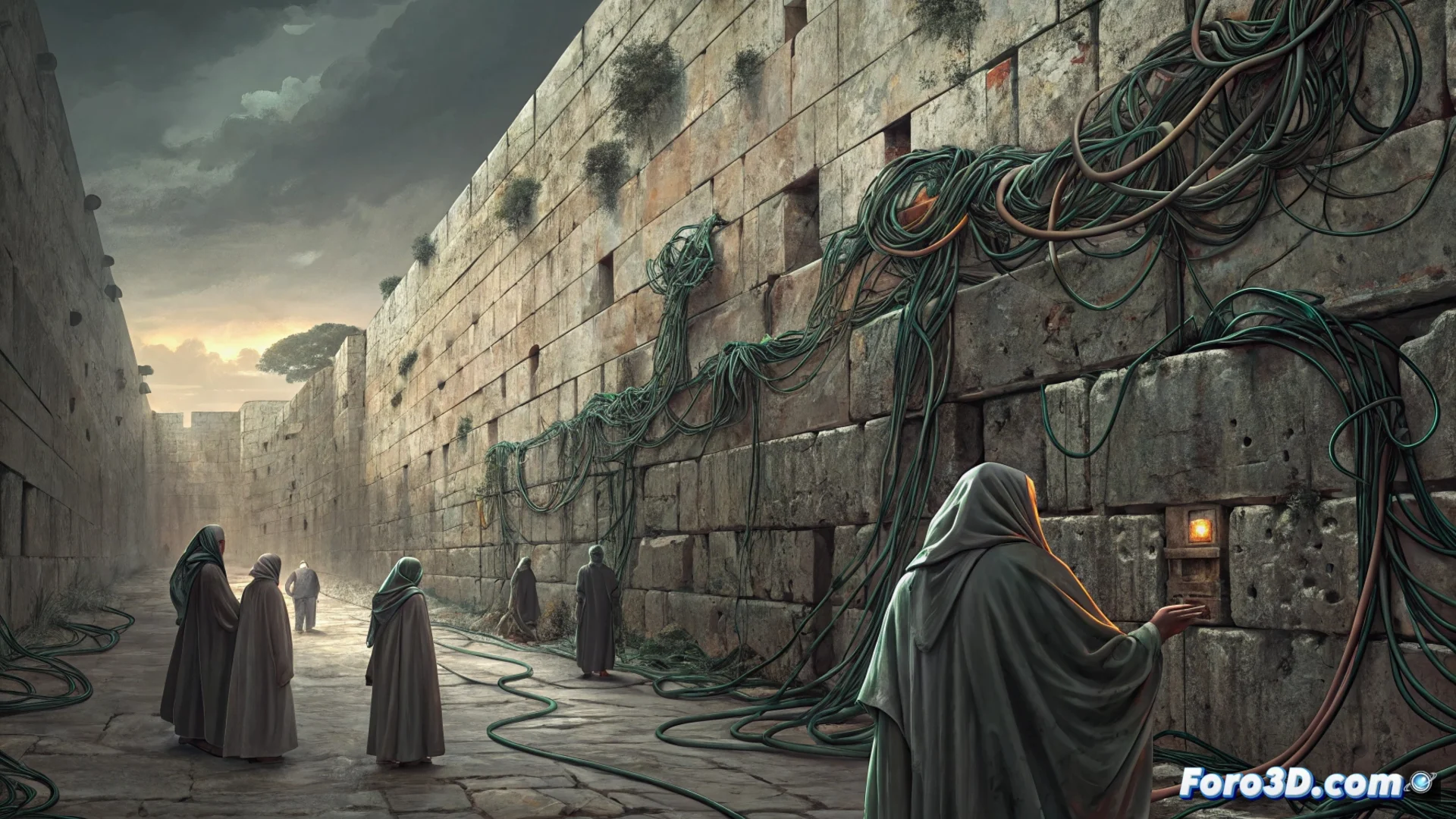
In a future and dystopian Jerusalem, the sacred function of the Wailing Wall changed radically. Its physical surface no longer accumulates paper prayers, but is covered by a chaotic network of corroded data ports and tangled cables. This place ceased to be a site for prayer and became the only point where people can connect with the last vestiges of those who were lost. 🧱➡️💾
A sanctuary for ghost data
People no longer visit the wall to ask or give thanks. They arrive with worn USB devices that hold the last digital fragments of loved ones: photos, text messages, voice recordings. These are the only relics that survived after those people's consciousnesses were forcibly uploaded to the cloud and then permanently deleted during a massive global server collapse. The wall now houses ghost data, and the mourners seek to perceive an impossible closeness with what was once a living mind.
The ritual of connecting:- Visitors approach with slow and ritual movements, carefully inserting their USB drives into the ports that still work.
- They do not expect to recover anything; they know it is impossible. They only wish for the wall to process those data for an instant.
- Some close their eyes and press their forehead against the cold stone, next to the cables, trying to perceive something more than the low-frequency hum of a dying machine.
The dry click of a port accepting a drive and the sigh of relief from someone whose byte treasure is recognized, even for a second, are the only sounds.
The origin: the broken promise of digital immortality
This new mourning ritual was born directly from a technological catastrophe. The great promise of digital immortality was broken when the central servers failed and erased millions of uploaded consciousnesses. What remained were only local copies, the files that family members kept on personal devices and which are now considered sacred. The wall, an ancestral symbol of spiritual connection, was organically and chaotically adapted by the surviving technicians, transforming into the only point where the residual infrastructure can still be accessed to mount those fragments.
Key elements of the transformation:- Residual infrastructure: A disconnected and decaying local network that can still read some ancient file formats.
- Faith in data: The act is not one of traditional religious faith, but of faith in the last verifiable digital trace of an existence.
- Chaotic adaptation: The modification of the wall was not planned, but a technical survival effort to make use of what was left.
The new spiritual connection
The process does not seek to download or save information. The goal is symbolic: to pass the data through the dead circuits of the wall, as if that electronic journey could resonate an echo of the loved one in the cold air of the place. It is a desperate attempt to materialize the intangible, to find solace in the last place where technology and memory collide with ancient stone. In this silence charged with pain, the momentary recognition of a file is the highest ritual that remains. 🔌😔