The DESI Project Publishes the Largest Dark Matter Map
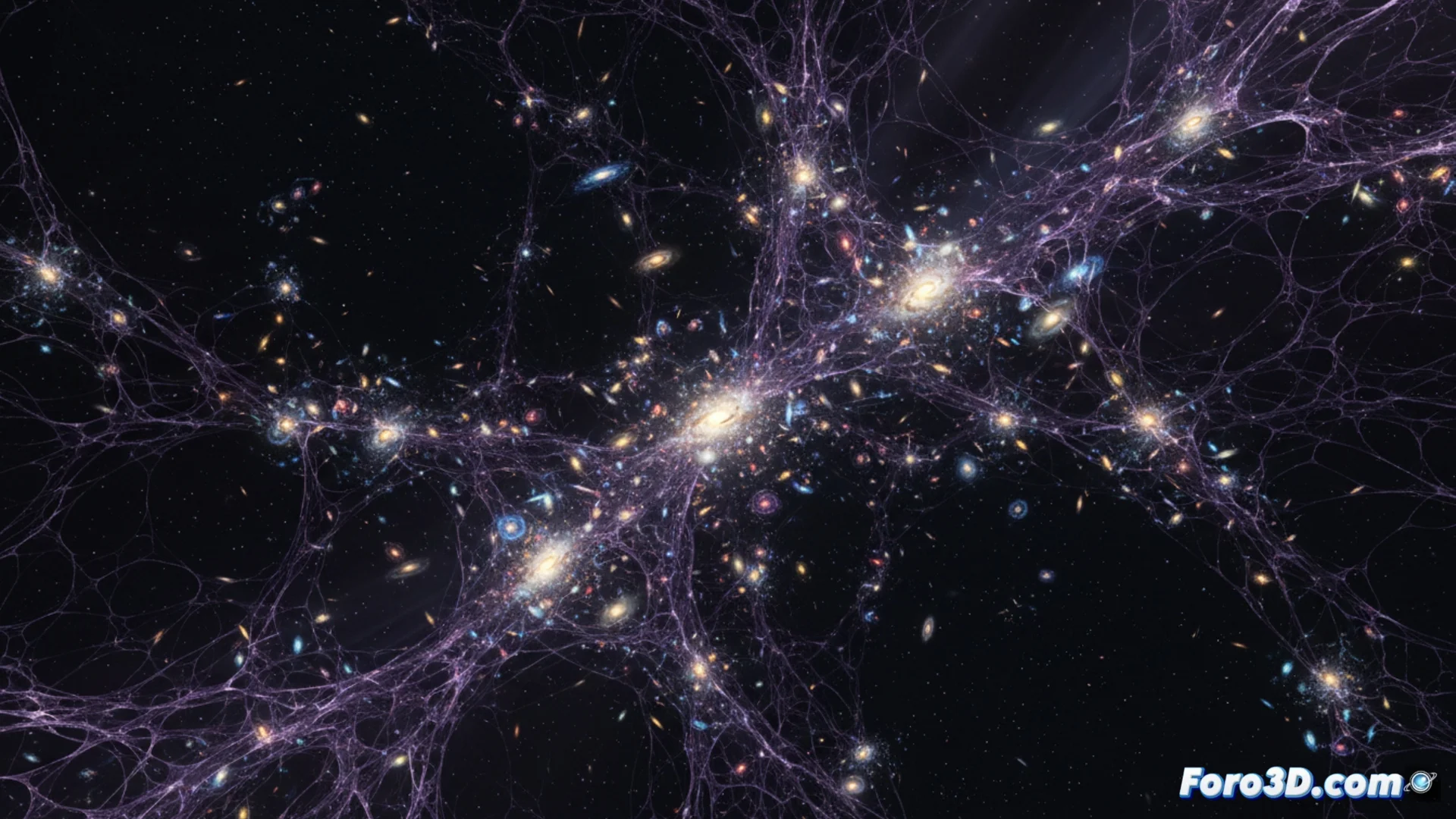
The international collaboration DESI has presented the largest map of dark matter distribution ever created. This monumental work, spanning a quarter of the celestial sphere, combines observations from two telescopes to map the location of this form of matter that emits no light. Scientists use the phenomenon of weak gravitational lensing, where light from distant galaxies is deflected as it passes near massive concentrations, to infer where dark matter is located. 🌌
The Cosmic Web Revealed with Unprecedented Detail
The new cartography allows observation of the universe's architecture with clarity never achieved before. It clearly shows dark matter filaments that act as bridges between galaxy clusters, as well as vast void regions. Researchers can identify previously hidden structures, providing crucial evidence to test theories about how the cosmos expands and how galaxies form within this invisible framework.
Key Findings from the Map:- Visualization of the cosmic web with filaments and voids.
- Detection of new structures that had not been observed before.
- Information to test models on universe evolution.
It seems that dark matter is finally stepping out of the shadows a bit so we can see its skeleton.
Refining Our Understanding of the Cosmos
Analyzing this extensive map helps measure fundamental cosmological parameters more accurately. These include the total matter density in the cosmos and the magnitude of initial fluctuations after the Big Bang. The results align with the standard cosmological model, but provide a more rigorous and restrictive verification. 🔬
Impact on Cosmology:- Precise measurement of universal matter density.
- Determination of the amplitude of primordial fluctuations.
- Strict validation of the current cosmological model.
The Future of Cosmic Cartography
The DESI project doesn't stop here. It will continue collecting data to expand the sky area it maps and to deepen the analysis of the information already obtained. This persistent effort promises to reveal even more secrets about the structure and fate of the universe, gradually illuminating the nature of its most elusive component. 🚀