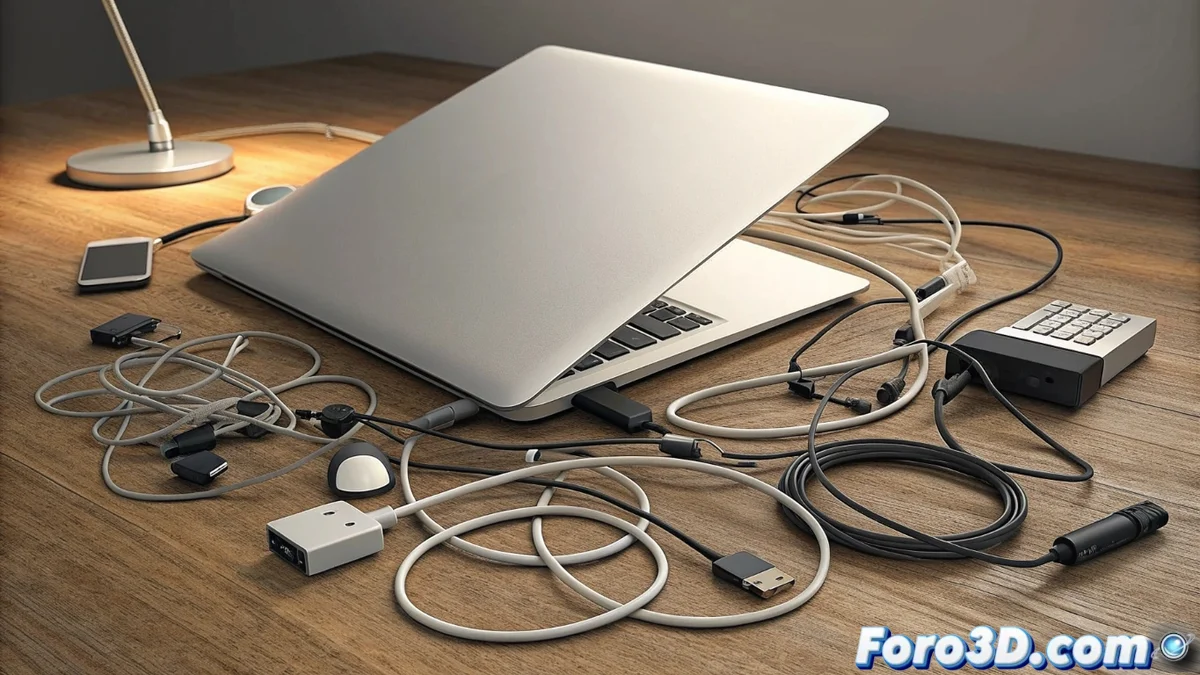
The Dependency on Adapters in Modern Hardware
Manufacturers prioritize slim and aesthetic designs, which motivates the removal of essential ports like USB-A, HDMI, and 3.5 mm audio jack. This strategy forces users to rely on an ecosystem of external adapters to connect basic peripherals, a step back in convenience. 🔌
The Hidden Cost of Minimalism
Acquiring these dongles represents an additional expense that is not always considered when purchasing the main device. Their reduced size and separable nature make them prone to being lost, abruptly interrupting workflows or leisure moments. The lack of standardization worsens the problem: an adapter for one model may become useless with the next generation if the manufacturer changes the port standard.
Immediate Practical Problems:- Extra Cost: Adapters are separate paid accessories, increasing the total cost of owning the device.
- Easily Lost: Their small size makes them objects that are frequently misplaced, leaving the hardware unusable for simple tasks.
- Limited Compatibility: The transition between standards like USB-C, Thunderbolt 4, or proprietary ports makes accessories obsolete quickly.
The modern user manages a collection of adapters that add clutter, contradicting the promise of simplicity and portability of portless hardware.
Accelerated Obsolescence and Environmental Impact
When a brand updates its connection standard, previous adapters become useless, artificially accelerating their useful life cycle. This not only economically affects the consumer but also contributes to generating more electronic waste. Users are trapped in a cycle of constantly updating their dongle kit to maintain functionality that was previously universal and permanently integrated.
Consequences of the Short Cycle:- Electronic Waste: Discarded adapters increase technological trash, a growing environmental problem.
- Forced Dependency: The user must buy new accessories for their expensive device to perform basic functions.
- Compromised Functionality: Losing the specific dongle can disable a laptop from connecting to a projector, headphones, or external storage.
A Simplicity That Complicates
Ironically, the pursuit of a minimalist design results in the user having to carry multiple adapters, adding bulk and logistical complexity. The user experience degrades, replacing plug-and-play connectivity with active accessory management. Maintaining basic functionality becomes an additional and costly task, far from the simple and direct integration that characterized previous hardware. 📦