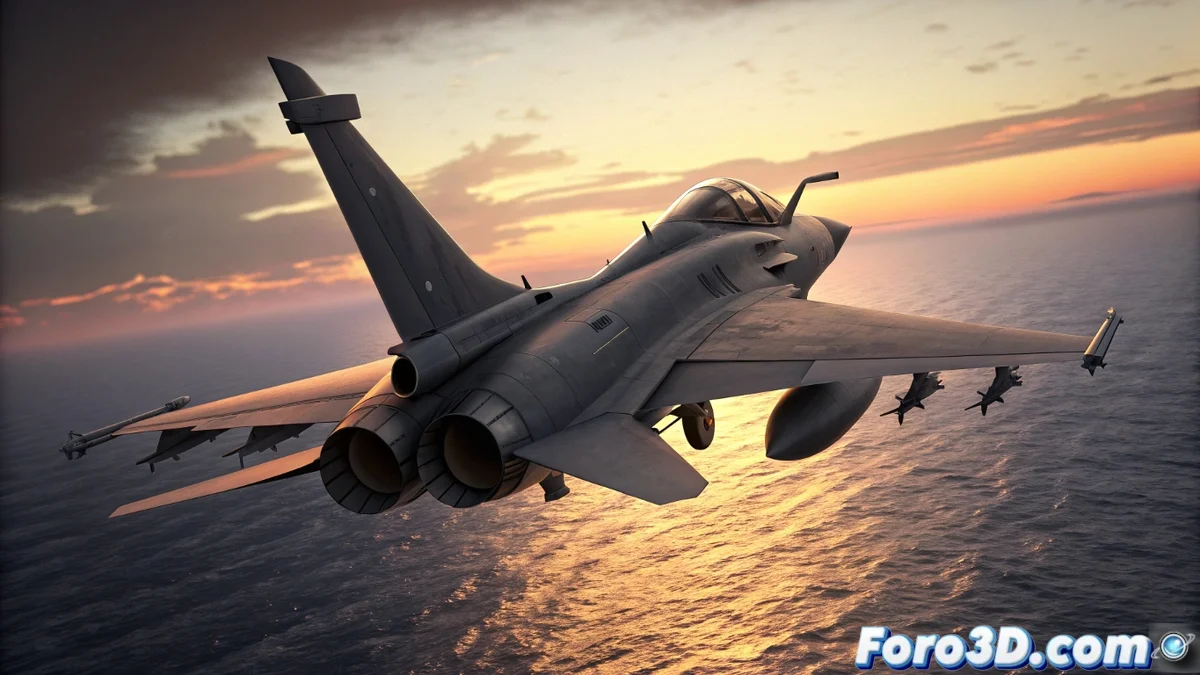
The Dassault Rafale: technical analysis of the French multirole fighter
The Dassault Rafale embodies the pinnacle of French military engineering, a generation 4.5 combat aircraft whose main virtue is an unmatched operational versatility. Designed from the outset to be an omnirole platform, it can switch missions in mid-flight, from air superiority to precision ground or naval strikes with devastating effectiveness. This flexibility is achieved through deep integration of its systems and aerodynamics optimized for extreme performance ✈️.
The engineering behind its agility: the active delta
The Rafale's silhouette is unique, defined by its delta wing combined with canard planes positioned high and far forward. This architecture, known as active delta, creates an inherently unstable aircraft controlled by computer, granting it exceptional agility in close combat maneuvers. The canards do not act only as elevators; they work in conjunction with the wing's control surfaces to optimize aerodynamic flow, increasing lift and reducing drag.
Distinctive details of its design:- Delta-canard configuration: Provides controlled instability for tighter turns and the ability to maintain high angles of attack.
- Fixed refueling probe: Integrated into the nose, unlike the retractable systems of other aircraft.
- M88 engine nozzles: Feature a cleaner profile without the visible thrust vectoring petals seen on other fighters, while offering high performance.
“Its greatest threat is not an enemy missile, but the maintenance bill after a mission that exploits all its capabilities.” – Common joke among its pilots.
Weapons arsenal and combat management systems
The Rafale's power lies in its ability to deploy an adaptive arsenal managed by one of the world's most advanced avionics suites. For air-to-air combat, it is the first European platform to operate the fearsome Meteor missile, whose ramjet engine gives it unparalleled range and pursuit capability. It complements this power with the versatile MICA missiles, available in radar-guided and infrared versions.
Key components of its weapons system:- Internal GIAT 30 cannon: A 30 mm revolver cannon for visual close combat (dogfight).
- SCALP EG cruise missile: Stealthy long-range weapon for precision strikes against critical infrastructure.
- Exocet anti-ship missile: Provides powerful deterrence and naval strike capability.
- RBE2 AESA radar: Active electronically scanned array radar that can track and engage multiple targets simultaneously in any direction.
- SPECTRA system: Integrated electronic warfare suite that combines alerting, countermeasures, and passive protection, acting as an intelligent shield.
Conclusion: the definition of modern versatility
The Dassault Rafale transcends the category of mere fighter to become a complete weapons system. Its success is not based on being the best in a single aspect, but on offering optimal and balanced performance across all domains of modern air combat. From its revolutionary active delta aerodynamics to its integration with state-of-the-art weapons like the Meteor, it represents a design philosophy where adaptability and multi-sector efficacy are the fundamental pillars. It is, without a doubt, a testament to European technological excellence in the 21st century 🛡️.