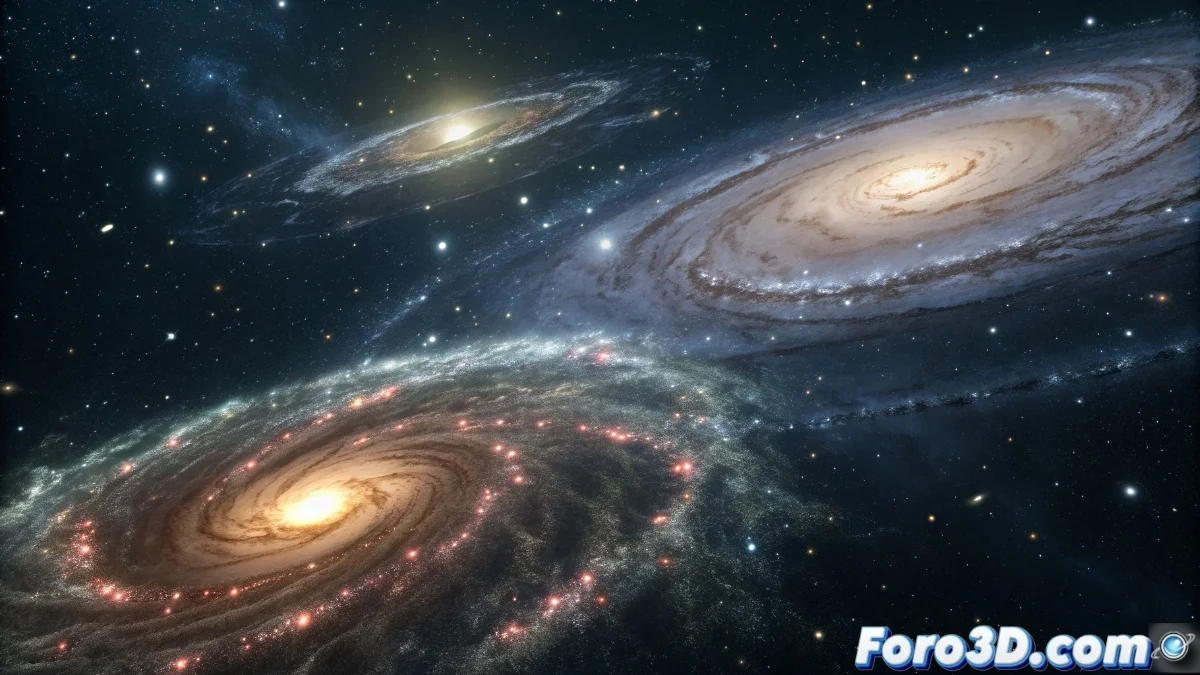
The Cosmological Enigma of Variable Dark Energy
The scientific community faces one of the deepest mysteries of modern cosmology: determining whether the observed fluctuations in dark energy constitute a fundamental property of the universe or simply reflect limitations in our measurement capabilities. 🔭
Computational Simulations as a Research Tool
To address this question, international teams have developed virtual models of the cosmos that incorporate all known components of the universe, including the temporal evolution of structures on cosmic scales. These synthetic universes allow for the systematic exploration of different physical scenarios through the controlled variation of fundamental parameters.
Key Components of the Simulations:- Detailed inclusion of dark matter and its influence on the formation of cosmic structures
- Modeling of the possible temporal evolution of dark energy density
- Recreation of galaxy formation processes over billions of years
The scientific irony: to understand the real universe we must create fictional universes, though at least in these we don't face budgetary limitations for cosmic expansion.
Cross-Validation Methodology
The research process involves running thousands of parallel simulations that are then compared with real astronomical observations, including data from type Ia supernovae, gravitational lensing effects, and galaxy distribution maps. This exhaustive verification allows for the identification of consistent patterns that confirm or refute the variability hypothesis.
Observational Data Sources Used:- Measurements of distant supernovae as cosmological distance indicators
- Analysis of gravitational lenses that reveal the mass distribution in the universe
- Three-dimensional cartographies of the galaxy distribution on large scales
Distinguishing Between Cosmological Signals and Methodological Artifacts
The research demonstrates how systematic errors in instrumentation or in the combination of heterogeneous data can generate statistical illusions comparable to multiple poorly calibrated thermometers suggesting non-existent climate changes. Comprehensive analysis through simulations avoids premature conclusions and allows distinguishing between genuine cosmological phenomena and methodological distortions, refining our understanding of the accelerated expansion of the cosmos. 🌌