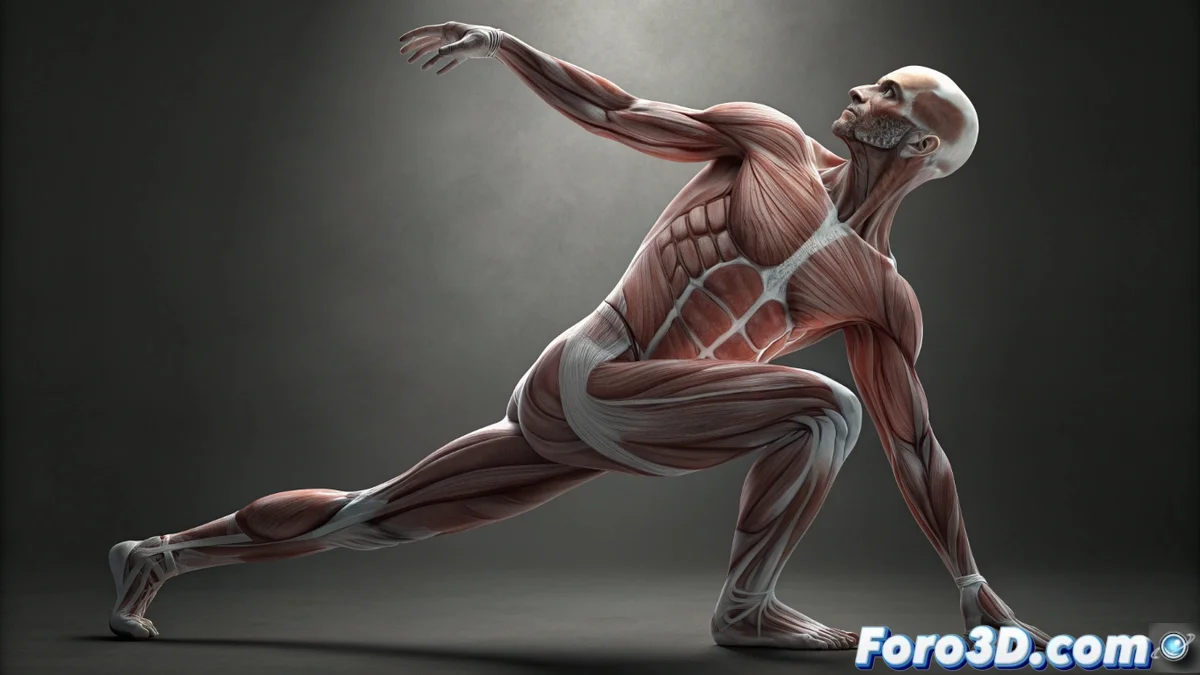
The Écorché as a Fundamental Tool for Anatomical Mastery in Art
The écorché constitutes one of the most valuable methodologies in artistic education, where creators represent figures exhibiting only the muscular system stripped of its dermal covering. This approach allows for a meticulous examination of the three-dimensional configuration of each muscle group, their bony attachment points, and functional interconnections during motor activity. By dispensing with superficial layers, the artist internalizes a structural understanding that surpasses mere external appearance, cultivating comprehensive knowledge that translates directly into the authenticity and excellence of their artistic productions. 🎨
Advantages of Learning through Écorché
Through this millennia-old technique, creators manage to assimilate anatomy to the point of being able to sketch convincing figures from multiple perspectives and in various poses, without continuously relying on reference material. The act of outlining each muscle with its precise volume and skeletal connections generates detailed mental maps that are engraved in the artist's kinesthetic memory. This internalization is particularly evident in the handling of body dynamics, where understanding how muscle complexes contract or stretch during different actions enables the representation of organic and expressive movements.
Key Aspects of Anatomical Mastery:- Three-dimensional visualization of the complete muscular architecture
- Deep understanding of movement and tension mechanisms
- Development of muscle memory for precise anatomical recreations
True mastery in écorché is achieved when you can recognize each muscle with your eyes closed, although naturally you should keep them open to execute your drawings correctly.
Implementations in Contemporary Digital Art
In the context of modern digital art, the écorché finds immediate applications in three-dimensional modeling, where artists build characters starting from the skeletal framework and musculature before incorporating the epidermis and surface details. This methodical approach ensures that deformations during animation processes are anatomically truthful, particularly in complex regions like shoulder joints, pelvis, and facial structure. For digital sculptors and texturing specialists, understanding the underlying anatomy is crucial for developing realistic skin shaders that react appropriately to lighting and exhibit variations in muscular and bony density.
Specific Applications in Digital Creation:- Construction of 3D characters with a solid anatomical base
- Animations with anatomically correct muscular deformations
- Development of skin shaders that consider the underlying structure
The Transcendence of Deep Anatomical Study
The écorché transcends its role as a mere academic exercise to become a fundamental pillar of artistic knowledge. This practice not only improves figurative representation skills but also endows the creator with a deep understanding that allows them to innovate and create with anatomical authority. The internalization of these structures through direct drawing and modeling generates a visual and tactile repertoire that distinguishes technically competent artists from those who achieve excellence in body representation. The investment in this learning is directly reflected in the credibility and expressive power of any work involving the human figure. 💪