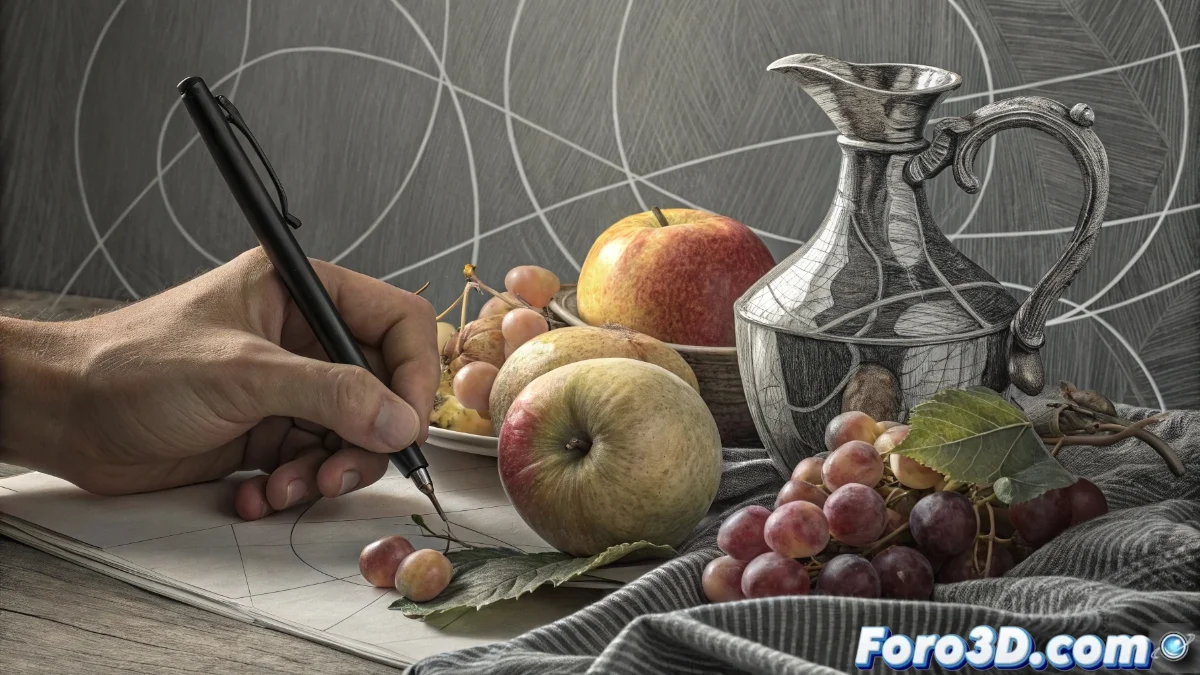
The Continuous Negative Contour Technique to Improve Your Drawing
Continuous negative contour represents a revolutionary approach to the creative process, where the artist directs their gaze towards the empty spaces surrounding objects instead of concentrating on the solid forms. This methodology trains visual perception to capture proportions more accurately, eliminating mental biases about the expected appearance of things. 🎨
Essential Preparations to Begin
Before starting with negative contour exercises, it is essential to gather the appropriate materials and establish an environment conducive to concentration. Selecting objects with defined silhouettes and interesting spatial relationships maximizes the benefits of this artistic practice.
Elements needed for the exercise:- Drawing surface such as medium-quality paper and a pencil with soft lead for fluid strokes
- Model or visual reference with complex shapes like furniture, plants, or compositions of overlapping objects
- Organized workspace free of distractions to maintain concentration during the session
True mastery in drawing does not lie in what you look at, but in how you learn to see the spaces between things
Detailed Execution Process
The method is implemented through a careful sequence where conscious observation precedes manual action. By focusing exclusively on the voids around the subject, a deeper understanding of spatial relationships and organic proportions is developed.
Steps to master the technique:- Identify specific negative spaces such as areas between chair legs, gaps in foliage, or intervals between stacked objects
- Trace the contour of these voids with an uninterrupted line, keeping the pencil in permanent contact with the paper
- Follow the eye movement with the hand at a constant speed, avoiding corrections during the drawing process
Transformative Benefits of Practice
The regular application of continuous negative contour produces significant improvements in observation and graphic representation skills. Artists develop an intuitive connection between what they perceive and how they translate it onto paper, resulting in more balanced drawings and representations faithful to reality. This discipline not only refines technique but fundamentally transforms the way we interpret the visual world around us. ✏️