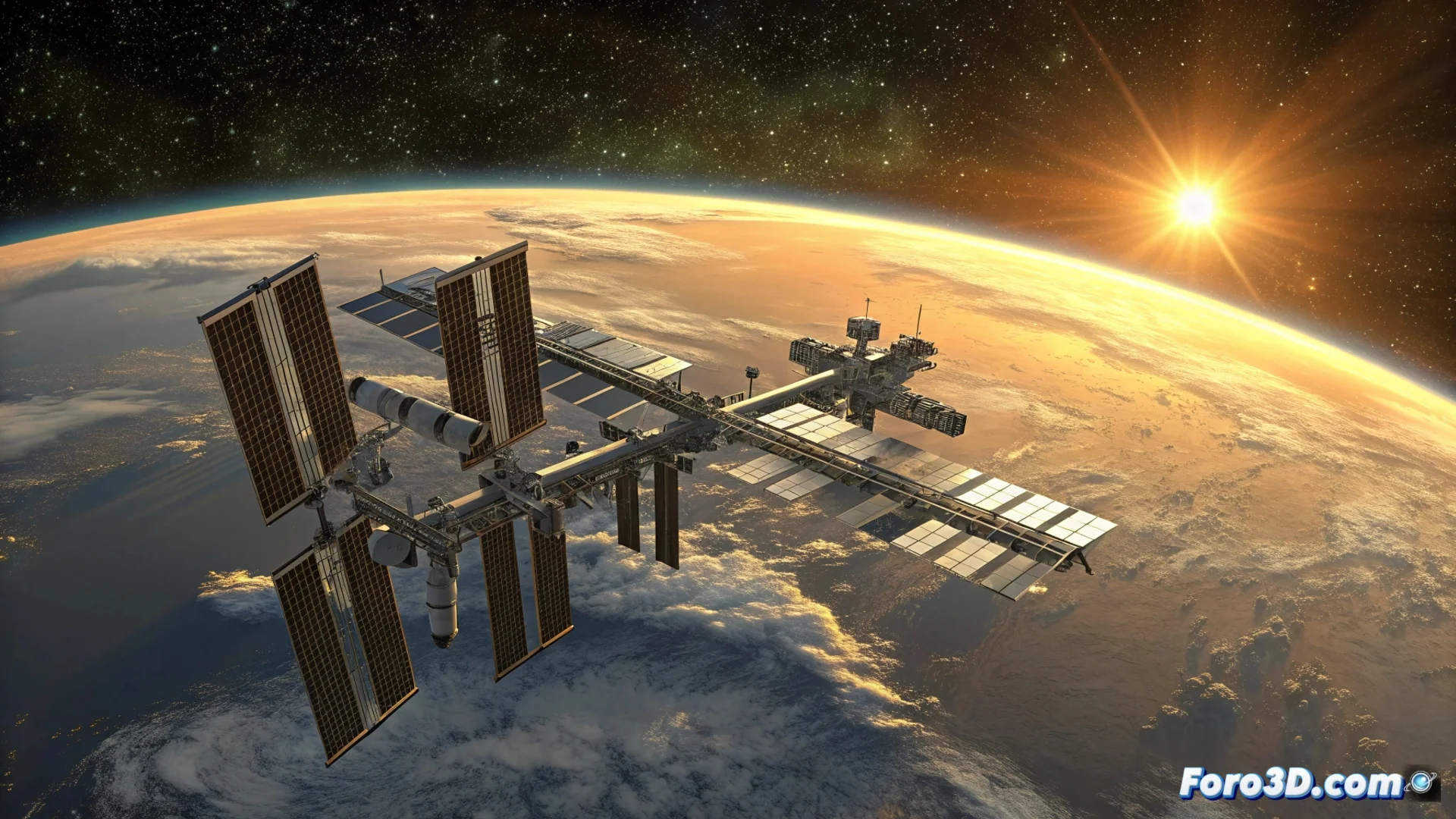
The ISS's Constant Orbit Enables Unique Microgravity Science
The International Space Station completes a full orbit around our planet every hour and a half. This incessant orbital cycle, which accumulates thousands of revolutions annually, forms the foundation for conducting science in microgravity conditions that cannot be simulated on Earth's surface. The enormous complex, comparable in size to a football field, changes its orientation relative to the Sun and the vacuum of space with each turn, providing an exceptional viewpoint for research. 🛰️
A Laboratory Where Gravity Barely Acts
In this environment, physical phenomena manifest differently. Fluids, materials, and flames develop without the distorting influence of gravity, allowing examination of their essential behavior. Researchers can observe how purer crystals are generated or how biological tissues grow in 3D. It's like trying to bake without the dough settling in one spot, a perfect scenario for validating hypotheses.
Key Advantages of Microgravity:- Allows observation of fundamental physical phenomena without gravitational interference.
- Facilitates growing biological tissues in three dimensions with more complex structures.
- Enables production of crystals and materials with purity and structure impossible on Earth.
If an astronaut drops an object, in 45 minutes it will be on the other side of the module, a literal reminder that everything is in motion.
Each Revolution is a New Observation Window
This perpetual motion causes the station to regularly transit between sunlight and Earth's shadow. This rapid cycle is invaluable for testing how materials withstand extreme thermal changes or for calibrating instruments that monitor the planet. The constantly evolving position also helps analyze the impacts of cosmic radiation on various systems, from electronic components to plant experiments.
Applications of the Orbital Cycle:- Test material resistance to sudden temperature changes (thermal cycles).
- Calibrate and verify Earth observation instruments from a changing perspective.
- Study the effects of space radiation on biological and electronic systems.
The Foundation for the Future of Space Research
The ISS's rapid orbit is not just a technical curiosity; it is the operational framework that enables its function as a laboratory. It provides a stable and predictable microgravity environment, plus cyclical exposure to deep space conditions. This rhythm is the backbone that supports hundreds of experiments, paving the way for future missions beyond low Earth orbit. 🌌