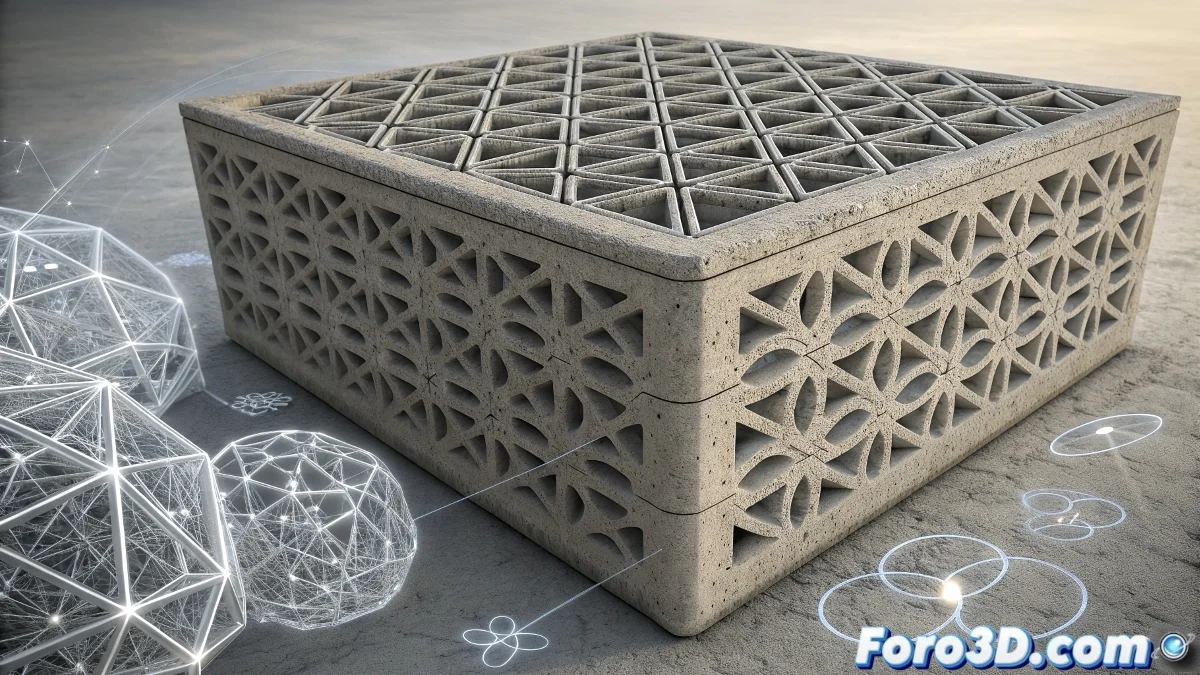
When Carbon Becomes Construction's Ally
The construction industry faces its most significant revolution in decades with a development that sounds almost like magic: 3D printed concrete capable of capturing 142% more carbon than traditional mixes. This innovation not only improves construction efficiency through digital manufacturing but also inverts the environmental equation of one of the planet's most polluting materials. What was once part of the climate problem now becomes part of the solution.
The key lies in a reinvented chemical composition that transforms atmospheric carbon dioxide from a threat into a structural component. During the curing process and throughout the material's lifespan, this specialized concrete actively sequesters carbon, achieving a negative footprint that challenges all previous expectations about construction materials.
This is not just another construction material; it's a carbon sponge shaped like a building
Revolutionary Features of the New Material
- Modified chemical composition to maximize CO2 capture
- Full compatibility with industrial 3D printing systems
- Enhanced structural strength thanks to controlled carbonation
- Optimized surface texture for greater air exposure area
The Science Behind Enhanced Carbon Capture
The secret to the 142% improvement in carbon capture lies in a synergistic combination of factors. The complex geometry achievable through 3D printing creates an exponentially greater surface area for the chemical reaction, while special additives catalyze the carbonation process. The result is a material that not only reduces emissions but actively contributes to cleaning the atmosphere while fulfilling its structural function.
3D printing also allows optimizing the orientation and design of elements to maximize exposure to ambient air. This freeform design capability, impossible with traditional formwork, turns every structure into an efficient carbon sink that works silently for decades.
Impact on Built Sustainability
- Drastic reduction in carbon footprint for construction projects
- Potential carbon-negative certification for complete buildings
- Perfect synergy between construction efficiency and environmental benefit
- New economic models based on carbon credits
The scalability of this technology promises to transform entire cities into carbon sinks. Every building, bridge, or infrastructure built with this material becomes an environmental asset instead of an ecological liability. Preliminary calculations suggest that mass construction with this concrete could significantly offset emissions from other industrial sectors, representing a crucial advance in the fight against climate change.
For the first time in history, building more can mean polluting less
And while skeptics review the data for the fourth time, this concrete keeps capturing carbon silently, proving that sustainable innovation can be as solid as a rock... literally 🌱