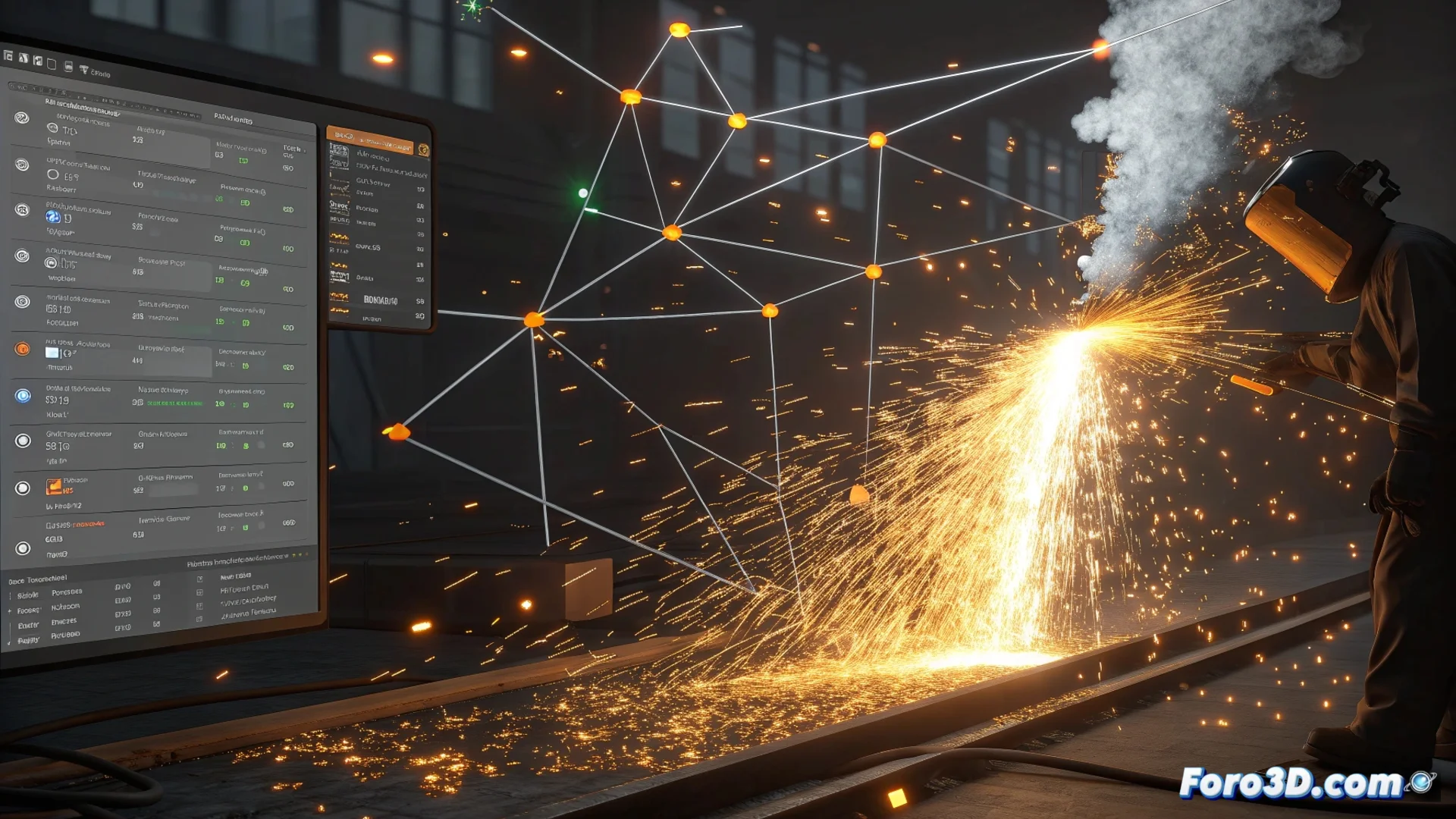
Combustion's Particle Operator Integrates Effects into Nodal Compositions
Combustion's particle engine operates natively within its own node-based composition environment. This tool allows generating and manipulating complex simulations, such as dust clouds or spark showers, without leaving the main workspace. The integration is complete. 🎬
Visual Control via a Node Network
The user defines all aspects of the simulation by connecting specialized nodes in a graphical network. From this panel, the emission origin is set, velocity vectors are adjusted, forces like gravity are applied, and the lifespan of each particle is programmed. This visual method allows modifying parameters and observing changes immediately.
Key parameters that can be adjusted:- Emission Source: Defines the shape and location where particles are born.
- Dynamic Behavior: Controls speed, acceleration, and applied physical forces.
- Appearance and Lifespan: Manages visual appearance, textures, and the time each particle exists.
By generating particles within the composition tree itself, they combine directly with other image and video layers.
Unified Rendering within the Final Composition
A main advantage is that particle effects are processed and rendered within the same final composition. This eliminates the step of exporting to an external application specialized in simulations. The engine treats all elements uniformly, which optimizes workflow time and preserves visual coherence throughout post-production.
Benefits of this integrated approach:- Agile Workflow: No need to switch between different programs.
- Contextual Preview: See particles interacting with the rest of the scene in real time.
- Total Control: Every aspect of the effect remains editable until the end of the project.
A Powerful System for Artists
Mastering this nodal system to control every particle can be as meticulous as wanting your coffee to behave predictably. However, it offers seamless control and perfect integration, making adding complex dynamic effects just another part of the creative process, not a separate task. The barrier between composition and simulation practically disappears. 💥