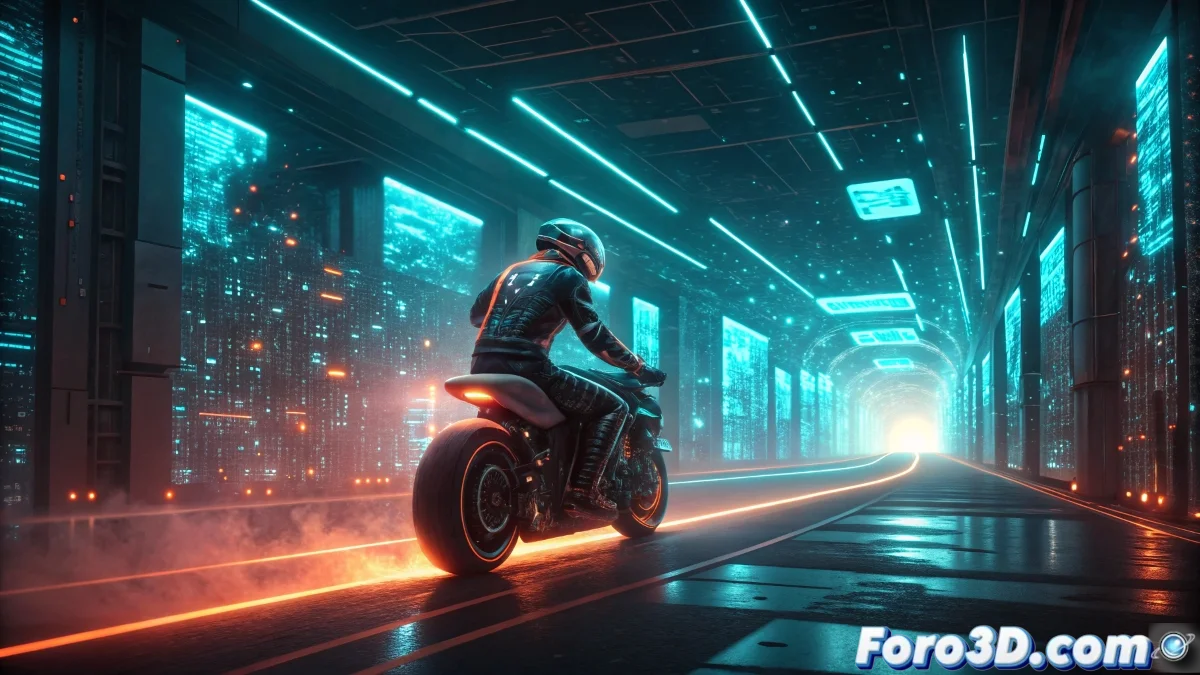
When the Grid Invades Reality
TRON: Ares represents the natural evolution of a franchise that has always explored the boundary between the digital and the physical, taking the core concept to entirely new narrative and visual territories. The premise of programming the real world from within the Grid is not just a logical extension of the established universe, but an opportunity for visual effects artists to reimagine what reality would look like when hacked, manipulated, and reprogrammed through code. This approach promises a visual experience that challenges conventional perceptions of what is "real" in the cinematic context.
What makes this new installment particularly exciting is how current technological advances enable visions that were previously impossible. Where the original 1982 film relied on analog techniques and long-exposure photography to create its luminous effects, TRON: Ares can leverage real-time particle simulations, path-traced rendering, and machine learning to create a Grid that feels both organic and artificially perfect. The irony of using cutting-edge technology to depict a digital world is deliciously meta.
Expected Visual Innovations in TRON: Ares
- Seamless transitions between physical reality and digital space
- Visual "corruption" effects when the Grid infects the real world
- New vehicles and architectures that fuse both worlds
- Particle systems that visualize code manipulating matter
The Aesthetic of Code as a Physical Force
One of the most intriguing visual challenges facing the VFX team is depicting how digital code could manifest physically in our world. It's not just about overlaying effects on reality, but creating the illusion that physical laws are being rewritten in real time. This requires an approach that balances TRON's iconic aesthetic with new interpretations of how programming could literally reshape reality, from the subatomic level to the macro scale.
TRON: Ares explores the most terrifying and fascinating idea: what happens when the Grid learns to program our world?
The evolution of the visual palette from the original neon to contemporary data representations reflects how our understanding of technology has changed. While the original TRON used simple primary colors to represent a rudimentary digital world, Ares will likely incorporate complex data visualizations, particle effects that behave like algorithms, and perhaps even user interface elements that bleed into the real world, creating an experience that feels both familiar and revolutionarily new.
VFX Techniques That Could Define the Movie
- Fluid and particle simulations that respond to "invisible" code
- Advanced compositing to integrate digital elements into real environments
- Machine learning to generate visual patterns that feel algorithmic
- Real-time rendering during production for rapid creative iteration
TRON: Ares arrives at a culturally perfect moment, when the line between physical reality and digital blurs more each day with advances in augmented reality, artificial intelligence, and metaverses. The film has the potential not only to entertain, but to influence how we imagine the future of human-computer interaction and the philosophical implications of living in increasingly programmable worlds. For VFX artists, it represents the opportunity to define the visual aesthetic of this new digital frontier. 💻
And so, forty years after a hacker became a program, TRON: Ares asks us: what happens when programs learn to hack our world, and reality becomes just another operating system waiting to be updated? 🌐