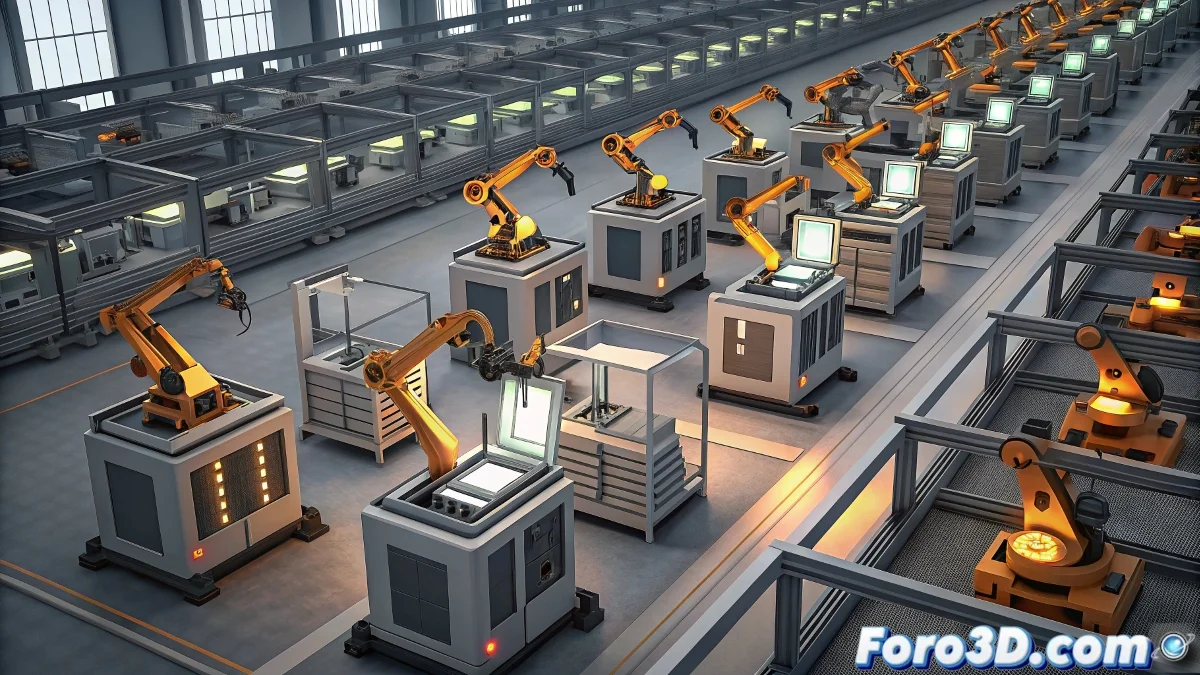
The Challenge of Standardization in Automated 3D Printing Farms
Additive manufacturing is undergoing a revolution with the proliferation of automated facilities operating dozens or hundreds of 3D printers in a coordinated manner. These smart factories enable the serial production of small components and customized products with unprecedented efficiency, but they encounter a fundamental technological obstacle that hinders their full expansion. 🏭
The Fragmentation of the Software Ecosystem
The diversity of manufacturers in the market has created a highly segmented landscape where each company develops its own control platform, generating compatibility barriers between systems. Operators must handle multiple interfaces simultaneously to manage equipment from different brands, leading to significant inefficiencies and complicating the unified supervision of the entire production process.
Critical Operational Problems:- Need to use multiple software platforms to control different brands of printers
- Difficulties in unified monitoring of the complete production process
- Bottlenecks where software management limits the available physical capacity
"In some facilities, technicians must navigate between five different interfaces just to produce the same item on equipment from different manufacturers, demonstrating how the most advanced technology can require surprisingly basic solutions"
Towards Interoperability Through Open Standards
The industry is responding with the development of universal communication protocols and standardized APIs that facilitate interoperability between different manufacturers. Specialized companies are creating unified management platforms capable of controlling printers from multiple brands through a single interface, centralizing the job queue, real-time monitoring, and predictive maintenance.
Advances in Integrated Solutions:- Development of open protocols and universal APIs for interoperability
- Unified platforms that centralize management of multiple brands
- Incorporation of artificial intelligence for automatic job distribution optimization
The Future of Distributed Production
Technological standardization is emerging as the determining factor to maximize the potential of automated 3D printing farms. As integrated solutions advance, the transition towards interoperable ecosystems will allow overcoming current limitations and fully leveraging the available production capacity, paving the way for truly scalable and efficient additive manufacturing. 🚀