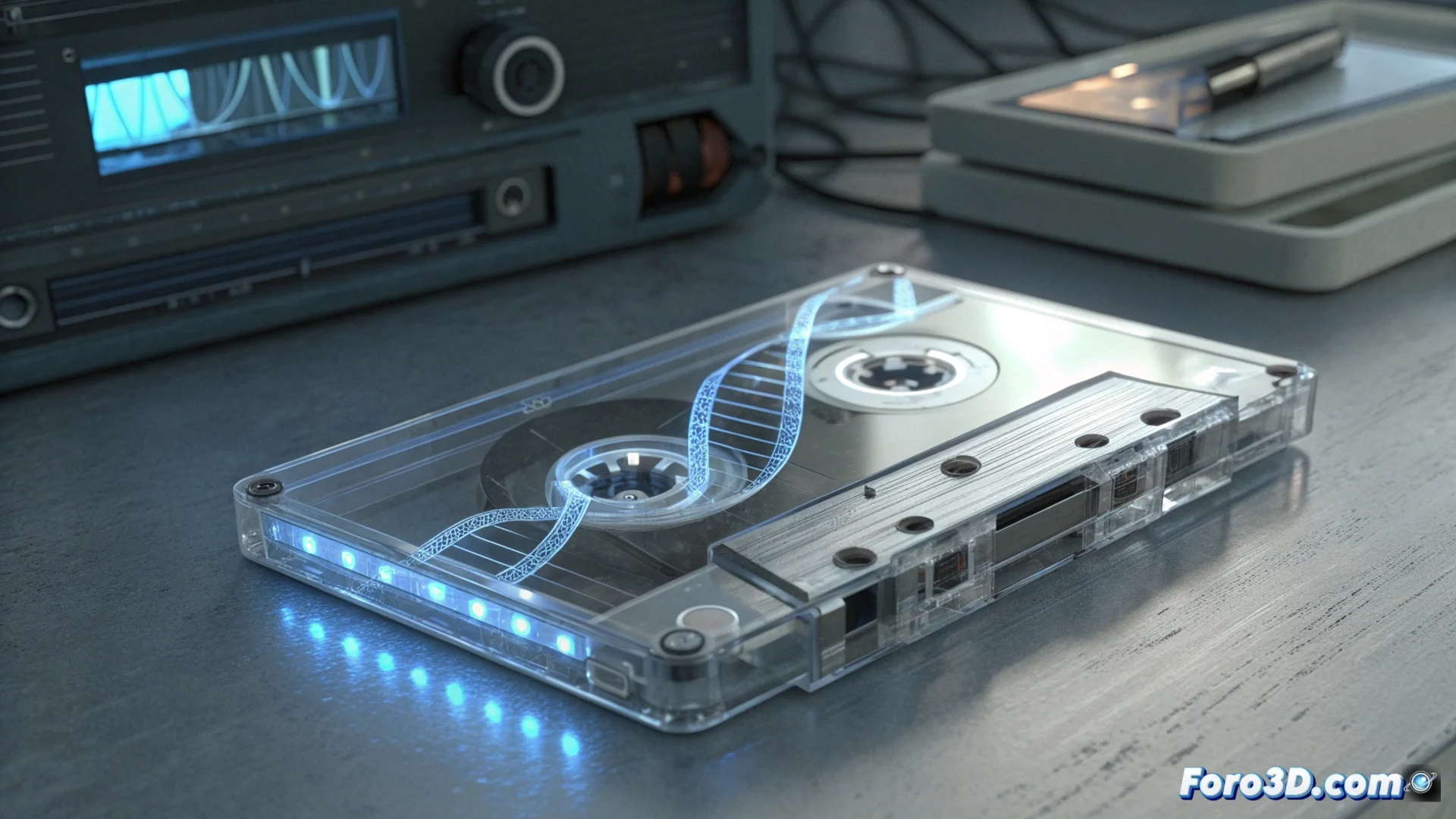
The Cassette Returns in 2025 with Massive Storage Capacity
A symbol of decades past is ready for a spectacular return. The cassette format is not coming back for nostalgia, but driven by a radical innovation that replaces magnetic tape with synthetic DNA. This change enables previously unthinkable capacities. 🧬
The Technology Behind Storing in DNA
The principle mimics how nature stores information. Digital data (zeros and ones) is converted into the sequence of four DNA letters: A, C, G, T. A device synthesizes strands with this code and deposits them stably in the cartridge. To read, a special device sequences these strands and translates the letters back into bits. The data density achieved far surpasses any current SSD or HDD.
Key Features of This Evolution:- Extreme Capacity: A single cassette can hold up to 36 petabytes. This is equivalent to storing all recorded music in history in an object the size of a matchbox.
- Long-Term Stability: Synthetic DNA offers exceptional durability for archiving information for decades or centuries.
- Spatial Efficiency: It achieves astronomical storage density, reducing the physical space needed for large volumes of data.
This technology does not seek to replace your daily hard drive, but to transform how we preserve knowledge and digital culture on a planetary scale.
The Path to a Commercial Product
Several companies and laboratories are working to overcome current challenges. The main difficulty is not storing the data, but writing and reading it at a practical speed and accessible cost. Current prototypes write slowly, but read at speeds that are already useful.
Challenges and Projections:- Write Speed: Synthesizing DNA strands is a chemical process that is currently slower than recording on a traditional magnetic medium.
- Reader Cost: Sequencing technology must become more affordable to reach the consumer market.
- Estimated Timelines: Analysts predict that these technical hurdles will be overcome within a five-year horizon, enabling use for professional archiving.
A Future Encoded in Nitrogenous Bases
The cassette of the future won't need you to blow on it, but it will contain a complete library in a biological format. This reinvention positions DNA storage as the definitive solution for storing the vast amount of data we generate, ensuring its preservation for future generations. The dust you try to remove could literally be the history of humanity encoded. 💾