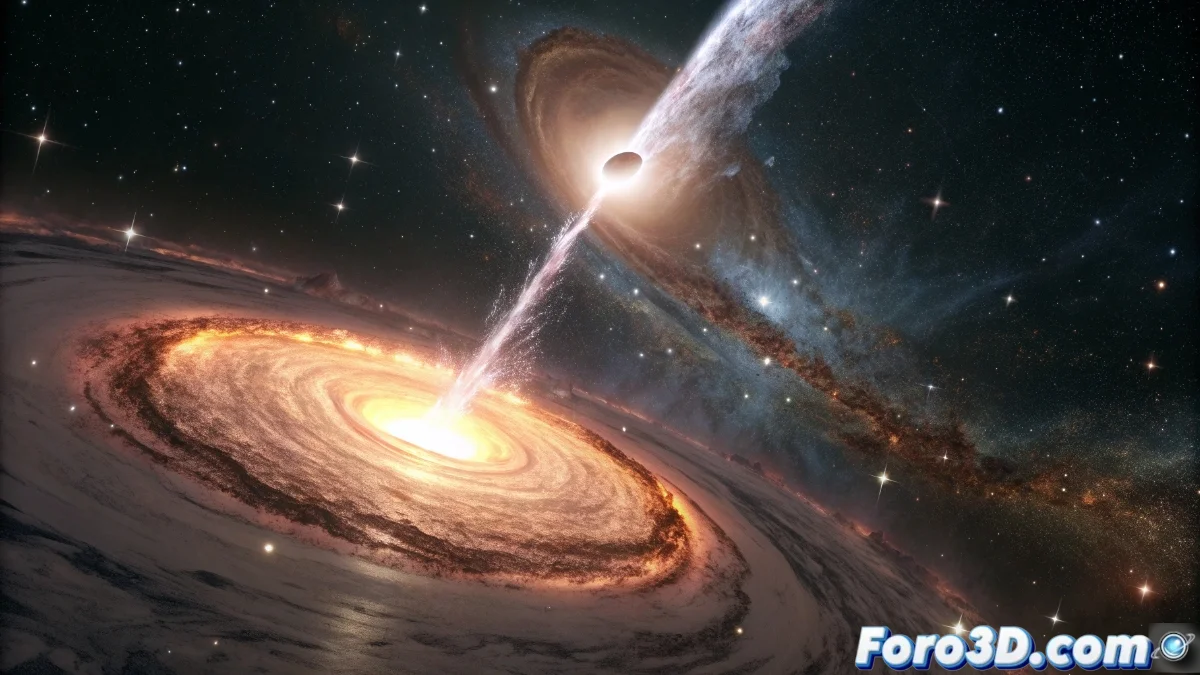
The Brightest Flash from a Black Hole Tearing Apart a Star
An international team of astronomers has recently recorded the most powerful luminosity phenomenon ever documented in the cosmos, originating when the colossal gravitational attraction of a black hole completely shredded a massive star that ventured too close to its cosmic domain. This cataclysmic event, classified as a tidal disruption, generated an energy emission so immense that it outshone the combined glow of all the stars in its host galaxy for an extended period, marking an unprecedented milestone in the annals of observational astronomy. 🌌
Mechanism of Extreme Stellar Destruction
When a stellar body approaches the zone of influence of a supermassive black hole, the gravitational tidal forces drastically overcome the internal gravity that holds its structure together, initiating a process known as spaghettification where the star is elongated and fragmented into streams of matter. The stellar remnants then form an accretion disk that spins furiously around the event horizon, reaching incredible temperatures and emitting multispectral radiation detectable even across vast intergalactic distances.
Stages of the destructive process:- Stellar approach to the critical gravitational influence region of the black hole
- Dominance of tidal forces over the star's self-gravity, causing extreme deformation
- Complete fragmentation of the star and formation of a high-energy accretion disk
These events allow us to observe fundamental physics operating under conditions we cannot recreate in terrestrial laboratories - Dr. Elena Torres, astrophysicist
Scientific Repercussions of the Historic Discovery
This exceptional phenomenon provides the scientific community with a unique window to investigate the limits of general relativity in intense gravity environments and analyze the mechanisms of matter accretion in the most violent contexts of the universe. The gathered information enables the validation of theoretical models about the growth of black holes through the consumption of stellar material and the behavior of matter under extreme gravitational stresses, providing fundamental perspectives on galactic evolutionary dynamics and strong gravitational field regimes.
Key contributions to astronomical research:- Verification of theories on the growth and feeding of supermassive black holes
- Study of material behavior under extreme gravity conditions
- Understanding of the formation and evolution processes of galactic structures
The Ultimate Cosmic Spectacle
It seems that in the cosmos there are also entities that demand all the attention, eclipsing entire galaxies with their dramatic stellar disintegrations. These tidal disruption events not only set new luminosity records but continue to reveal the fundamental mysteries of physics under conditions that challenge our conventional understanding of space-time and gravity. 💫