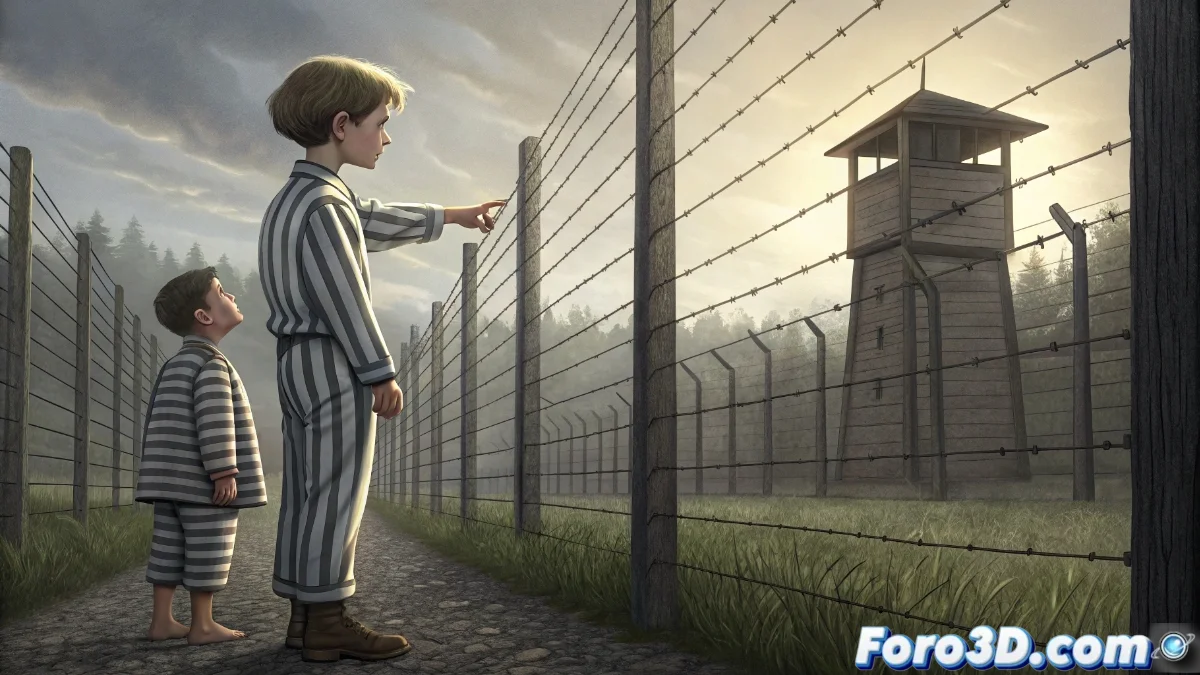
The Boy in the Striped Pajamas: An Innocent Friendship in Dark Times
John Boyne transports us to a moving vision of the Holocaust through the eyes of Bruno, a young German boy unaware of the cruelty surrounding him. His life changes radically when he moves near a concentration camp, where from his window he spots people in striped outfits that spark his curiosity. Driven by his childlike nature, Bruno explores the boundaries of his new home and encounters a fence that separates his world from that of Shmuel, a Jewish boy. Despite the physical and social barriers, they forge a pure bond that challenges the divisions imposed by adults, demonstrating how humanity can emerge even in the most dismal circumstances. 🌟
Narration from a Child's Innocence
The work employs Bruno's point of view to highlight the abyss between childish naivety and the ferocity of the Nazi regime. Bruno interprets events with his limited understanding, calling Auschwitz "Auchviz" and believing Shmuel's outfit is part of a game. This approach allows the author to reveal the horrors of the Holocaust without resorting to explicit descriptions, focusing on the emotions and bewilderment of the protagonist. The friendship between the two children stands as a symbol of purity amid tragedy, where the barbed wire not only demarcated spaces but embodied the rift between induced ignorance and ruthless reality.
Key Aspects of the Narrative Perspective:- The childlike voice as a filter to soften the harshness of historical events
- Bruno's misunderstanding of Nazi symbols, such as the striped uniforms
- The contrast between innocent interpretation and the dark context surrounding it
The barbed wire not only divides territories but represents the gap between forced ignorance and harsh reality.
Emotional Impact and Educational Value
The Boy in the Striped Pajamas serves as a pedagogical resource to bring readers of all ages closer to topics like the Holocaust and discrimination. Its accessible yet profound narrative invites reflection on the consequences of hatred and the importance of empathy. The shocking ending emphasizes the tragedy indirectly, leaving a lasting impression about the loss of innocence and the cost of indifference. Through this story, Boyne not only recounts a friendship but questions how societies allow inhumanity to prevail, reminding us that behind every statistic are human faces with dreams and fears.
Educational and Emotional Elements:- Gradual introduction to historical horrors for young audiences
- Promotion of critical reflection on prejudices and social consequences
- Friendship as a vehicle for transmitting values of tolerance and compassion
Irony and Transcendence in the Plot
In an irony-laden twist, Bruno laments the monotony of his new home, unaware that his greatest adventure will lead him to cross a boundary that, for others, is insurmountable for far more sinister reasons than a mere childish pastime. This element underscores the protagonist's tragic innocence, as he navigates an adult world full of secrets and dangers. The work culminates in a cautionary message about the invisible borders that separate people and how childlike curiosity can unveil bitter but necessary truths to understand human complexity in times of conflict. 💔