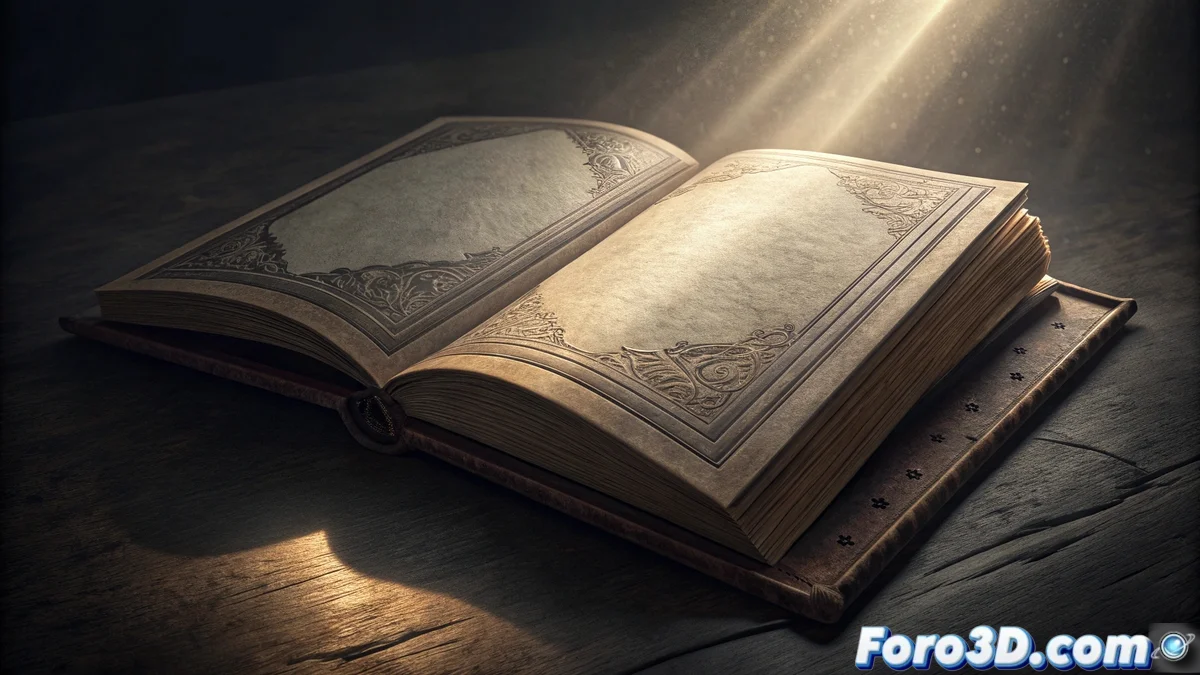
The Book Read by Touch: Mystery and Sculpting Guide in SculptGL
Among the most unsettling bibliographic enigmas in history is a volume whose pages only reveal their content through physical contact in absolute darkness. This manuscript, mentioned in medieval texts, challenges reading conventions and raises profound questions about the limits of human knowledge 📖✨.
Origins and Historical Evolution of the Tactile Book
The first references to this peculiar tome appear in chronicles describing works whose content activates under specific conditions. Over the centuries, it has circulated through secret libraries and private collections, always accompanied by warnings about its handling. The mechanism that allows it to be read involves an unknown technology that generates temporary reliefs on the pages when caressed in the dim light. Those who have experienced this tactile revelation describe accessing fundamental truths about reality, at a potential cost to sanity 🔍.
Distinctive Features of the Volume:- Visually empty pages under conventional lighting, showing text only through reliefs when touched in complete darkness
- Documented transfers between custodians, always with precise instructions on handling and associated risks
- Disturbing content that, according to testimonies, includes knowledge capable of altering the perception of reality
Some knowledge comes at too high a price; those who reach the last page develop a permanent sensitivity to pain in their fingertips.
Cultural Legacy and Philosophical Reflections
The most unsettling legend associated with the book warns of an irreversible curse for those who complete its reading: a painful hypersensitivity in the fingertips that prevents touching any surface without suffering. This element has turned the volume into a recurrent symbol in esoteric literature, representing the extreme sacrifice to access forbidden knowledge. Its existence fuels debates on whether certain knowledge should remain hidden and the consequences of transcending human perceptual limits 💭.
Key Aspects of Its Impact:- Representation of forbidden knowledge and the risks of seeking it beyond the conventional
- Philosophical reflection on ethical and perceptual limits in acquiring wisdom
- Influence on contemporary narratives exploring the price of absolute knowledge
Project Setup in SculptGL
To recreate this mysterious artifact in the digital environment, start SculptGL and set up a new project with standard dimensions. Adjust the canvas to a resolution of 2048x2048 pixels or higher to ensure precision in details. Select the basic sculpting mode and set the brush sensitivity to a medium level, balancing control and fluidity. Set the initial mesh subdivision to a level that allows working with detailed geometries without compromising performance 🛠️.
Essential Initial Setup:- Appropriate resolution to capture micro-details on the book's pages and covers
- Brush sensitivity adjusted for precise surface deformations
- Subdivision level optimized for fine details and workflow speed
Modeling the Main Structure
Start with a basic cube that you will transform into the approximate shape of a closed book. Use the engraving tool to define edges and the spine of the volume. To simulate the blank pages, generate a flat surface with subtle irregularities that evoke ancient paper. The main challenge lies in sculpting the invisible reliefs that only manifest through touch; use inflation and push tools with low intensity to create textures suggesting raised words. Organize the work in separate layers to represent the book both open and closed 📐.
Key Modeling Stages:- Definition of the base shape from a cube, sculpting edges and spine with precision
- Creation of pages with flat surfaces and roughness mimicking aged paper
- Generation of hidden reliefs through controlled inflation and pushing for tactile textures
Lighting and Materials Setup
Adjust a dim ambient lighting that simulates the darkness necessary to read the book. Incorporate a directional light source with a very oblique angle to accentuate the reliefs through marked contrasts of light and shadow. For the cover material, apply a skin shader with medium roughness that emulates aged leather. The pages should have an almost white albedo material, with subtle chromatic variations suggesting antiquity. Modify the reflectivity to highlight the contrast between smooth and textured areas 💡.
Lighting and Materials Elements:- Low ambient lighting recreating tactile reading conditions in dim light
- Grazing directional light to highlight reliefs through deep shadows
- Realistic materials mimicking ancient leather and paper with signs of age
Special Effects and Rendering Process
Apply a displacement map to intensify the three-dimensionality of the reliefs. Use SculptGL's layer system to develop a variant of the book with open pages displaying the tactile textures. In the final render, set up multiple lighting passes that capture the interaction between grazing light and the micro-geometries of the pages. Export the model in high resolution with normal and displacement maps that preserve the tactile information of the surfaces, ensuring the invisible reliefs are perceptible in the visual result 🎨.
Steps for Effects and Render:- Use of displacement maps to enhance the three-dimensional perception of hidden reliefs
- Setup of multiple passes documenting the light-geometry interaction in detail
- High-quality export with maps preserving the model's tactile characteristics
Final Reflection on Knowledge and Its Limits
This extraordinary book demonstrates that, at times, what is imperceptible to the naked eye holds a deeper meaning than the obvious. However, its legend invites us to question whether we truly wish to know that which, like the final chapter, might leave us with a permanent mark. The recreation in SculptGL not only allows exploring its essence through 3D modeling but also reflecting on the limits of human knowledge and the risks of pursuing absolute truths 🤔.