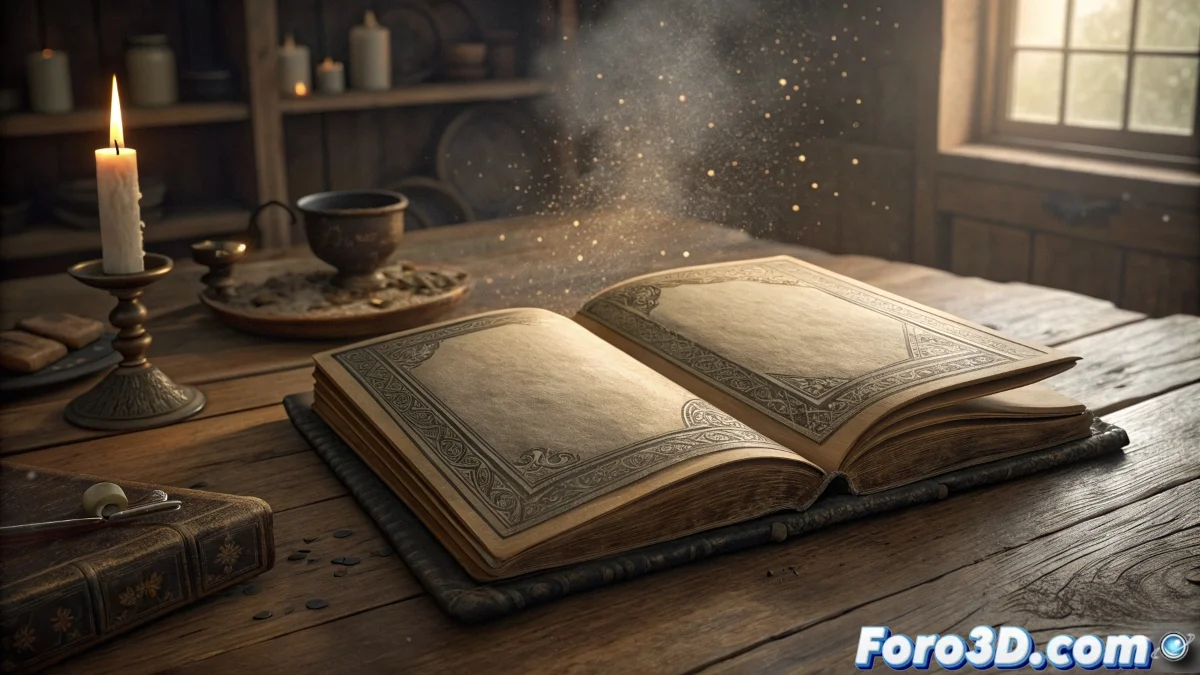
The self-writing recipe book: legend and animation
Oral traditions from medieval European folklore, especially in Central and Eastern Europe, gave rise to the fascinating legend of the self-writing recipe book. These narratives emerged during times of food scarcity, reflecting the psychological need for specific foods through supernatural tales. The inherited book symbolizes the generational transmission of culinary knowledge, while the initially blank pages represent hidden potential and family secrets to be discovered. According to oral tradition, these volumes appear as common objects, bound in worn leather, whose pages mysteriously fill over time 📖✨.
Development and evolution of the legend
Between the 17th and 18th centuries, the legend acquired regional variants that enriched its narrative. In some German versions, the book only responded to the direct descendants of the original family, while Slavic traditions incorporated elements of white magic, suggesting that the object channeled unconscious food desires. During the 19th-century Romanticism, these tales gained popularity in Gothic literature, exploring the duality between culinary pleasure and psychological trauma. The warning about implanted memories evolved from simple bad memories to specific traumas linked to family secrets or repressed ancestral experiences.
Key aspects of the evolution:- Regional variants: German with lineage restrictions and Slavic with white magic.
- Literary influence: Adaptation in 19th-century Gothic literature to explore human conflicts.
- Evolution of warnings: From simple negative memories to complex traumas related to family heritage.
The book not only satisfies hunger but also reveals the deepest secrets of the family soul.
Cultural impact and enduring legacy
This legend endures as a cultural metaphor about the unforeseen consequences of satisfying immediate desires, anticipating modern concepts like gustatory memory and psychological trauma. It represents the connection between food and memory in popular psychology, serving as a moral warning against seeking pleasure without considering the emotional cost. In contemporary culture, it influences narratives about double-edged magical objects and has been reinterpreted in video games, fantasy literature, and television series that explore reinvented folklore.
Influences in modern media:- Video games: Interactive objects with emotional side effects.
- Fantasy literature: Reinterpretations blending cooking and the supernatural.
- Television series: Narratives that update folklore for current audiences.
Project preparation and initial setup in Adobe Animate
To animate this legend, launch Adobe Animate and create a new HTML5 Canvas document with dimensions of 1920x1080 pixels at 24 fps. Set up an extended timeline for a 10-second animation and organize layers by elements: background, book, pages, magical text, and special effects. Import visual references of ancient books and manuscripts to maintain stylistic coherence, and prepare a sepia color palette with aged tones that evoke antiquity and mystery 🎨.
Setup steps:- Document and fps: 1920x1080 pixels at 24 fps for smoothness.
- Layer organization: Separation by key elements for an orderly workflow.
- References and palette: Use of manuscript images and sepia colors for authenticity.
Modeling, lighting, and special effects
Draw the book with the rounded rectangle tool, applying subtle gradients to simulate three-dimensional volume. Create separate symbols for the cover, spine, and inner pages, designing two states: blank page and page with text. Use the inky brush with rough texture for the calligraphy that appears progressively, and animate the book opening with classic motion tweens, paying attention to the realistic physics of turning pages. For lighting, apply filters that simulate a flickering candlelight and use adjustment layers with blending modes like multiply for shadows and soft light for golden highlights. Create movie clip symbols for the text glow effect, using animated masks that reveal the writing gradually. To simulate paper antiquity, apply low-opacity noise textures and a water stain effect in dark sepia colors. Implement floating dust particles with animated sprites and smooth random motion, and add a magical sparkle effect when new text appears, combining motion blur filters with brightness changes. For the transition from blank page to full text, use shape tweens controlled by bones that mimic how ink spreads naturally. When exporting, select WebGL format to preserve complex visual effects and compress the animation with Adobe Animate's high-quality settings ⚡.
Key technical elements:- Three-dimensional modeling: Use of gradients and symbols for realism.
- Lighting effects: Candlelight and highlights for a mysterious atmosphere.
- Advanced animations: Shape tweens and bones for natural movements.
Conclusion and final reflection
The legend of the self-writing recipe book not only encapsulates ancestral beliefs about food and memory but also offers a rich foundation for creative 2D animation projects. By combining traditional techniques with modern tools like Adobe Animate, it is possible to revive these narratives with visual effects that enhance their magical and emotional essence. This approach not only preserves cultural legacy but adapts it for new audiences, demonstrating how medieval folklore continues to inspire contemporary digital art 🌟.