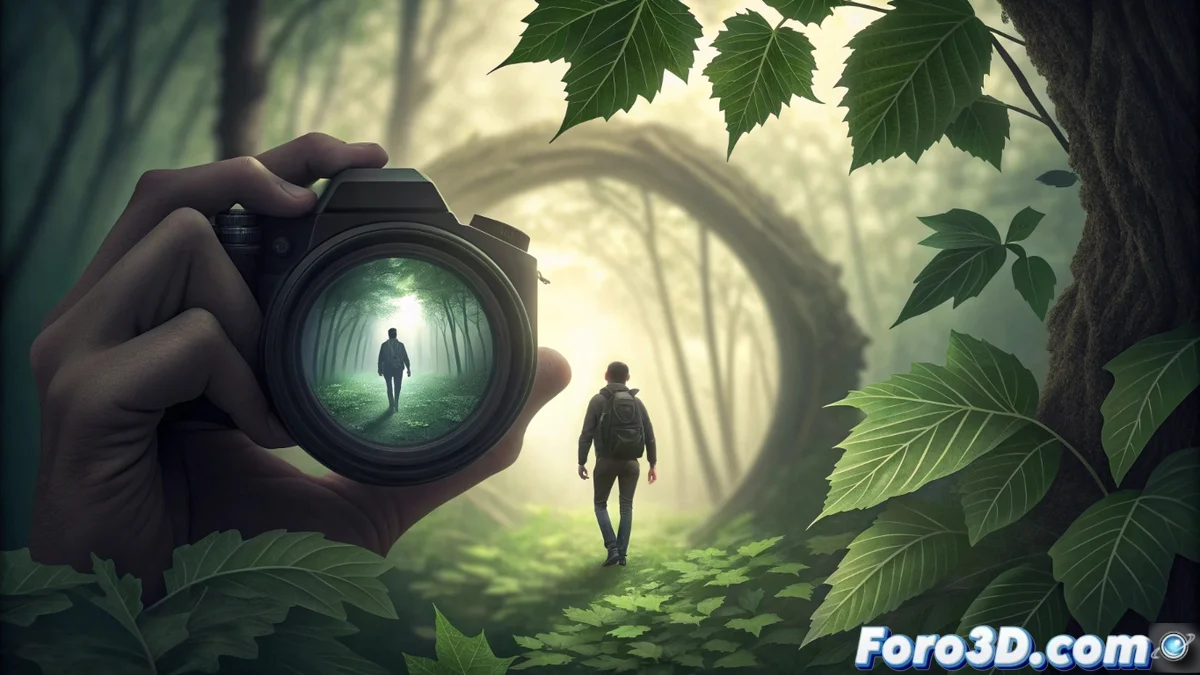
The Blurred Foreground Technique to Add Depth
In photography, seeking ways to separate the subject from the background and add dimension is key. A powerful compositional strategy is to use a blurred foreground. This method places an element very close to the lens, leaving it completely out of focus to act as a frame that directs attention toward the main point of interest, located behind it. The result is images with defined layers and a palpable sense of three-dimensionality. 🌄
Implementing This Compositional Resource
To apply this technique, you need a lens that can focus at short distances, such as a macro lens or one with a reduced minimum focus distance. Set the aperture to its widest value (for example, f/1.8 or f/2.8) to achieve a very limited depth of field. Place the object that will serve as the frame (like a leaf, a piece of glass, or your own hand) in the closest plane, almost touching the lens, and verify that it is out of focus. Then, adjust the manual or automatic focus on the main subject, aligning it with the spaces or gaps left by the foreground element. Experimenting with different textures and shapes in this blurred plane enriches the final effect.
Key Steps to Execute the Technique:- Use a lens with good close-up focus capability.
- Open the aperture to the maximum to reduce depth of field.
- Position the frame object very close to the lens, ensuring it is blurred.
- Focus precisely on the main subject behind the frame.
- Experiment with different foreground objects to vary the result.
The out-of-focus foreground is not an accidental element; it is a deliberate compositional tool that structures the viewer's gaze.
Equipment and Settings That Optimize the Process
Although you can try it with any camera, the most consistent results come with bright lenses of fixed focal length, which usually offer a wide maximum aperture and quality optics. A 50mm f/1.8 lens is an accessible and very effective option to start with. In these situations, manual focus usually provides more precise control than automatic, allowing you to select exactly the point of sharpness. Using a tripod is crucial in low-light scenes or when seeking a very stable composition, as any minimal movement can alter the delicate spatial relationship between the blurred frame and the subject.
Equipment and Configuration Recommendations:- Fixed focal length lenses with wide aperture (e.g., 50mm f/1.8, 85mm f/1.4).
- Prioritize manual focus for precise control of the focus point.
- Use a tripod to keep the composition stable, especially in low light.
- Set a large aperture (low f-number) to achieve the blur.
Avoiding Common Mistakes
A common mistake is underestimating the importance of the foreground object just because it is out of focus. Its shape, posture, and arrangement still influence the overall composition. For example, a hand with a forced or unnatural posture, even if blurred, can be perceived as a discordant element that distracts rather than guides the gaze. Therefore, it is vital to choose and place the foreground element with the same intention as the main subject, caring for its silhouette and how it interacts with the negative space. Mastering this technique allows creating images with a visual depth that captivates the viewer. 📸