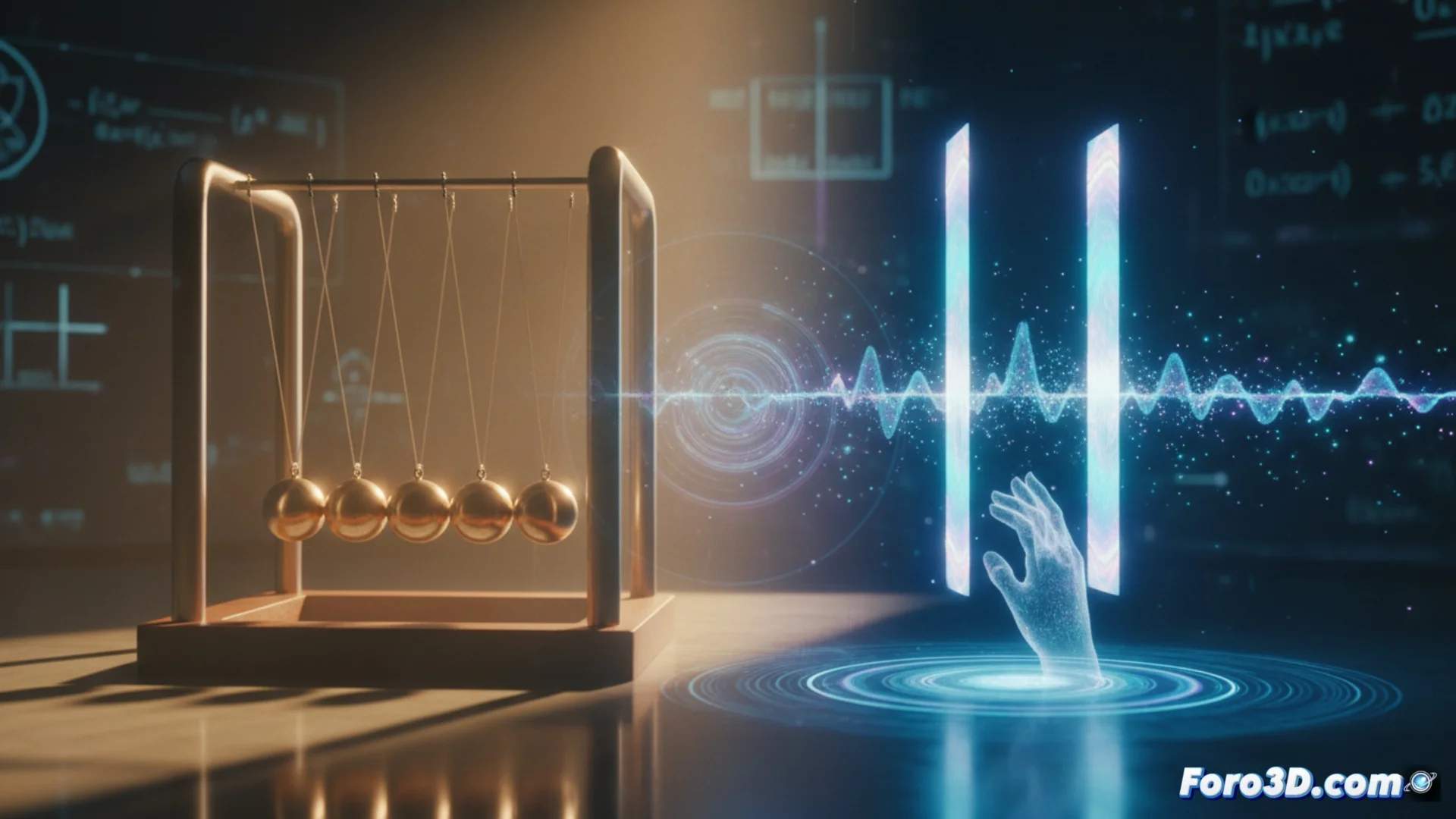
The Blurry Boundary Between Classical and Quantum Physics
Defining the exact point where classical behavior ends and quantum behavior begins represents a persistent challenge for science 🧪. Fundamental particles such as electrons, atoms, and even isolated molecules clearly demonstrate quantum properties. A revealing fact is that the famous double-slit experiment with light was carried out in 1801, long before the principles of quantum mechanics were established. This indicates that phenomena from the quantum realm have been present in research considered classical for a long time, although they were not interpreted as such.
The Quantum Domain Expands
Today, quantum physics continues to surprise by showing that its peculiar effects can manifest in larger and more complex systems than previously thought possible 🔬. The limits of what we categorize as quantum behavior are expanding continuously because experiments are more precise and controlled. This progress challenges our macroscopic perception and points to the fact that the change between the two physical regimes is progressive and less defined.
Evidence of Quantum Expansion:- Demonstration of superposition and entanglement in complex molecules and nanoscopic objects.
- Experiments that bring the observable scale closer to the everyday, challenging the principle of decoherence.
- Refinement of isolation and measurement techniques that allow fragile quantum states to be preserved for longer.
It seems that Schrödinger's cat might be, simultaneously, more alive and more dead than we supposed, and inside a box of ever larger dimensions.
Investigating the Transition Zone
Current research efforts are focused on understanding this intermediate gray zone, where objects are not fully governed by classical laws nor exhibit a fully quantum character. Exploring this limit is fundamental for two main objectives: creating more advanced and stable quantum technologies, and deepening the basic knowledge of how nature works 🚀.
Implications of Studying the Limit:- Allows the design of quantum computers with greater coherence and fewer errors.
- Helps answer why we do not perceive quantum effects directly in our daily experience, despite their rules underpinning all material reality.
- Addresses deep questions about measurement and the transition from the probabilistic to the deterministic.
Towards a Unified Understanding
Each new discovery in this field brings us a little closer to unraveling the mystery of the quantum-classical transition. Research not only seeks to build a bridge between two descriptions of reality but also drives practical innovations. Understanding this blurry boundary is, ultimately, understanding the very foundations of what we consider real 🌌.