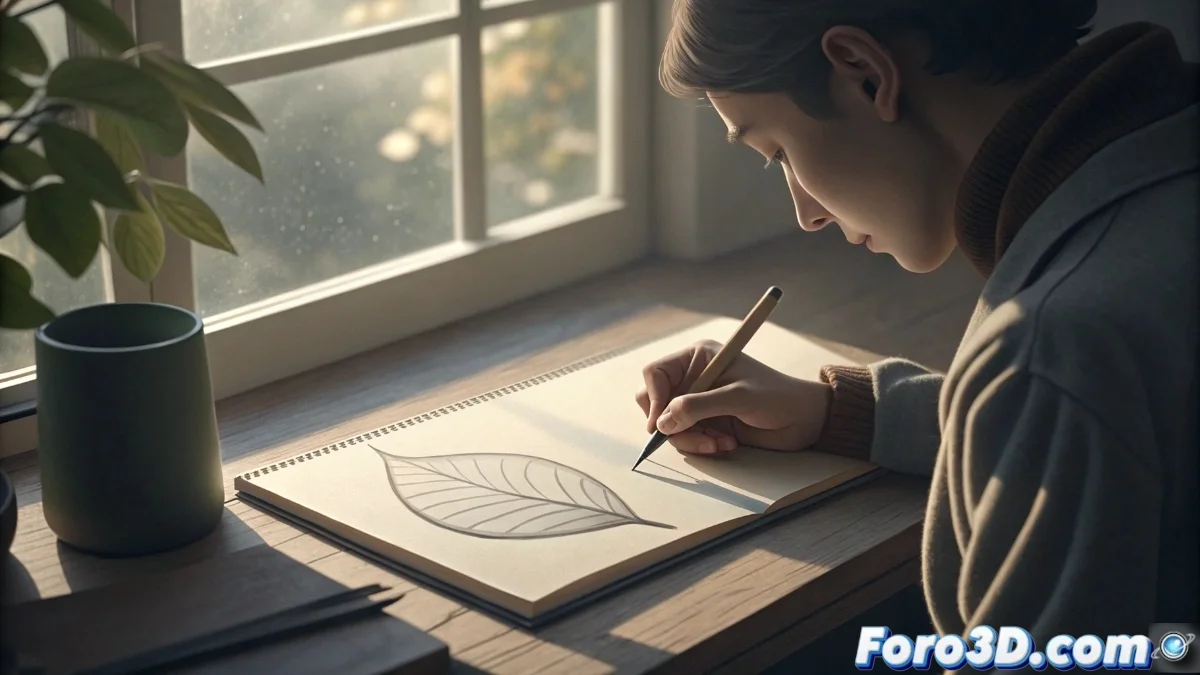
The Blind Contour: Essential Technique for Visual Artists
Blind contour represents a drawing methodology where the creator traces the outlines of an object while keeping their gaze exclusively on the model, without checking the paper during the process. This discipline fosters a unique neural connection between the visual and motor systems, forcing the brain to interpret shapes more deeply and transmit that information directly to hand movements 🎨.
Benefits of Continuous Training
Regular practice of this observation exercise generates notable improvements in visual analysis capacity and accuracy in graphic representations. Draftsmen experience how their manual dexterity becomes more confident when capturing dimensions and nuances that would normally escape a conventional glance. This approach helps dismantle mechanical drawing patterns, facilitating more authentic and natural representations based on what is actually perceived versus what is assumed 👁️.
Documented Specific Benefits:- 70% increase in proportion accuracy after 4 weeks of constant practice
- Development of visual memory and accelerated spatial abstraction capacity
- Significant reduction in dependence on corrections during the initial sketch
True drawing does not reside in what the hand traces, but in how the eye learns to see - each blind line is a silent dialogue between perception and expression
Progressive Integration in Artistic Training
To implement the blind contour method in learning routines, it is suggested to start with basic elements like household utensils or vegetables, dedicating minimum sessions of 10 minutes daily. It is essential to maintain a slow and uniform speed, concentrating on each curvilinear and angular detail of the observed subject. Subsequently, one can scale towards more elaborate structures like facial anatomy or limbs, always prioritizing detailed observation over the final product on the support ✏️.
Recommended Complexity Phases:- Beginner level: simple geometric objects and basic natural elements
- Intermediate level: compositions with multiple elements and varied textures
- Advanced level: anatomical studies and scenes with complex perspective
The Value of Process Over Result
Initial attempts frequently produce results that seem like abstract cartographies of imaginary worlds, but the true value resides in the sensory connection process that is established. This technique transforms the relationship between vision and manual execution into an intuitive collaboration where hand and eye develop their own language of non-verbal communication, creating solid foundations for any subsequent artistic expression 🖋️.